
Modern industrial plants rely heavily on automation. PLCs, DCS systems, smart sensors, and pressure transmitters continuously monitor and control processes with high accuracy. From the outside, this raises a logical question.
If everything is automated, why do plants still install mechanical pressure gauges?
The answer lies in how industrial plants actually operate, not how they look on paper.
Automation depends on electricity, communication networks, software logic, and calibrated sensors. Mechanical pressure gauges depend only on the physical pressure in the system. This fundamental difference makes them irreplaceable, especially in safety-critical environments.
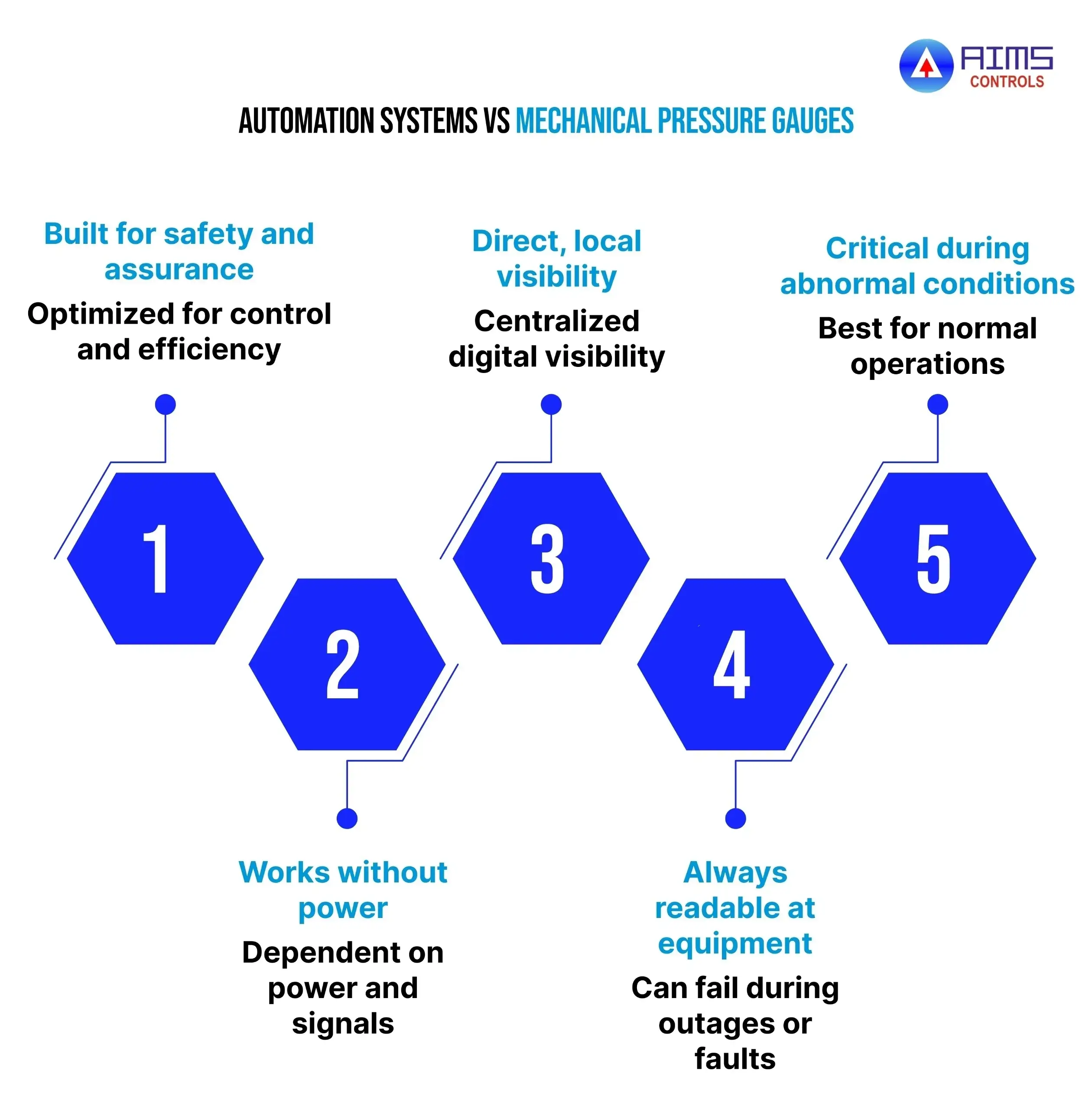
In real plant conditions, failures happen. Power can be lost. Signals can drop. Control systems can freeze or display incorrect values. When this happens, operators and maintenance teams still need a direct, local, and reliable indication of pressure.
That is why mechanical pressure gauges are not legacy instruments. They are a mandatory safety and operational requirement, even in highly automated industrial plants.
This article explains:
- Why automation does not eliminate the need for mechanical gauges
- Where mechanical pressure gauges become critical
- How they support safety, maintenance, and compliance in modern plants
The Rise of Automation in Modern Industrial Plants
Automation has become the backbone of modern industrial operations. Today, most plants rely on automated systems to control pressure, flow, temperature, and level with minimal manual intervention.
At the core of this automation are:
- PLC and DCS systems that process control logic
- Pressure transmitters that convert pressure into electrical signals
- Control rooms where operators monitor values on screens
These systems improve efficiency, consistency, and remote monitoring. They also reduce human error during normal operations.
But here’s the important part.
Automation does not mean the process is self sufficient. Every automated measurement still depends on multiple layers working correctly, including sensors, wiring, power supply, communication networks, and software.
When all layers work perfectly, automation performs well. When even one layer fails, visibility can be lost instantly.
This is where many misunderstand automation.
Automation improves control, but it also increases system complexity. As complexity increases, the need for simple, independent, and locally visible instruments becomes stronger, not weaker.
Mechanical pressure gauges exist because they operate outside the automation stack. They do not depend on software logic or signal transmission. They show pressure directly at the point of measurement, which is critical when automated systems are unavailable or unreliable.
What Automation Actually Means in Industrial Environments
In industrial plants, automation does not mean machines think or decide on their own. It means measurements are converted into signals, processed by control systems, and used to take predefined actions.
In a typical automated pressure system:
- A pressure transmitter senses pressure
- The signal is sent to a PLC or DCS
- Logic decides what action to take
- Operators see values on a screen, not at the equipment
This setup works well during normal operation. But it relies on several conditions being met at the same time:
- Continuous power supply
- Healthy sensors and wiring
- Accurate calibration
- Stable communication networks
- Correct software logic
If any one of these fails, pressure information may:
- Disappear from the screen
- Freeze at an incorrect value
- Show delayed or misleading data
Automation handles data. It does not guarantee physical visibility at the equipment level.
Mechanical pressure gauges fill this gap. They show the actual pressure directly at the process point, without relying on any external system. This is why automation and mechanical gauges are designed to work together, not replace each other.
Common Misconception: Automation Eliminates Manual Instruments
A common belief in modern plants is that once pressure is monitored digitally, manual instruments become unnecessary. This assumption is widespread and incorrect.
Here’s the clear reality.
Automation processes information. It does not guarantee that information is always available, accurate, or visible at the equipment level.
When people say automation replaces mechanical pressure gauges, they usually assume:
- Digital readings are always accurate
- Control systems never fail
- Operators always have screen access
- Maintenance happens only under ideal conditions
None of these assumptions hold true in real plants.
Mechanical pressure gauges serve a different purpose than transmitters. They provide instant, local, and independent pressure indication. They do not depend on software, wiring, power, or communication networks.
This is why automation standards and plant design practices do not treat mechanical gauges as optional add ons. They treat them as a baseline requirement for safety and operational confidence.
In simple terms:
- Automation improves efficiency and control
- Mechanical gauges protect visibility and decision making
Removing mechanical pressure gauges does not make a plant more modern. It makes it more vulnerable during abnormal conditions.
What Is a Mechanical Pressure Gauge?
A mechanical pressure gauge is a device that shows pressure directly at the point of measurement using mechanical movement, not electronics.
In simple terms, it converts pressure into the movement of a needle on a dial. No power supply. No signal transmission. No software.
This direct behavior is what makes mechanical pressure gauges reliable in industrial environments.
Key characteristics of a mechanical pressure gauge
- Works purely on physical pressure
- Does not require electricity or batteries
- Provides local, real time pressure indication
- Continues working even during power or system failures
Most industrial plants use mechanical pressure gauges as the first level of pressure visibility, especially on critical equipment like pumps, compressors, and pressure vessels.
Why this definition matters in automated plants
In automated systems, pressure data usually travels through multiple layers before reaching the operator. A mechanical pressure gauge removes all those layers and shows the actual condition instantly.
This is why, even in highly automated plants, mechanical pressure gauges are not considered outdated. They are considered foundational instruments that support safety, maintenance, and operational confidence.
How Mechanical Pressure Gauges Work (Bourdon Tube Basics)
Most mechanical pressure gauges used in industrial plants work on a Bourdon tube mechanism.
A Bourdon tube is a curved metal tube sealed at one end. When pressure enters the tube, the tube tries to straighten. This small physical movement is transferred through a linkage to a needle on the dial.
As pressure increases, the needle moves.
As pressure decreases, the needle moves back.
There is no electronic conversion involved.
Simple breakdown of the process
- Pressure enters the gauge through the process connection
- The Bourdon tube flexes due to pressure
- Mechanical linkage amplifies the movement
- The needle displays the pressure on a calibrated scale
This design has been used for decades because it is:
- Mechanically simple
- Stable under harsh conditions
- Easy to inspect and trust visually
In automated plants, this simplicity is an advantage. When digital systems fail or behave unpredictably, the Bourdon tube gauge continues to show pressure without interruption
Why Mechanical Gauges Are Considered Passive Instruments
Mechanical pressure gauges are called passive instruments because they do not require any external input to function.
They do not need:
- Electrical power
- Batteries
- Signal wiring
- Software or configuration
The pressure in the process itself is the only driving force.
This passive nature is exactly why mechanical gauges remain critical in automated plants. When power is lost, communication fails, or control systems shut down, passive instruments continue to operate normally.
In industrial safety design, passive instruments are valued because:
- They have fewer failure points
- Their behavior is predictable
- They provide direct physical feedback
From a plant design perspective, this makes mechanical pressure gauges an independent layer of information. They sit outside the automation system and remain available when automated measurements cannot be trusted or accessed.
This independence is the core reason mechanical pressure gauges are still mandatory, not optional, in modern industrial plants.
Role of Mechanical Pressure Gauges in Safety and Compliance
Independent Pressure Verification
Provides direct, local pressure visibility without reliance on power, software, or control systems.
Reliability During Failures
Remains readable during PLC failures, communication loss, shutdowns, and emergency conditions.
Layered Safety Protection
Acts as an independent safety layer alongside automation, alarms, and operating procedures.
Audit & Inspection Readiness
Meets auditor expectations for visible, on-site pressure indication at critical process points.
Human-Centric Decision Support
Enables clear, unambiguous pressure confirmation for operators during maintenance and abnormal situations.
Choosing the Right Mechanical Pressure Gauge for Industrial Use
Not all mechanical pressure gauges are suitable for industrial environments. Selecting the right gauge is critical for accuracy, safety, and long term reliability.
At AIMS Controls, gauge selection is treated as an engineering decision, not a formality.
Accuracy Class, Range, and Construction Considerations
A mechanical pressure gauge must be chosen based on how and where it will be used.
Key factors include:
- Pressure range
The normal operating pressure should fall in the middle of the gauge range, not at the extremes.
- Accuracy class
Higher accuracy is required for critical processes and safety related applications.
- Overpressure capability
Gauges must tolerate pressure spikes without permanent damage.
- Construction material
Stainless steel cases and wetted parts are preferred for industrial and corrosive environments.
Choosing the wrong range or construction can lead to misleading readings and early failure.
Why Industrial Grade Gauges Matter
Industrial plants operate under vibration, temperature variation, and harsh conditions. General purpose gauges are not designed for this reality.
Industrial grade mechanical pressure gauges:
- Maintain accuracy over long periods
- Resist vibration and environmental stress
- Provide consistent readings during abnormal conditions
Using industrial grade gauges ensures that local pressure indication remains reliable when it is needed most. This reliability is why quality mechanical pressure gauges remain a mandatory part of automated industrial plant design.
Conclusion
Automation has reshaped how industrial plants operate, but it has not removed the need for simple, independent instruments. Mechanical pressure gauges remain mandatory because they address risks that automation alone cannot eliminate.
From commissioning and maintenance to emergencies and audits, mechanical pressure gauges provide direct pressure visibility when systems are offline, data is questionable, or decisions must be made quickly.
At AIMS Controls, we see mechanical pressure gauges not as legacy components, but as foundational safety instruments. They strengthen automation by adding clarity, redundancy, and trust at the process level.
The most reliable industrial plants are not those that remove mechanical gauges, but those that design automation and mechanical visibility to work together.
Talk to our experts today to select the right mechanical pressure gauges for your process and strengthen your plant’s safety, compliance, and operational confidence.
Frequently Asked Questions
Are mechanical pressure gauges mandatory in automated plants?
Yes. Safety standards and engineering best practices require local, independent pressure indication at critical points to ensure verification during failures, audits, and emergencies.
Why aren’t pressure transmitters alone sufficient?
Transmitters depend on power, networks, and software. During outages, maintenance, or system faults, mechanical gauges remain readable and provide immediate confirmation at the equipment.
Do safety standards actually expect local gauges?
Yes. Auditors and inspectors routinely expect visible, on-site pressure indication to verify safe conditions without relying on control systems or screens.
Do mechanical pressure gauges need calibration?
Yes. Periodic calibration is required, but mechanical gauges allow visual detection of drift or damage, making issues easier to identify compared to hidden electronic faults.
Why are mechanical gauges still used despite advanced automation?
Because they add simplicity and independence. They do not share failure modes with automation and serve as a trusted physical reference during abnormal conditions.