
Isolation valve, Back seating to prevent stem blow-out.
- Stem type: Hard seated stem
- Wetted parts: AISI 316 SS, AISI 316L SS, Monel
- Stem: Conical metal tip
- Max. working pressure: 413.7 bar (6000 psi)
- Max. working temperature: 240°C

Isolation valve, Back seating to prevent stem blow-out.

Block & Bleed valve, Back seating to prevent stem blow-out, M8 x 1mm (F) plugged drain.

Multi-port valve, Back seating to prevent stem blow-out, Isolation Test & Drain

Miniature design, Back seating to prevent stem blow-out.

Miniature design, Back seating to prevent stem blow-out.

Economical version, Leak point reduction.

Economical version, Leak point reduction.

Isolation valve, Back seating to prevent stem blow-out, Tube end connections.

1 isolate & 1 vent valve, 1/4″ NPT (F) plugged drain.

2 isolate & 1 vent valves, 1/4″ NPT (F) x 2 Nos plugged drains.

2 isolate 1 equalize & 1 vent valves, As per DIN 19213 design, 1/4″ NPT (F) plugged drain.
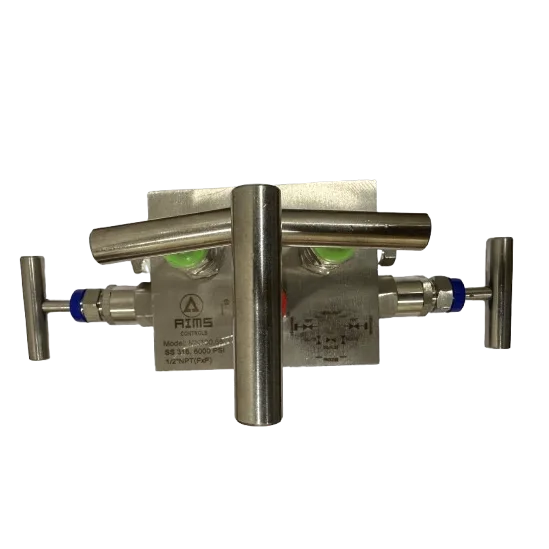
2 isolate 1 equalize & 2 vent valves, 1/4″ NPT (F) x 2 Nos plugged drains.
A trusted valve manifolds manufacturer and supplier in India, we engineer integrated pressure instrument valve blocks that consolidate isolation, equalizing, and venting functions into compact, modular assemblies for safe sensor installation, maintenance, and calibration. Valve manifolds are essential accessories in pressure instrumentation systems, protecting transmitters and gauges from sudden pressure spikes, enabling safe removal for calibration without system shutdown, and preventing measurement errors from reference pressure variations. Our manifold solutions serve process automation engineers, facility managers, and OEM integrators who require reliable pressure isolation and control across petrochemical facilities, power generation plants, hydraulic systems, and process automation networks.
A valve manifold is an integrated valve block combining multiple isolation, equalizing, and venting functions into a single pressure instrument interface. Rather than installing separate isolation valves, equalizing valves, and venting components individually on sensor connections, manifolds consolidate these functions into a unified block that connects directly to process pressure and transmitter/gauge inputs.
Valve manifolds serve as protective barriers and control interfaces, enabling technicians to safely isolate, equalize, and vent pressure without affecting system operation or creating measurement errors.
Common Valve Manifold Applications:
Valve manifolds function through a coordinated series of valve operations. The process pressure port connects to the system, while transmitter/gauge ports branch off the manifold block. Isolation valves on each port enable independent closure, blocking pressure to the sensor while system operation continues uninterrupted.
Equalizing valves connect the high and low pressure ports together, reducing the pressure differential across the transmitter diaphragm to zero, protecting delicate sensor elements during pressure surges. Venting valves release trapped pressure, preventing dangerous buildup when isolating transmitters or disconnecting sensors.
This integrated valve arrangement eliminates the need for separate external valves, reducing installation complexity, leak points, and system footprint while providing safe, reliable pressure control.
Compact manifolds featuring isolation valves on both high and low-pressure ports. 2-valve manifolds provide basic pressure isolation for simple gauge or transmitter protection in non-critical applications. Smallest footprint; ideal for space-constrained installations where pressure spike protection is sufficient without equalizing capability.
Industry-standard manifolds combine two isolation valves with one equalizing valve connecting the high and low pressure ports. 3-valve manifolds enable safe sensor removal with pressure equalization, protecting transmitter diaphragms during maintenance. The most common manifold type suitable for general industrial pressure transmitter applications.
Premium manifolds add venting capabilities to the 3-valve base configuration. 5-valve manifolds include separate equalizing and venting valves, enabling complete pressure control, isolation, equalization, and venting in a single unit. Ideal for critical applications, differential pressure measurement systems, and hazardous area installations requiring maximum safety.
Valve blocks that mount directly onto the transmitter or gauge bodies via threaded or flange connections. Direct mounting eliminates external pressure tubing, reduces leak points, and provides compact installation in confined spaces. Ideal for remote sensor installations and equipment-mounted applications where separate manifolds are impractical.
Standalone valve blocks are installed separately from sensors, connected via SAE or ISO pressure tubing. Remote mounting enables centralized manifold installation in accessible panel locations, simplifying maintenance and valve operation. Common in process control systems where transmitters are distributed but manifolds are consolidated for technician access.
Integrated valve and pressure transmitter assemblies combine manifold and transmitter functions into a single unit. Coplanar designs eliminate separate transmitter mounting, reduce space requirements, and ensure transmitter/manifold compatibility. Increasingly common in modern compact automation systems and OEM equipment designs.
Q: What is a valve manifold, and what does it do in a pressure instrumentation system?
A valve manifold is an integrated valve block combining isolation, equalizing, and venting functions for transmitters and gauges. It enables safe sensor removal without system shutdown, protects sensors from pressure spikes, and maintains stable reference pressure for accurate measurement.
Q: What is the difference between a 2-valve manifold and a 5-valve manifold?
2-valve manifolds provide only isolation capability for basic gauge protection. 5-valve manifolds add equalizing and venting functions enabling complete pressure control, isolation, equalization to zero pressure differential, and venting, essential for critical DP transmitter applications and hazardous service.
Q: Where are valve manifolds typically used in industrial applications?
Valve manifolds protect transmitters in petrochemical refineries, power plants, pharmaceutical reactors, HVAC systems, water treatment facilities, and hydraulic equipment. Any system requiring safe sensor maintenance without shutdown relies on manifold isolation capability.
Q: Why are valve manifolds required in differential pressure transmitter systems?
Differential pressure transmitters measure the pressure difference between two process points. Valve manifolds enable the isolation of each port independently, equalize the high and low pressure sides to zero differential before maintenance, and vent trapped pressure, protecting the sensitive DP transmitter diaphragm.
Q: What materials are valve manifolds manufactured from, and how do I choose the right one?
Standard manifolds use ductile iron for general industrial service. Stainless steel (304/316) is required for corrosive or sanitary applications. Specialty alloys (duplex, Hastelloy) are needed for aggressive chemical service. Select material based on your specific process fluid and corrosion risk.