Level Transmitter Supplier in Gujarat, India
A reliable level transmitter supplier and manufacturer delivers one of the most essential instruments in modern process automation. Level transmitters provide continuous, real-time level data that drives process control loops, inventory management systems, safety shutdown functions, and remote monitoring platforms, making accuracy, reliability, and long-term stability non-negotiable.
What is a Level Transmitter?
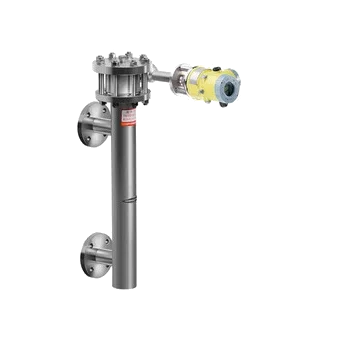
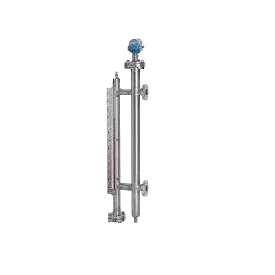
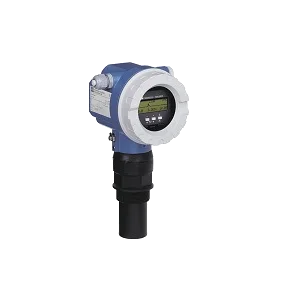
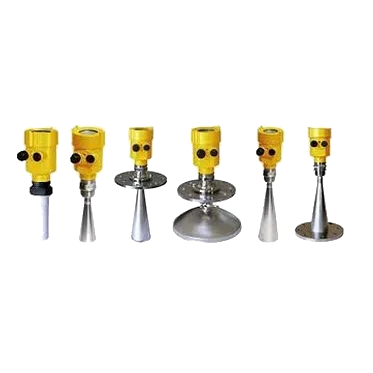
A level transmitter is a process instrument that continuously measures the exact level of liquid, slurry, or bulk solid inside a tank, vessel, or silo and transmits a proportional 4-20 mA, HART, Modbus, or digital fieldbus signal to a PLC, DCS, or SCADA system.
Unlike a level switch that only detects high or low points, a level transmitter provides a continuous, scalable output representing the full measurement range, giving operators and control systems complete, real-time visibility of the process at all times.
Level transmitters are used for:
- Continuous process level control loops
- Tank inventory and volume management
- Custody transfer and fiscal metering
- Overfill prevention with early warning
- Interface level measurement between two liquids
- Remote monitoring via SCADA and DCS platforms
- Safety Instrumented System (SIS) inputs
Key Features of Quality Level Transmitters
- Continuous 4-20 mA analog output with HART digital communication
- Modbus RTU, PROFIBUS PA, Foundation Fieldbus, and Wireless HART options
- Integral LCD for local indication of level, percentage, volume, and temperature
- Built-in self-diagnostics for predictive maintenance and early fault detection
- High accuracy from ±1mm to ±5mm, depending on the technology selected
- SIL 1, SIL 2, and SIL 3 certified versions for safety instrumented systems
- ATEX Zone 0, Zone 1, and Zone 2 certified for explosive atmosphere installations
- Wide process range, vacuum to 400 Bar, -196°C to +450°C
- Wetted materials in SS316L, Hastelloy, PTFE, and ceramic for aggressive media
- Remote mount electronics available for high-temperature and vibration-prone installations
- Multivariable versions measuring level, temperature, and pressure simultaneously
- Loop-powered design, no separate power supply required for standard 4-20 mA versions
Applications of Level Transmitters
Oil & Gas: Crude oil storage tanks, separator vessels, offshore platform vessels, LNG storage, pipeline pig receivers, flare knockout drums, and wellhead level monitoring.
Chemical & Petrochemical: Reactors, distillation columns, storage tanks for acids and solvents, blending vessels, and chemical dosing systems requiring precise level control.
Water & Wastewater: Pump wet wells, chemical dosing tanks, clarifiers, filter vessels, effluent holding tanks, and stormwater management sumps.
Power Generation: Boiler drum level, deaerator tanks, condensate vessels, fuel oil day tanks, and cooling tower basin level monitoring.
Pharmaceuticals & Biotechnology: Bioreactors, WFI storage tanks, buffer preparation vessels, and hygienic process equipment in GMP-compliant manufacturing.
Food & Beverage: Ingredient storage silos, mixing tanks, fermentation vessels, pasteurizer tanks, and CIP solution monitoring.
Cement & Mining: Limestone silos, coal hoppers, ore storage bins, slurry tanks, and tailings pond level management.
Marine & Offshore: Ballast tanks, bunker fuel tanks, cargo vessel gauging systems, and bilge level monitoring.
Frequently Asked Questions
Q: What is the difference between a level switch and a level transmitter?
A level switch outputs a simple ON/OFF signal when the level reaches a defined high or low set point. A level transmitter provides a continuous 4-20 mA signal representing the exact level at all times. Switches are used for alarms and pump control. Transmitters are used for continuous process control and inventory management.
Q: Which level transmitter technology is the most accurate?
Guided wave radar and magnetostrictive level transmitters offer the highest accuracy, typically ±1mm. They are preferred for custody transfer, reactor level control, and applications where precise level measurement directly impacts product quality or process safety.
Q: Can a level transmitter also perform the function of a level switch?
Yes. Most modern level transmitters include programmable relay outputs for high and low level alarms, combining continuous measurement and point level switching in a single device, reducing installation cost and panel wiring.
Q: What does loop-powered mean for a level transmitter?
A loop-powered transmitter operates entirely from the 4-20 mA signal loop itself, drawing its operating power from the same two wires that carry the output signal. No separate power supply cable is needed, simplifying installation and reducing wiring costs.
Q: How often should level transmitters be calibrated?
For general process applications, annual calibration is standard practice. For custody transfer, fiscal metering, or safety-critical SIL applications, calibration intervals may be 3 to 6 months, depending on regulatory and functional safety requirements.
Q: Which level transmitter is best for corrosive chemical applications?
Non-contact technologies such as radar and ultrasonic are ideal for aggressive media as they have no wetted parts in contact with the fluid. Where probe contact is unavoidable, instruments with PTFE-lined, Hastelloy, or ceramic wetted components provide reliable long-term performance.
Q: What is a remote mount level transmitter?
A remote mount transmitter separates the sensing element from the electronics housing using a signal cable. This is used in high-temperature applications where electronics cannot be exposed to process heat, or in high-vibration environments where integral electronics may be damaged.
Why Choose a Specialist Level Transmitter Supplier & Manufacturer
- Complete range of level transmitter technologies from a single trusted source
- Independent application engineering support for correct technology and product selection
- Factory calibration with NABL-traceable certificates on every transmitter dispatched
- SIL 1, SIL 2, and SIL 3 certified products with complete functional safety documentation
- ATEX and IECEx certified instruments for all hazardous area zones, including Zone 0
- Custom probe lengths, wetted materials, flange ratings, and remote mount configurations
- Fast delivery from stock on standard products, with short lead times on custom variants
- On-site commissioning, calibration, and after-sales technical support