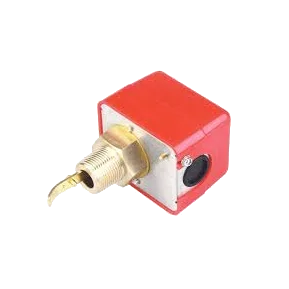
Flow Switches Manufacturer/Supplier in Gujarat, India
A vane-type flow switch is a simple, robust, and highly reliable device used to detect the presence or absence of fluid flow in a pipeline. Also known as a paddle type or flapper type flow switch, it triggers an electrical signal when flow reaches a set threshold, protecting equipment, activating alarms, and automating process control.
What is a Vane Type Flow Switch?
A vane-type flow switch is a mechanical flow detection device that uses a paddle or flapper inserted into the pipeline. When fluid flows past the paddle, it deflects the vane, which in turn actuates a micro-switch or reed switch to send an ON/OFF electrical signal to a control panel, pump, alarm, or relay system.
When the flow stops or drops below the set threshold, the paddle returns to its resting position and the switch resets automatically.
How Does a Vane-Type Flow Switch Work?
The operating principle is straightforward and mechanical:
- The paddle/vane is inserted into the pipe through a threaded or flanged connection
- Flowing fluid pushes against the paddle, causing it to deflect or pivot
- The deflection actuates an internal micro-switch or magnetic reed switch
- The switch sends an electrical output signal (NO/NC contact)
- When flow ceases, the spring or gravity resets the paddle to its original position
- The switch returns to its default state automatically
No external power is required for the mechanical operation, only for the output signal circuit.
Types of Vane Flow Switches
Paddle Type Flow Switch: A flat, rectangular paddle extends into the pipe. Best suited for larger pipe diameters and moderate-to-high flow rates. Simple and cost-effective.
Flapper Type Flow Switch: Uses a hinged flapper plate that swings open with flow. Ideal for slurries and fluids with suspended solids due to its self-cleaning action.
Adjustable Paddle Flow Switch: Comes with interchangeable or resizable paddles to suit different pipe sizes, flow rates, and fluid densities.
Side-Mounted Vane Switch: Installed horizontally on the side of the pipe. Suitable for horizontal pipelines where top mounting is not possible.
Inline Vane Flow Switch: Full-bore inline design for accurate switching in smaller diameter pipes.
Key Features of Vane Type Flow Switches
- Mechanical paddle/flapper actuation: no external energy needed for sensing
- SPDT micro-switch output: Normally Open (NO) and Normally Closed (NC) contacts
- Adjustable trip point: set point can be tuned to specific flow velocities
- Wide pipe size range: available for pipe sizes from ½ inch to 12 inches and above
- Multiple body materials: brass, stainless steel SS304/SS316, cast iron, PVC
- Paddle material options: SS, Buna-N, EPDM, PTFE for chemical compatibility
- Weatherproof & explosion-proof enclosures: IP65, IP67, ATEX rated options
- High-temperature versions: available for steam and hot water applications
- Visual indicator: many models include an LED or flag indicator for local status
Applications of Vane Type Flow Switches
Vane-type flow switches are used wherever reliable flow/no-flow detection is critical:
- Pump Protection: Detects loss of flow to prevent dry-running and pump damage
- Cooling Water Systems: Confirms coolant flow to machinery, compressors, and heat exchangers
- HVAC Systems: Monitors chilled water and hot water circulation in air handling units
- Boiler Feed Systems: Ensures adequate water flow before burner ignition
- Fire Suppression Systems: Triggers alarms when sprinkler water flow is detected
- Chemical Dosing Lines: Confirms chemical feed flow to treatment processes
- Water Treatment Plants: Monitors flow in filtration and dosing circuits
- Oil & Gas Facilities: Detects seal oil and lube oil flow in rotating equipment
- Food & Beverage: Confirms CIP (Clean-In-Place) flow in sanitary pipelines
- Marine & Offshore: Seawater cooling and ballast flow monitoring
Advantages of Vane Type Flow Switches
Simple & Reliable: Minimal moving parts mean fewer failure points and a long service life.
No Power for Sensing: The mechanical paddle operates without electricity, making it safe for hazardous areas.
Easy Installation: Thread-in or flange-mount designs allow quick fitting into existing pipelines with no major modification.
Self-Resetting: Automatically resets when flow resumes or stops, requiring no manual intervention.
Wide Fluid Compatibility: Suitable for water, oils, chemicals, and mild slurries when the correct paddle material is selected.
Cost-Effective: One of the most affordable flow detection technologies with low maintenance costs.
Versatile Output: SPDT contacts integrate easily with PLCs, relays, alarms, and control panels.
Frequently Asked Questions
Q: What is the difference between a paddle-type and a flapper-type flow switch?
A paddle type uses a rigid flat blade that deflects sideways with flow, while a flapper type uses a hinged plate that swings open in the flow direction. Flapper types are better suited for fluids carrying suspended solids as they are less prone to clogging.
Q: Can vane-type flow switches be used for gas flow detection?
Yes, but with limitations. For gas applications, higher flow velocities are required to generate enough force to deflect the paddle. Always consult the manufacturer for gas-specific sizing and minimum velocity requirements.
Q: What does SPDT mean in a flow switch?
SPDT stands for Single Pole Double Throw. It means the switch has one common terminal, one Normally Open (NO) contact, and one Normally Closed (NC) contact, giving you flexibility to wire for flow-present or flow-absent signaling.
Q: How do I select the right paddle size?
The paddle must be sized to fit within the pipe bore without touching the pipe wall. Most manufacturers provide a paddle selection chart based on pipe inner diameter and minimum detectable flow velocity.
Q: Are vane flow switches suitable for viscous fluids?
Yes, for moderately viscous fluids. For highly viscous media such as heavy oils or slurries, a flapper-type with a larger paddle area or a dedicated viscous flow switch should be selected.
Q: What maintenance does a vane flow switch require?
Minimal. Periodic inspection of the paddle for wear, corrosion, or buildup is recommended. The micro-switch contacts should be checked for proper operation during scheduled plant maintenance.
Why Choose a Specialist Vane Type Flow Switch Manufacturer?
Sourcing from a dedicated manufacturer ensures:
- Factory-calibrated trip points for your exact flow velocity
- Material certificates and traceability for pressure system compliance
- Custom paddle lengths, body materials, and enclosure ratings on request
- Full range of approvals, CE, ATEX, UL, and WRAS, where required
- Technical support for correct sizing, installation, and integration
- Reliable supply with standard stock and fast lead times for custom variants