
Vent hole for drain, Backelite cover on handle.
- Type: 2 Way / 3 Way
- Material: AISI 316 SS / AISI 316L SS / AISI 304 SS
- Gaskets / Seals: PTFE
- Maximum working pressure: 100 bar
- Maximum working temperature: 180°C

Vent hole for drain, Backelite cover on handle.
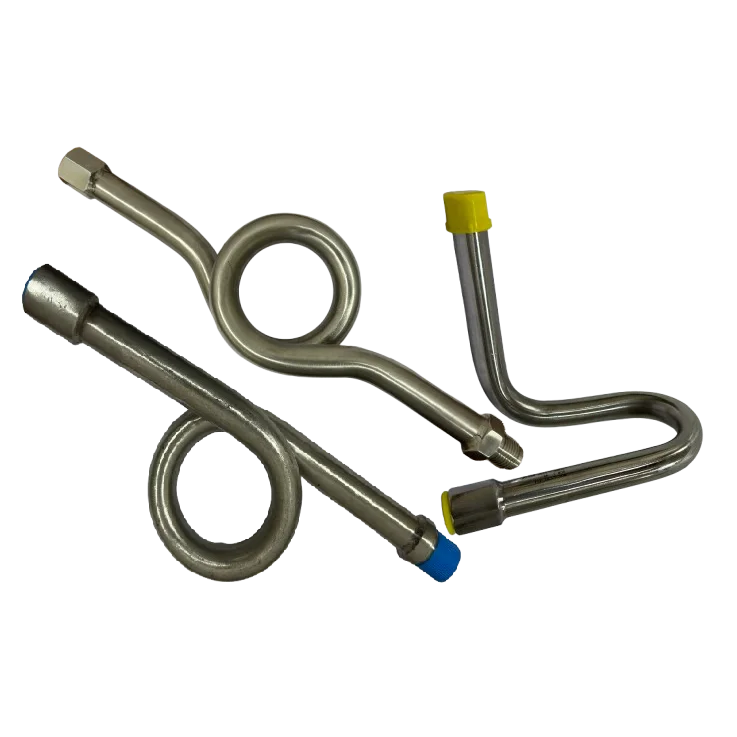
3 different loop designs, Tig welded & hydro-tested, Seamless pipes construction, Threads welded, Max working pressure 160 bar, Max working temperature 400 degrees C.

All SS construction, Adjustable needle design.


All SS construction, 4 variable designs.

Dual flushing ports, Flanged & in-line seal designs, Optional exotic materials, Up to 600# rating
A trusted pressure accessories manufacturer and supplier in India provides the essential connecting and protective components that sit between your process line and pressure instruments. Often overlooked, these accessories are critical to instrument accuracy, longevity, and safe operation, protecting gauges, transmitters, and switches from pressure spikes, temperature extremes, pulsation, and corrosive media.
Pressure accessories are auxiliary components installed between a process pipeline or vessel and a pressure measuring instrument. They do not measure pressure themselves, but they protect, isolate, condition, and connect pressure instruments to the process, ensuring accurate readings and extended instrument life.
Without the right accessories:
A gauge cock is a small isolation valve installed directly below a pressure gauge or instrument to allow safe isolation for maintenance, replacement, or zeroing without shutting down the process line.
A siphon is a coiled or U-shaped tube installed between a steam or hot fluid line and a pressure gauge. It traps a column of condensate that acts as a thermal barrier, protecting the gauge Bourdon tube and internals from direct contact with high-temperature steam or hot process fluids.
A pulsation dampener, also known as a snubber, is installed in the instrument connection to protect pressure gauges and transmitters from rapid pressure fluctuations, pulsation, and water hammer caused by reciprocating pumps, compressors, and pressure surges.
An instrument saver, also called a gauge saver or overpressure protector, is a spring-loaded device that automatically closes when process pressure exceeds the instrument’s safe working range, protecting it from overpressure damage and extending service life.
A flushing ring is a ring-shaped accessory installed between the process flange and a diaphragm seal or pressure instrument. It provides a side port connection for flushing, purging, or injecting a barrier fluid, keeping the instrument connection clean and free from blockage by viscous, crystallizing, or slurry-type process fluids.
A cooling tower, also known as a cooling element or cooling attachment, is an extended length of tubing or a finned heat dissipation element installed between a high-temperature process line and a pressure instrument. It cools down the process fluid before it reaches the instrument, protecting it from thermal damage without trapping condensate like a siphon.
Oil & Gas: Instrument isolation on wellheads and platforms, siphons on high-pressure steam lines, dampeners on compressor discharge, and flushing rings on crude oil and heavy slurry tappings.
Chemical & Petrochemical: Gauge cocks on reactor and storage vessel instruments, flushing rings on crystallizing and viscous chemical lines, and instrument savers on high-surge process conditions.
Power Generation: Siphons on boiler steam drum instruments, cooling elements on superheated steam lines, dampeners on feedwater pump discharge, and manifolds on DP transmitters.
Pharmaceuticals: Hygienic gauge cocks and flushing rings in SS316L for sterile process connections and CIP/SIP system instrumentation.
Water & Wastewater: Dampeners on pump discharge gauges, gauge cocks for routine maintenance isolation, and flushing rings on sludge and slurry instrument connections.
Food & Beverage: Food-grade compatible gauge cocks and flushing rings in hygienic designs for filling lines, pasteurizers, and CIP systems.
Refineries: Complete instrument impulse line assemblies with root valves, siphons, dampeners, and manifolds for column, reactor, and fired heater instrumentation.
HVAC & Utilities: Gauge cocks on chilled water and compressed air system instruments, dampeners on reciprocating compressor discharge gauges.
Q: What is the difference between a siphon and a cooling element?
A siphon traps condensate to create a thermal barrier between hot steam and the instrument; the instrument never directly contacts the steam. A cooling element physically cools the process fluid through extended tubing or fins before it reaches the instrument. Cooling elements are used where process temperatures are too high for a siphon alone, such as superheated steam applications.
Q: Why is a pulsation dampener necessary on a pressure gauge?
Reciprocating pumps and compressors generate rapid pressure fluctuations that cause pointer flutter, mechanical fatigue, and premature gauge failure. A pulsation dampener restricts the flow of fluid into the instrument connection, smoothing out pressure spikes and significantly extending gauge and transmitter service life.
Q: When should a flushing ring be used?
A flushing ring should be used whenever the process fluid is viscous, crystallizing, polymerizing, or contains suspended solids that could block the instrument connection. The flushing ring allows a clean barrier fluid to be injected, keeping the tapping clear and the instrument reading accurately.
Q: What is the purpose of a gauge cock?
A gauge cock is an isolation valve that allows a pressure instrument to be safely isolated from the process for maintenance, recalibration, or replacement without shutting down the process line. It is standard practice to fit a gauge cock on every pressure instrument installation.
Q: What materials are available for pressure accessories in corrosive service?
For corrosive applications, SS316 is the standard material. For highly aggressive acids and oxidizing chemicals, Hastelloy C-276, Monel, and Duplex stainless steel options are available. PTFE-lined versions are offered for specific aggressive media compatibility requirements.
Q: Are pressure accessories available with ATEX certification?
Most pressure accessories are passive mechanical components that do not require ATEX certification themselves. However, instrument manifolds and gauge cocks supplied as part of a certified instrument assembly are manufactured to meet the requirements of ATEX-certified system installations.