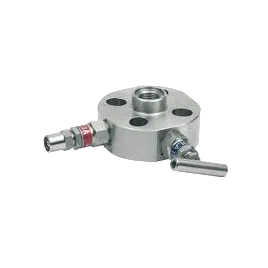
Valve Manifolds Manufacturer/Supplier in Gujarat, India
A trusted valve manifolds manufacturer and supplier in India, we engineer integrated pressure instrument valve blocks that consolidate isolation, equalizing, and venting functions into compact, modular assemblies for safe sensor installation, maintenance, and calibration. Valve manifolds are essential accessories in pressure instrumentation systems, protecting transmitters and gauges from sudden pressure spikes, enabling safe removal for calibration without system shutdown, and preventing measurement errors from reference pressure variations. Our manifold solutions serve process automation engineers, facility managers, and OEM integrators who require reliable pressure isolation and control across petrochemical facilities, power generation plants, hydraulic systems, and process automation networks.
What are Valve Manifolds?
A valve manifold is an integrated valve block combining multiple isolation, equalizing, and venting functions into a single pressure instrument interface. Rather than installing separate isolation valves, equalizing valves, and venting components individually on sensor connections, manifolds consolidate these functions into a unified block that connects directly to process pressure and transmitter/gauge inputs.
Valve manifolds serve as protective barriers and control interfaces, enabling technicians to safely isolate, equalize, and vent pressure without affecting system operation or creating measurement errors.
Common Valve Manifold Applications:
- Differential pressure transmitter isolation enabling safe sensor removal without process shutdown
- Pressure transmitter and gauge protection from sudden pressure spikes and pulsating flow
- Reference pressure equalization and venting for accurate DP measurement in multi-point systems
How Valve Manifolds Work
Valve manifolds function through a coordinated series of valve operations. The process pressure port connects to the system, while transmitter/gauge ports branch off the manifold block. Isolation valves on each port enable independent closure, blocking pressure to the sensor while system operation continues uninterrupted.
Equalizing valves connect the high and low pressure ports together, reducing the pressure differential across the transmitter diaphragm to zero, protecting delicate sensor elements during pressure surges. Venting valves release trapped pressure, preventing dangerous buildup when isolating transmitters or disconnecting sensors.
This integrated valve arrangement eliminates the need for separate external valves, reducing installation complexity, leak points, and system footprint while providing safe, reliable pressure control.
Why Valve Manifolds are Important in Industrial Applications
- Safe Transmitter/Gauge Removal Without System Shutdown: Manifold isolation valves enable sensor disconnection and calibration during equipment operation, preventing production loss and eliminating dangerous emergency repair scenarios.
- Protection from Pressure Spikes & Pulsating Flow: Integrated equalizing functions protect delicate sensor diaphragms from sudden pressure surges, vibration-induced oscillations, and pulsating pump discharge, extending sensor lifespan significantly.
- Accurate Differential Pressure Measurement: Valve manifolds enable stable reference pressure conditions and eliminate measurement errors from pressure fluctuations at the connection point, ensuring consistent DP transmitter accuracy.
- Reduced System Complexity & Installation Cost: Consolidating multiple valve functions into a single block reduces component count, connection points, leak pathways, and installation labor compared to an individual valve assembly.
- Regulatory Compliance & Safety Documentation: Pressure equipment directives mandate isolation and venting capabilities for sensor protection. Valve manifolds provide documented, integrated safety equipment meeting regulatory requirements.
- Simplified Maintenance & Reduced Downtime: Manifold-integrated functions enable routine sensor maintenance (removal, replacement, recalibration) without complex external valve manipulation or system shutdown coordination.
Without the Right Valve Manifolds
- Sensor Damage from Uncontrolled Pressure Spikes: Unprotected transmitters exposed to sudden pressure surges experience diaphragm rupture, internal fracture, and measurement failure, requiring expensive sensor replacement.
- Impossible to Service Sensors Without System Shutdown: Lacking manifold isolation capability, sensor removal forces a complete system shutdown, creating production loss, emergency response costs, and potential safety hazards.
- Measurement Errors from Unstable Reference Pressure: Without manifold equalizing functions, pressure fluctuations introduce DP transmitter errors, preventing accurate control in critical processes and degrading product quality.
- Complex External Valve Assembly & Leak Pathways: Separate isolation and equalizing valves require custom piping, multiple connection points, and frequent maintenance, increasing system cost and creating leak-prone interfaces.
- Installation Complexity & Extended Commissioning Time: Custom external valve arrangements demand specialized engineering, non-standard piping layouts, and extended troubleshooting, delaying startup and increasing project costs.
- Inability to Demonstrate Equipment Protection Compliance: Systems lacking integrated manifold protection cannot satisfy pressure equipment directives or process safety management certifications required by regulatory bodies.
Types of Valve Manifolds
2-Valve Manifold
Compact manifolds featuring isolation valves on both high and low-pressure ports. 2-valve manifolds provide basic pressure isolation for simple gauge or transmitter protection in non-critical applications. Smallest footprint; ideal for space-constrained installations where pressure spike protection is sufficient without equalizing capability.
3-Valve Manifold
Industry-standard manifolds combine two isolation valves with one equalizing valve connecting the high and low pressure ports. 3-valve manifolds enable safe sensor removal with pressure equalization, protecting transmitter diaphragms during maintenance. The most common manifold type suitable for general industrial pressure transmitter applications.
5-Valve Manifold
Premium manifolds add venting capabilities to the 3-valve base configuration. 5-valve manifolds include separate equalizing and venting valves, enabling complete pressure control, isolation, equalization, and venting in a single unit. Ideal for critical applications, differential pressure measurement systems, and hazardous area installations requiring maximum safety.
Mounting Types of Manifolds
Direct Mount Manifold
Valve blocks that mount directly onto the transmitter or gauge bodies via threaded or flange connections. Direct mounting eliminates external pressure tubing, reduces leak points, and provides compact installation in confined spaces. Ideal for remote sensor installations and equipment-mounted applications where separate manifolds are impractical.
Remote Mount Manifold
Standalone valve blocks are installed separately from sensors, connected via SAE or ISO pressure tubing. Remote mounting enables centralized manifold installation in accessible panel locations, simplifying maintenance and valve operation. Common in process control systems where transmitters are distributed but manifolds are consolidated for technician access.
Coplanar Manifold
Integrated valve and pressure transmitter assemblies combine manifold and transmitter functions into a single unit. Coplanar designs eliminate separate transmitter mounting, reduce space requirements, and ensure transmitter/manifold compatibility. Increasingly common in modern compact automation systems and OEM equipment designs.
Key Features of Industrial Valve Manifolds
- SAE and ISO cavity designs enabling integration with standard transmitters and gauges
- Ductile iron or stainless steel bodies withstand pressures to 400 bar
- Precision-machined valve seats ensure tight shutoff without external leakage
- Low dead volume manifold cavities minimize pressure measurement errors
- Color-coded valve handles enabling quick visual identification of isolation status
- Integral pressure ports for optional pressure gauge installation
- NPT or ISO threaded connections compatible with standard instrumentation fittings
- Rapid pressure equalization minimizes transmitter diaphragm stress during maintenance
Applications of Valve Manifolds
- Oil & Gas Industry: Wellhead pressure transmitter protection, pipeline pressure monitoring manifolds, compressor discharge pressure isolation, subsea equipment instrumentation.
- Petrochemical Refineries: Reactor pressure measurement systems, distillation column DP transmitter manifolds, heat exchanger pressure monitoring, and hazardous area instrumentation.
- Power Generation: Steam system pressure transmitter protection, cooling water circuit DP manifolds, boiler outlet pressure isolation, and turbine inlet monitoring systems.
- Pharmaceutical Manufacturing: Reactor vessel pressure manifolds, autoclave sterilization cycle monitoring, GMP-compliant pressure transmitter isolation.
- HVAC Systems: Chilled water DP transmitter manifolds, boiler pressure protection, compressor discharge monitoring, multi-zone pressure control systems.
- Water Treatment Plants: Filter differential pressure measurement manifolds, multi-stage pump pressure monitoring, and pressure transmitter protection in chemical dosing systems.
- Hydraulic Systems: Pump discharge pressure protection, cylinder load pressure monitoring, proportional valve feedback pressure manifolds, accumulator isolation, and venting.
How to Select the Right Valve Manifold
- Identify Transmitter Type: Specify gauge pressure, absolute, or differential pressure measurement requirement. Select a manifold cavity design matching your transmitter configuration (2, 3, or 5-valve capacity).
- Define Operating Pressure Range: Identify maximum system pressure; select manifolds rated 1.5× your maximum operating pressure for safety margin. Standard manifolds handle 0-250 bar; specialty designs reach 400+ bar.
- Choose Valve Configuration: 2-valve manifolds for gauge protection only; 3-valve for standard transmitter isolation; 5-valve for DP transmitter systems and hazardous applications requiring maximum safety.
- Determine Installation Method: Specify direct mount (transmitter-mounted), remote mount (panel-installed), or coplanar design based on your system layout and maintenance accessibility requirements.
- Select Material Compatibility: Ductile iron manifolds suit general industrial use; stainless steel is required for corrosive or sanitary applications; special alloys are required for hazardous chemical service.
- Verify Port Configurations: Confirm NPT/ISO thread sizes match your process tubing and transmitter connections. Specify gauge port requirement if pressure monitoring is desired on the manifold itself.
Frequently Asked Questions
Q: What is a valve manifold, and what does it do in a pressure instrumentation system?
A valve manifold is an integrated valve block combining isolation, equalizing, and venting functions for transmitters and gauges. It enables safe sensor removal without system shutdown, protects sensors from pressure spikes, and maintains stable reference pressure for accurate measurement.
Q: What is the difference between a 2-valve manifold and a 5-valve manifold?
2-valve manifolds provide only isolation capability for basic gauge protection. 5-valve manifolds add equalizing and venting functions enabling complete pressure control, isolation, equalization to zero pressure differential, and venting, essential for critical DP transmitter applications and hazardous service.
Q: Where are valve manifolds typically used in industrial applications?
Valve manifolds protect transmitters in petrochemical refineries, power plants, pharmaceutical reactors, HVAC systems, water treatment facilities, and hydraulic equipment. Any system requiring safe sensor maintenance without shutdown relies on manifold isolation capability.
Q: Why are valve manifolds required in differential pressure transmitter systems?
Differential pressure transmitters measure the pressure difference between two process points. Valve manifolds enable the isolation of each port independently, equalize the high and low pressure sides to zero differential before maintenance, and vent trapped pressure, protecting the sensitive DP transmitter diaphragm.
Q: What materials are valve manifolds manufactured from, and how do I choose the right one?
Standard manifolds use ductile iron for general industrial service. Stainless steel (304/316) is required for corrosive or sanitary applications. Specialty alloys (duplex, Hastelloy) are needed for aggressive chemical service. Select material based on your specific process fluid and corrosion risk.
Advantages of Using Valve Manifolds
- Enables safe sensor removal and calibration without production shutdown
- Protects transmitters from pressure spikes, extending sensor lifespan
- Consolidates multiple isolation functions, reducing installation complexity
- Provides accurate DP measurement through pressure equalization
- Reduces system cost by eliminating a separate external valve assembly
- Simplifies maintenance, reducing technician skill requirements
- Enables rapid pressure venting, preventing dangerous pressure buildup
Why Choose a Specialist Valve Manifolds Manufacturer & Supplier in India
- ISO 9001:2015 certified manufacturing with precision machining and pressure testing
- 18+ years of pressure instrumentation manifold design and manufacturing expertise
- Complete manifold range from 2-valve to 5-valve configurations
- Direct mount, remote mount, and coplanar mounting options available
- SAE and ISO cavity designs compatible with all standard transmitters
- Ductile iron, stainless steel, and specialty alloy material options
- Custom manifold configurations for non-standard pressure ranges and applications
- Competitive pricing 25-35% lower than imported manifolds
- Fast lead times with stock availability for standard configurations
- Technical support and application engineering for manifold selection
- Compliance with IS standards, ISO 4413, and pressure equipment directives
- Proven track record with leading automotive, petrochemical, and power sector clients