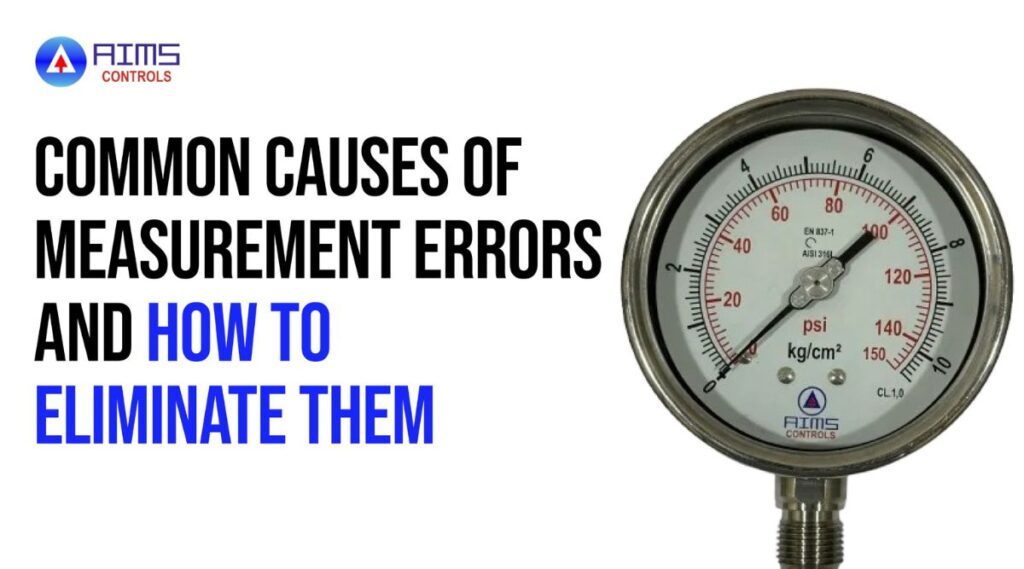
Industrial plants depend on accurate readings to keep operations stable. When a pressure gauge drifts, when a flow meter shows a low reading, when a level switch misfires, or when temperature sensors respond slowly, the entire process becomes unreliable. Batches go off spec. Pumps run dry. Tanks overflow. Energy is wasted. Operators troubleshoot measurement errors that never existed in the first place.
Most failures inside a plant don’t start with equipment.
They start with wrong measurements.
This guide explains the real reasons behind measurement errors and how to eliminate them across pressure, flow, level, and temperature instruments.
AIMS Controls manufactures precision instruments trusted across industries. If you need help choosing the right device, their team is ready to support you.
Key Takeaway
Top Five Causes of Measurement Errors
These issues explain most field measurement problems:
- Wrong instrument selection
- Incorrect installation
- Process disturbances
- Environmental stress
- Poor calibration and maintenance
This guide breaks down each cause and shows how to solve it.
What Causes Measurement Errors
Instrument Selection Errors
Most measurement issues begin with selecting the wrong instrument.
Common mistakes include:
- Incorrect pressure range
- Using standard gauges on corrosive or viscous media
- Wrong flow meter type for fluid characteristics
- Wrong level switch for foamy or turbulent liquids
- Wrong thermocouple type for temperature range
Choosing high-quality, application-matched instruments reduces long term drift.
Installation and Mounting Errors
Even the best instrument gives wrong readings if installed incorrectly.
- Wrong tapping point
- Incorrect sensor orientation
- Wrong insertion depth
- Flow meters mounted after elbows or valves
- Level switches installed too high or too low
- Blocked impulse lines
Process Induced Errors
Process behaviour directly affects measurement stability.
- Pulsation from pumps
- Cavitation
- Foam on tank surfaces
- Viscosity changes
- Sediment buildup
- Multiphase flow
Environmental Factors
Harsh surroundings damage instruments over time.
- Vibration
- Temperature swings
- Corrosive atmosphere
- Humidity or moisture
- Electrical interference
Calibration and Maintenance Issues
Every instrument drifts with time.
- Bourdon tube fatigue
- Electrode coating
- Oxidation in thermocouples
- Float blockage
- Scaling inside tanks
Routine calibration keeps readings aligned with actual process values.
Pressure Measurement Errors
Causes and Fixes
Common Causes
- Pressure spikes
- Vibration
- Wrong range
- Blocked impulse lines
- Temperature influence
- Corrosive or viscous media
- Pump pulsation
- Incorrect mounting
How to Fix Pressure Measurement Errors
- Install snubbers to control pressure spikes
- Use glycerin filled gauges in vibration areas
- Choose correct range using the thirty to seventy percent rule
- Use diaphragm pressure gauges for corrosive or viscous fluids
- Clean impulse lines regularly
- Use SS304 or SS316 gauges for chemical applications
- Calibrate periodically
- Install gauges at eye level and away from heat sources
Explore: Pressure gauge
Flow Measurement Errors
Causes and Fixes
Common Causes
- Insufficient straight pipe length
- Air pockets
- Sediment buildup
- Cavitation
- Temperature or viscosity fluctuation
- Wrong flow meter type
- Incorrect orientation
How to Fix Flow Measurement Errors
- Maintain proper straight runs upstream and downstream
- Use flow straighteners if required
- Remove trapped air and ensure full pipe flow
- Clean flow elements regularly
- Select the right flow meter for fluid type
- Stabilise temperature and pressure
- Install sensors at correct orientation
Explore : Transmitters
Level Measurement Errors
Causes and Fixes
Common Causes
- Foam
- Turbulence
- Sticky or viscous liquids
- Wrong mounting height
- Mechanical float damage
- Scaling
- Electrical interference
- Wrong level switch selection
How to Fix Level Measurement Errors
- Use stilling wells in turbulent tanks
- Install switches at correct heights
- Use float level switches for clean liquids
- Use capacitance or radar for viscous or sticky materials
- Clean floats and probes regularly
- Shield cables from electrical interference
- Use water level switches for utility tanks
- Replace damaged floats immediately
Temperature Measurement Errors
Causes and Fixes
Common Causes
- Incorrect insertion depth
- Poor thermal contact
- Conduction errors
- Wrong thermocouple type
- Ambient influence
- Aging drift
- Vibration
How to Fix Temperature Measurement Errors
- Insert sensors deeper into the process
- Ensure tight thermal contact
- Use thermowells for protection
- Select correct thermocouple type
- Shield from ambient heat influence
- Calibrate periodically
- Replace aged sensors
Field Troubleshooting Checklist
| Instrument | Error | Cause | Fix |
| Pressure | Flutter | Vibration | Use glycerin filled gauge |
| Sluggish response | Blocked impulse line | Clean impulse tube | |
| Sudden failure | Pressure spike | Install snubber | |
| Flow | Low reading | Air bubbles | Remove trapped air |
| Erratic reading | Turbulence | Add straight run or straightener | |
| High reading | Sediment | Clean flow element | |
| Level | False high | Foam | Add stilling well |
| False low | Float stuck | Clean or replace float | |
| Temperature | Slow response | Poor contact | Tighten probe |
| Drift | Aging | Replace or recalibrate |
This table helps operators troubleshoot issues quickly on the plant floor.
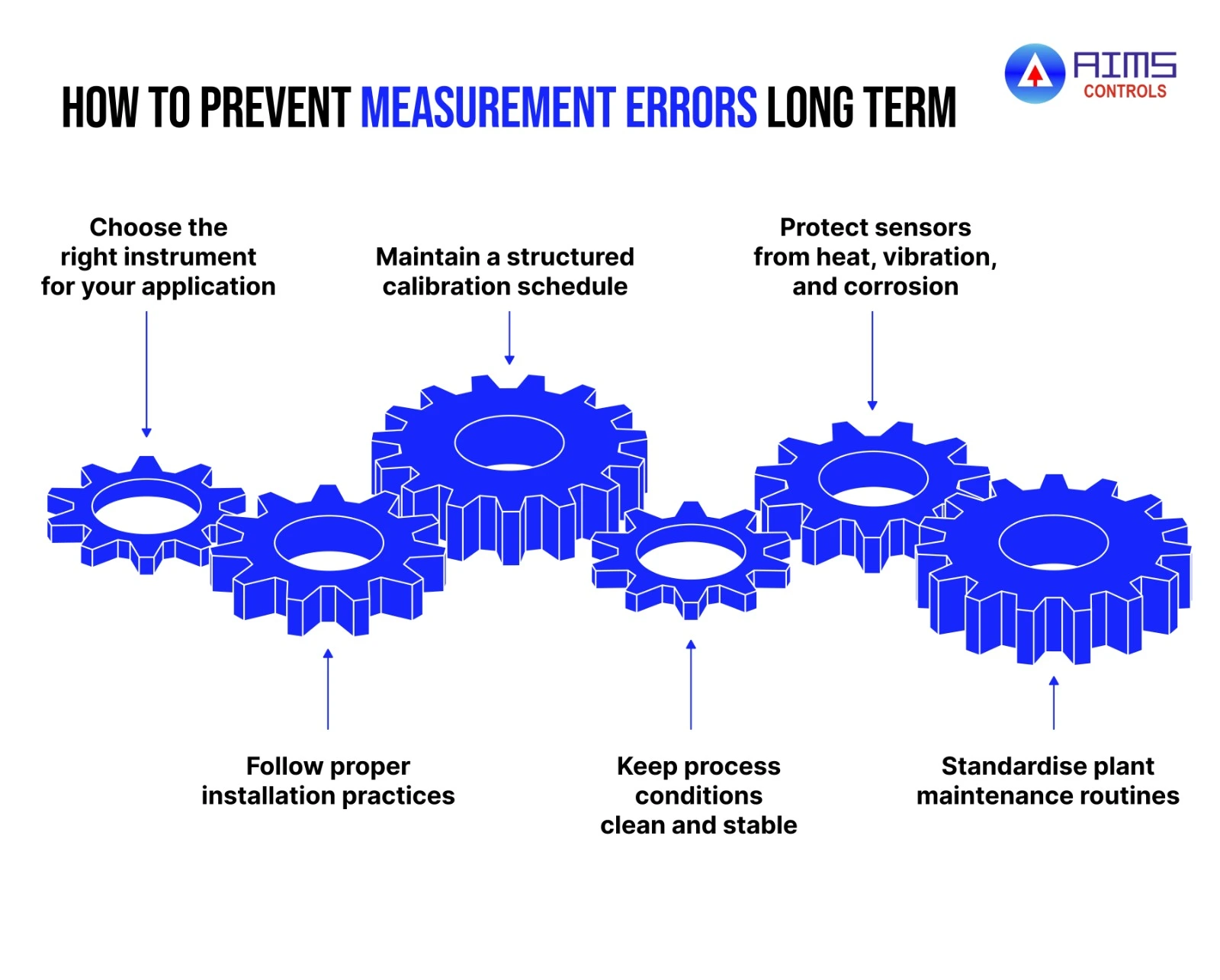
How to Prevent Measurement Errors Long Term
Why AIMS Controls Instruments Reduce Measurement Errors
AIMS Controls designs instruments built for accuracy and long-term stability.
What you get:
- SS304 and SS316 pressure gauges
- Glycerin-filled gauges for vibration
- Diaphragm gauges for corrosive or viscous fluids
- Reliable pressure and flow transmitters
- Durable float and level switches
- High-accuracy temperature gauges and thermocouples
These devices reduce drift, improve repeatability, and deliver consistent measurements across cycles.
Get Accurate Measurements and Reduce Downtime
If your plant is facing unstable readings, frequent calibration issues, or unexpected failures, AIMS Controls can help you choose the right pressure, flow, level, or temperature instrument.
Better instruments lead to fewer errors and smoother operations.
Reach out to the AIMS Controls team for expert support.
FAQ
What is the most common cause of measurement errors?
Usually incorrect instrument selection.
How often should instruments be calibrated?
Every three to six months for critical applications.
Why do pressure gauges drift?
Vibration, spikes, corrosion, or blocked impulse lines.
Why does a flow meter fluctuate?
Air pockets, sediment, or turbulence.
Why does a level switch misread?
Foam, turbulence, sticky liquids, or float blockage.
What is the best switch for water tanks?
A water level switch.
Do temperature sensors drift?
Yes, due to aging and oxidation.
Can AIMS Controls help with selection?
Yes, the team guides you based on your process needs.