Introduction
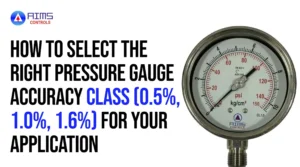
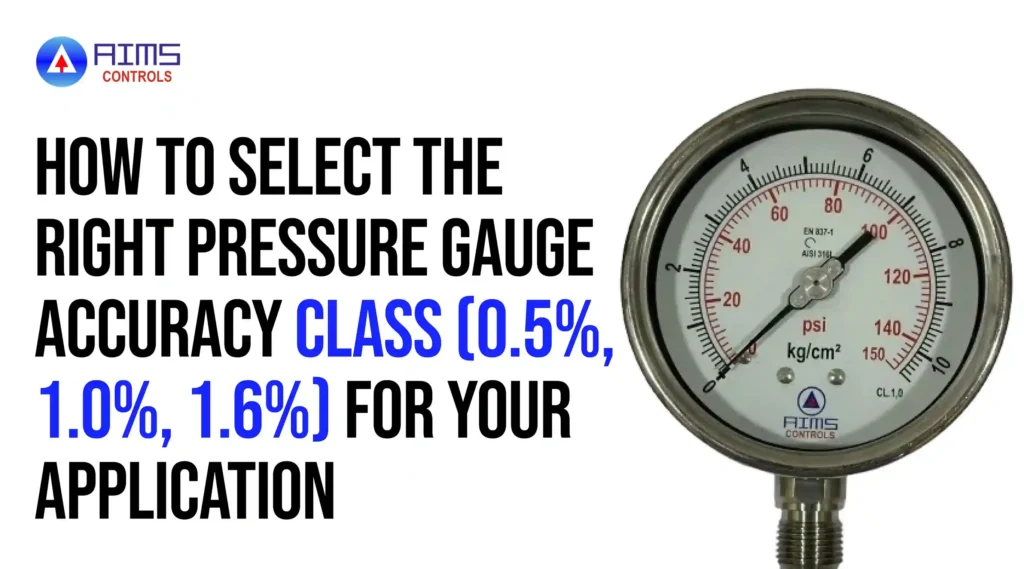
Selecting a pressure gauge accuracy class is not about choosing the highest number available. It is about matching accuracy to what your application actually needs. The wrong choice can lead to misleading readings, unnecessary cost, or poor decision-making on the shop floor.
This guide is for engineers, maintenance teams, and procurement professionals who need to specify pressure gauges with confidence. It explains how accuracy classes like 0.5%, 1.0%, and 1.6% work in real applications.
By the end, you will know which accuracy class fits your process, when higher accuracy is justified, and when it adds no real value.
Key Takeaway
- Pressure gauge accuracy class defines the maximum allowed error as a percentage of full-scale value
- Higher accuracy does not always mean better performance for every application
- 1.0% and 1.6% accuracy classes cover most industrial requirements
- 0.5% accuracy is typically needed only for critical measurements or reference checks
- Choosing the right accuracy class prevents over-specification and reduces cost
What Is Pressure Gauge Accuracy Class
Pressure gauge accuracy class defines the maximum permissible error of a gauge, calculated as a percentage of its full-scale range.
Key points to understand
- Accuracy is based on full scale, not the current reading
- The error limit stays the same across the entire dial
- A 1.0% accuracy gauge with a 100 bar range can deviate by ±1 bar at any point
In practical terms, the accuracy class tells you how reliable a reading is for decision-making, not how fine the needle movement appears. Choosing the right class ensures the gauge is suitable for monitoring, control, or reference use.
How Pressure Gauge Accuracy Is Calculated
Pressure gauge accuracy is calculated as a percentage of the gauge’s full-scale range, not the operating pressure. This is the most common point of confusion during specification.
Key points
- Accuracy is always referenced to maximum scale value
- The same error limit applies across the entire dial
- Lower readings do not mean lower error
Example
- Gauge range: 0 to 100 bar
- Accuracy class: 1.0%
- Maximum permissible error: ±1 bar
This means the reading can vary by up to ±1 bar whether the gauge is reading 10 bar or 90 bar. Understanding this calculation helps avoid choosing an accuracy class that appears precise on paper but is unsuitable in real operation.
Understanding Accuracy Classes (0.5%, 1.0%, 1.6%)
Pressure gauge accuracy classes indicate how tightly the gauge reading must stay within its allowable error band, which is also influenced by the types and construction of pressure gauges used in the application.
Each class serves a different purpose, and selecting the right one depends on how critical the measurement is, especially in applications such as differential pressure measurement.
0.5% Accuracy Class
This is a high-accuracy class used where pressure readings directly affect safety, compliance, or calibration.
Typical use cases
- Test benches and calibration setups
- Critical process control
- Verification of other instruments
Limitations
- Higher cost
- More sensitive to installation conditions and vibration
1.0% Accuracy Class
This is the most common choice for industrial applications that require dependable readings without excessive cost.
Typical use cases
- Process monitoring
- Hydraulic and pneumatic systems
- OEM equipment
Why it works well
- Good balance between accuracy and durability
- Suitable for most industrial decision-making
1.6% Accuracy Class
This class is designed for general monitoring where approximate pressure indication is sufficient.
Typical use cases
- Utility lines
- Compressors and pumps
- Non-critical monitoring points
Why it is used
- Cost-effective
- Robust for harsh environments
- Accuracy is sufficient when pressure trends matter more than exact values
How to Choose the Right Accuracy Class for Your Application
Selecting the correct pressure gauge accuracy class starts with understanding how the reading will be used, not with the specification sheet.
Decision logic
- Is the pressure reading safety-critical or compliance-related?
Choose 0.5% accuracy where incorrect readings could affect safety, testing, or regulatory acceptance. - Is the gauge used for routine process monitoring or control decisions?
1.0% accuracy is suitable for most industrial systems and offers a reliable balance between precision and cost. - Is the gauge used only for visual indication or trend monitoring?
1.6% accuracy is sufficient where exact values are not required.
Additional factors to consider
- Operating pressure should ideally fall within the middle range of the scale
- Harsh conditions like vibration and temperature can reduce effective accuracy, which is why design choices such as glycerin-filled vs dry pressure gauges matter
- Higher accuracy increases cost without benefit if the process does not demand it
Choosing the right accuracy class ensures the gauge supports decisions instead of creating false confidence.
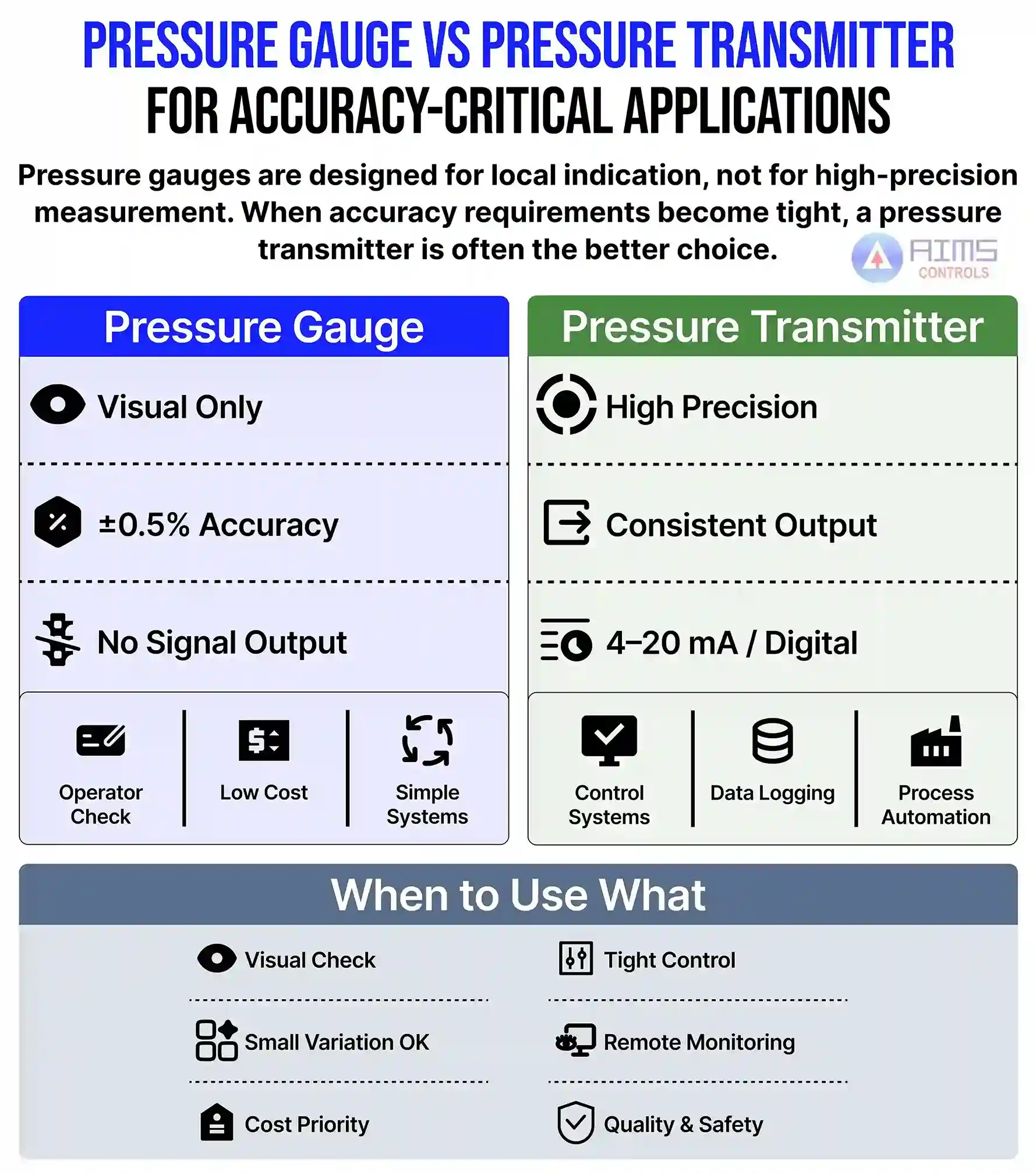
Pressure Gauge vs Pressure Transmitter for Accuracy-Critical Applications
Common Mistakes When Selecting Pressure Gauge Accuracy
Choosing the wrong pressure gauge accuracy class is often caused by assumptions rather than application needs.
Common issues
- Assuming higher accuracy is always better
- Ignoring full-scale range impact
- Confusing resolution with accuracy
- Overlooking operating conditions
- Using gauges for control instead of indication
Wear, vibration, temperature exposure, and pressure cycling can reduce accuracy, often appearing as early signs that a pressure gauge needs replacement.
Avoiding these mistakes leads to more reliable readings, lower maintenance issues, and better overall system performance.
What to Do Next
Once you understand how pressure gauge accuracy classes work, the next step is applying that knowledge to your specific system. Start by reviewing your operating pressure range, process criticality, and environmental conditions to avoid over- or under-specification.
If your application involves safety, compliance, calibration, or accuracy-sensitive processes, it is important to validate whether a higher accuracy pressure gauge or a pressure transmitter is the right solution for your setup. For general monitoring applications, focusing on durability, correct range selection, and operating conditions often delivers better long-term performance than simply choosing higher accuracy.
For application-specific guidance, technical consultation, or pricing support, connect with the experts at AIMS Controls. Their team can help you select the most suitable pressure measurement solution based on real operating conditions, not just catalog specifications. Contact AIMS Controls for consultation and quotes
FAQs About Pressure Gauge Accuracy
Is 0.5% accuracy always better for pressure gauges?
No. Higher accuracy is only beneficial when the application requires tight control or verification. For most industrial monitoring, 1.0% or 1.6% accuracy is sufficient.
How does pressure gauge range affect accuracy?
Accuracy is calculated from full-scale range. If a gauge is oversized, the error at normal operating pressure becomes proportionally larger.
Does pressure gauge accuracy change over time?
Yes. Wear, vibration, temperature exposure, and pressure cycling can reduce accuracy, which is why periodic calibration is important for critical applications.
Which accuracy class is best for general industrial use?
A 1.0% accuracy class is typically the best choice for industrial systems, offering a balance between reliability, durability, and cost.