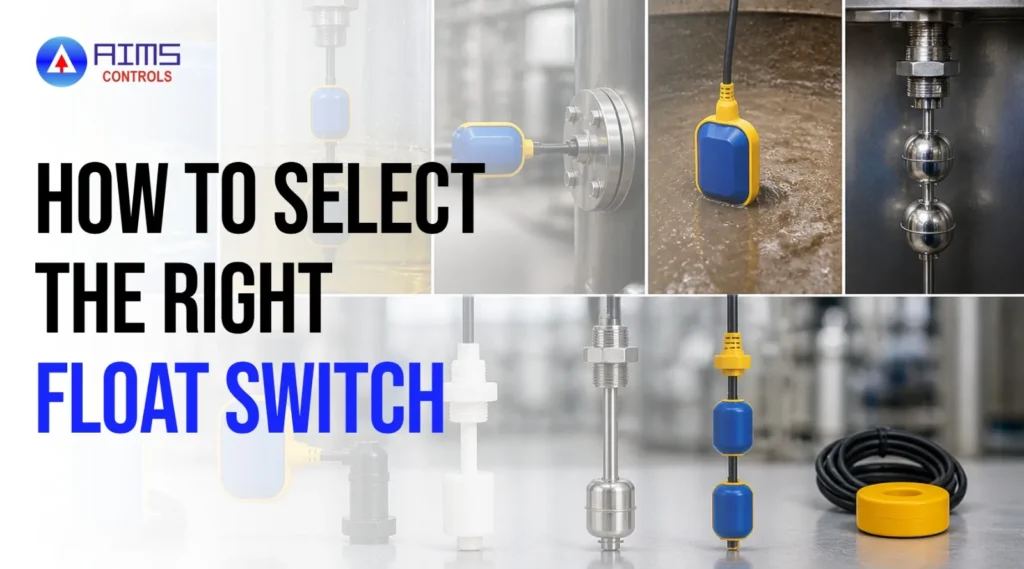
Choosing the wrong float switch doesn’t just cause inconvenience; it can lead to overflowing tanks, pump dry-runs, process shutdowns, and costly equipment damage. With dozens of float switch types and configurations available, the selection process matters more than most buyers realise.
This guide walks you through everything you need: how float switches work, what types are available, the key selection factors, and a practical decision framework you can use today.
What Is a Float Switch?
A float switch is a simple, reliable device that detects liquid levels and triggers an electrical signal, with no complex electronics, no programming required.
It’s used wherever you need a liquid level to automatically control something: a pump, an alarm, a valve, or a solenoid. Common applications include water storage tanks, sump pits, boiler feed systems, chemical dosing vessels, and industrial process tanks.
At AIMS Controls, float switches fall under our Level Instruments range, and they’re one of the most frequently specified products across the industries we serve.
How Does a Float Switch Work?
The operating principle is straightforward:
- A buoyant float rides on the liquid surface inside a tank or vessel
- As the liquid rises or falls, the float moves with it
- This movement actuates a reed switch inside the stem of a sealed glass capsule containing two metal contacts that snap open or closed when a magnet passes nearby
- The reed switch either opens or closes a circuit, signalling a pump to start, an alarm to trigger, or a valve to operate
Because the mechanism is purely mechanical and magnetic, a correctly specified float switch can run for years without attention.
Why Choosing the Right Float Switch Matters
A float switch isn’t a commodity item you can pick at random. The wrong specification creates real operational problems:
| Wrong Choice | What Goes Wrong |
| Incompatible float material | Corrosion in chemical media → false readings or complete failure |
| Incorrect mounting type | Switch doesn’t reach the target level → missed actuation |
| Wrong electrical rating | Contact arcing or damage in the pump control panels |
| Ignoring switching differential | Pump short-cycling → rapid on/off burns out motors |
| Wrong temperature rating | Seal failure or float deformation in hot process liquids |
Get the specification right, and a float switch will run maintenance-free for years. Get it wrong, and you’ll be troubleshooting system failures at the worst possible time.
Types of Float Switches
Float switches come in several configurations, each suited to specific installation requirements. Here’s a practical breakdown.
Vertical Float Switch
The most common type. The float slides up and down along a vertical stem, mounted through the top or side of a tank.
- Best for: Enclosed tanks, water treatment vessels, compact industrial tanks
- Advantage: Simple installation, available in single or multi-level configurations
- Limitation: Requires vertical clearance inside the tank, not suitable for very shallow vessels
Horizontal (Side-Mounted) Float Switch
Mounted through the tank side wall, with the float pivoting horizontally as liquid rises or falls past the set point.
- Best for: Tanks with limited vertical space or where top-entry isn’t possible
- Advantage: Can be installed on the side wall at exactly the required level
- Limitation: One unit per monitoring point; more fittings are needed for multi-level detection
Cable Float Switch
A weighted float hangs from a cable and swings to different angles as the liquid level changes, actuating at a set tilt angle.
- Best for: Sump pits, large open tanks, wastewater applications
- Advantage: Wide switching differential, easy to install, just hang it at the right depth
- Limitation: Not suitable for narrow tanks or liquids with heavy foam or debris
Magnetic (Reed Switch) Float Switch
Uses a permanent magnet inside the float body and one or more reed switches positioned in the stem. As the float passes each switch point, the magnet opens or closes the contacts.
- Best for: Clean liquids, boiler feed tanks, cooling water systems
- Advantage: No moving electrical parts are inherently reliable and long-lasting
- Limitation: Sensitive to external magnetic interference in some industrial environments
Multi-Point Float Switch
A single stem unit with multiple reed switches positioned at different heights, allowing level detection at several points simultaneously.
- Best for: Process tanks needing low, mid, and high-level alarms; automated refill systems
- Advantage: One installation point for multiple control outputs
- Limitation: More wiring complexity; stem length must match the tank depth exactly
Key Factors to Consider When Selecting a Float Switch
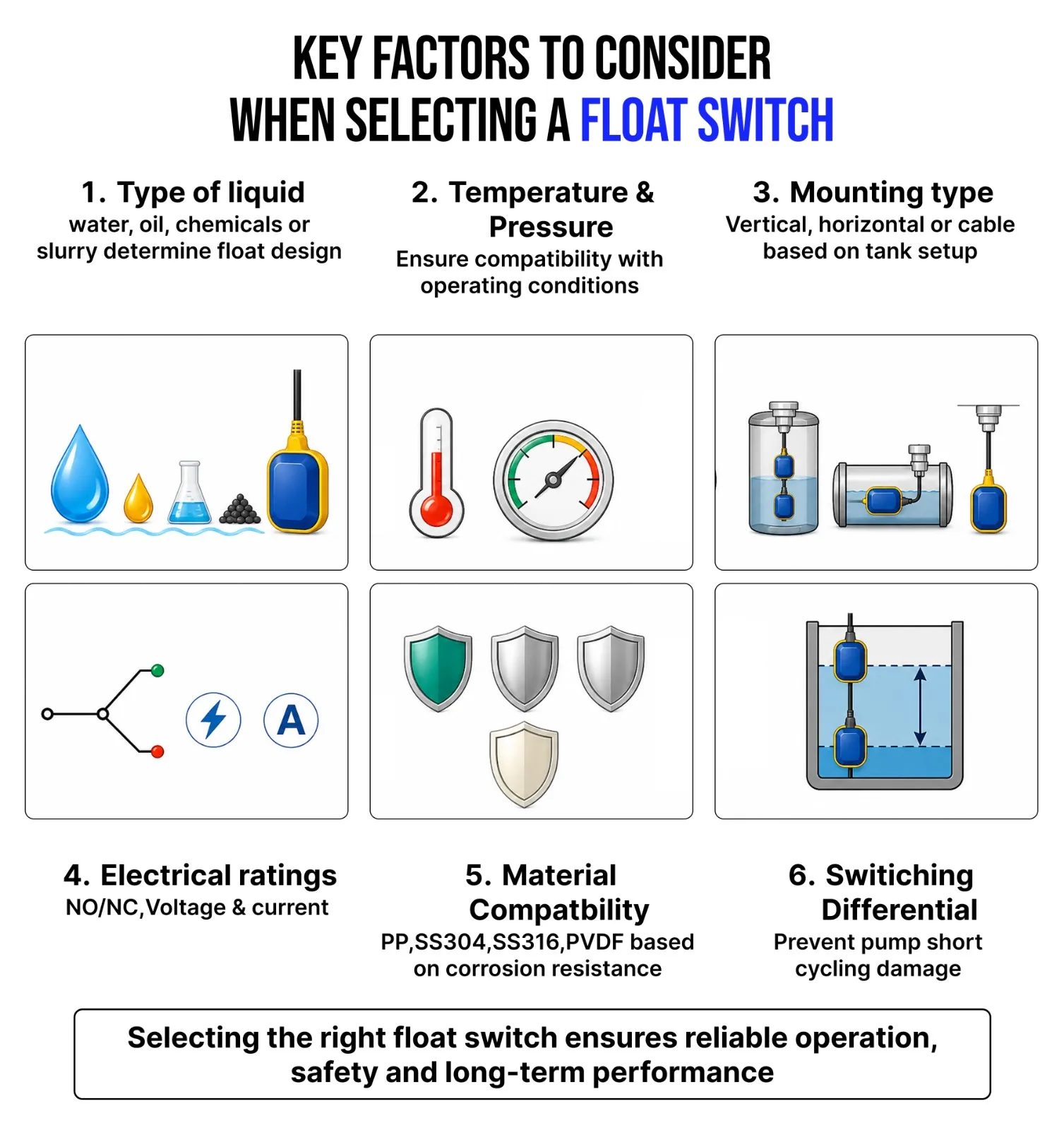
Run through this checklist before finalising any specification.
1. Type of Liquid
The media inside the tank directly determines which float switch materials and design are appropriate.
- Clean water: Most standard float switches work fine
- Oils & fuels: Avoid standard PVC floats; use stainless steel or Buna-N sealed units
- Acids & alkalis: Polypropylene (PP) or PVDF floats required; check every wetted component against a chemical compatibility chart
- Viscous or slurry liquids: Cable or wide-body floats prevent the unit from sticking
Also, confirm the specific gravity (SG) of the liquid. A float calibrated for water (SG = 1.0) may not reliably actuate in a light oil (SG = 0.8) or a dense chemical solution (SG > 1.2).
2. Temperature & Pressure
Every float switch has an operating temperature and pressure limit. Exceeding either causes seal failure or mechanical deformation.
- Standard units: Rated for ambient temperature liquids, typically up to ~80°C
- High-temperature applications (boilers, steam condensate): Look for stainless steel construction with PTFE seals, rated to 120°C+
- Pressurised vessels: Always check the pressure rating on the entire housing, not just the switch mechanism
3. Mounting Type
The tank design determines which mounting is feasible.
- Top entry → Vertical float switch (standard choice)
- Side wall entry → Horizontal float switch (use when top access is restricted)
- Open pit/sump → Cable float switch (flexible, no fixed entry point required)
Also, confirm the process connection standard BSP, NPT, or flanged, and whether a sealing gasket or compression fitting is required.
4. Electrical Ratings NO / NC, Voltage & Current
Float switches are either Normally Open (NO) or Normally Closed (NC), and the choice depends on your control logic.
- Normally Open (NO): Circuit is open at rest; closes when float rises, used to trigger a pump start on high level, or fill a tank on low level
- Normally Closed (NC): Circuit is closed at rest; opens when float rises, used for high-level alarms or pump stop functions
Always check the voltage and current rating of the reed switch contacts. A 230V AC relay circuit needs a different switch rating than a 24V DC PLC input. As a rule, derate the contact rating by 20–30% for longer service life.
5. Material Compatibility
Consider every component that will contact the liquid: the float body, stem, cable jacket, gasket, and process connection.
| Material | Suitable For |
| Polypropylene (PP) | Water, mild chemicals, and general industrial use |
| Stainless Steel 304 | Food & beverage, light chemical exposure |
| Stainless Steel 316 | Marine, pharmaceuticals, chloride-rich environments |
| PVDF / PTFE | Aggressive acids, solvents, high-purity media |
At AIMS Controls, we offer float switches in polypropylene and stainless steel as standard, with options for special media on request.
6. Switching Differential
The switching differential is the vertical distance between the ON point and the OFF point of the switch. It’s often overlooked, but it directly affects pump life and system behaviour.
- Too small a differential: The pump short-cycles (turns on and off rapidly), overheating the motor
- Too large a differential: The tank oscillates between extremes, wasting usable capacity or risking overflow
For pump control applications, a switching differential of 150–300 mm is generally recommended to protect the motor. For simple level alarms, a smaller differential is acceptable.
Common Applications of Float Switches
Float switches are used across a wide range of industries and liquid-handling systems:
| Industry / System | Typical Application |
| Water & wastewater treatment | Pump start/stop control in sumps, overhead tanks, and wet wells |
| Oil & gas | Level monitoring in separator vessels and produced water tanks |
| Chemical processing | High/low level alarms in dosing tanks and bulk storage vessels |
| HVAC & cooling systems | Chiller tank monitoring, cooling tower basin level control |
| Boiler systems | Low water level cutoff safety-critical, often code-required |
| Food & beverage | Ingredient tank management, CIP rinse water level control |
| Pharmaceutical | Process vessel level detection with hygienic stainless construction |
| Irrigation & agriculture | Pump protection in collection sumps and distribution tanks |
Step-by-Step Float Switch Selection Framework
If you’re specifying a float switch for a new or replacement installation, answer these questions in order:
- What liquid is in the tank?
Type, specific gravity, temperature, and pressure - What is the tank geometry?
Dimensions, available entry points, and depth at the target level - What do you need the switch to do?
Pump control, alarm, valve trigger, and how many set points? - What are your electrical requirements?
AC or DC voltage, current load, NO or NC logic - What wetted materials are acceptable?
Based on chemical compatibility and hygiene requirements - What switching differential do you need?
Based on pump type and system design - Are there environmental constraints?
Hazardous area classification (ATEX/IECEx), IP rating, and ambient temperature
If you can answer all, you have a complete specification. If any point is unclear, contact the AIMS Controls technical team, who can work through the selection with you; just share your process data and tank details.
For more practical insights on level measurement technologies and industrial instrumentation, explore our blog at AIMS Controls.
Mistakes to Avoid When Choosing a Float Switch
Selecting by price alone
A cheaper float switch made from incompatible plastic in a chemical dosing tank will fail in weeks. The total cost, including downtime, replacement, and potential process contamination, always exceeds the initial savings.
Ignoring specific gravity
A float designed for water will not reliably actuate in light hydrocarbons or dense slurries. Always confirm liquid density relative to the float’s buoyancy specification.
Installing a side-mounted switch in a foamy or viscous liquid
Foam or viscous media can hold the float in a false position, sending incorrect signals to your control system. Use a cable float or a dedicated submersible level sensor in these conditions.
Connecting high loads directly to reed switch contacts
Many float switches have contacts rated for 0.5A or 1A. Connecting a pump motor contactor coil directly without an interposing relay will cause contact arcing and failure. Always verify contact ratings against the actual load.
No switching differential consideration for pump control
Setting the ON and OFF levels too close together is one of the most common causes of motor burnout. Allow adequate differential, typically 150 mm minimum, for any pump control application.
Not confirming the process connection standard
A float switch specified in the BSP thread ordered for an NPT-threaded nozzle won’t seal. Confirm thread type and size before ordering, especially on replacement units.
Float Switch vs Other Level Sensors: When to Use What
A float switch isn’t always the right tool. Here’s a straightforward comparison:
| Sensor Type | Use When… | Limitations |
| Float switch | Simple ON/OFF control; reliable, low-cost; clean or mildly contaminated liquids | Not suitable for continuous level output; limited in high-foam or high-viscosity media |
| Ultrasonic level sensor | Continuous level measurement needed; liquid is corrosive or must not be contacted | Performance affected by vapour, foam, and turbulence |
| Capacitive level sensor | Level detection through vessel walls, solids or powders, as well as liquids | Calibration sensitive to changes in the media dielectric constant |
| Magnetic level gauge | Visual reading required alongside a switch output; high-pressure or high-temperature vessels | Primarily, a visual indicator requires a separate transmitter for a 4–20mA output |
| Radar level transmitter | High-accuracy continuous measurement in extreme conditions | Higher cost; requires more commissioning than a simple float switch |
For straightforward pump control and high/low level alarms, a float switch remains the most cost-effective and proven solution. Where you need a continuous 4–20mA level output or non-contact sensing, ultrasonic or radar transmitters are the better choice.
AIMS Controls supplies both, so the recommendation is always based on what’s right for the application.
Conclusion: Get the Specification Right the First Time
A float switch is a simple device, but the wrong specification leads to real consequences: equipment failures, process interruptions, and avoidable maintenance costs.
The key factors, liquid type, temperature, and pressure, mounting configuration, electrical rating, material compatibility, and switching differential, all need to be addressed together. Miss one, and the specification isn’t complete.
AIMS Controls has been supplying float switches and level instruments to process industries across India and internationally for over six years, backed by our founders’ 20+ years of instrumentation expertise. Whether you’re specifying a single replacement unit or sourcing float switches for a large process plant, we can help you get it right.
Have a float switch requirement? Share your process conditions and tank details with the AIMS Controls team. We’ll recommend the correct type, material, and configuration and back it up with technical documentation.
FAQs
What is a float switch, and how does it work?
A float switch is a device used to detect liquid levels in tanks. It works by using a floating component that rises or falls with the liquid, activating an internal switch to turn equipment like pumps on or off.
What are the different float switch types?
The main float switch types include:
- Vertical float switches
- Horizontal float switches
- Cable float switches
- Magnetic float switches
- Multi-point float switches
Each type is designed for specific mounting and application needs.
How do I choose the right float switch?
To select the right float switch, consider the liquid type, temperature, mounting style, electrical rating, and material compatibility. Matching these factors ensures reliable and long-term performance.
Which float switch is best for water tanks?
For water tanks, vertical or cable float switches are commonly used due to their simplicity and reliability. The choice depends on tank size and installation space.
Can float switches be used for chemicals or oil?
Yes, float switches can be used with chemicals or oil, but material compatibility is critical. Stainless steel or specialized plastic floats are recommended for corrosive liquids.
What is the difference between NO and NC in a float switch?
NO (Normally Open) means the circuit is open when the float is at rest, while NC (Normally Closed) means the circuit is closed. The choice depends on whether you want the device to activate on rising or falling liquid levels.
How long does a float switch last?
A float switch can last several years depending on usage conditions, liquid type, and build quality. Proper installation and maintenance significantly extend its lifespan.
What are common problems with float switches?
Common issues include float sticking, incorrect installation, and material corrosion. These problems can be avoided by selecting the right float switch and ensuring proper maintenance.
Do float switches require maintenance?
Float switches require minimal maintenance, but periodic inspection is recommended to ensure there is no buildup, corrosion, or mechanical blockage.
Are float switches better than other level sensors?
Float switches are simple, cost-effective, and reliable for many applications. However, for complex or non-contact measurement needs, other level sensors like ultrasonic sensors may be more suitable.