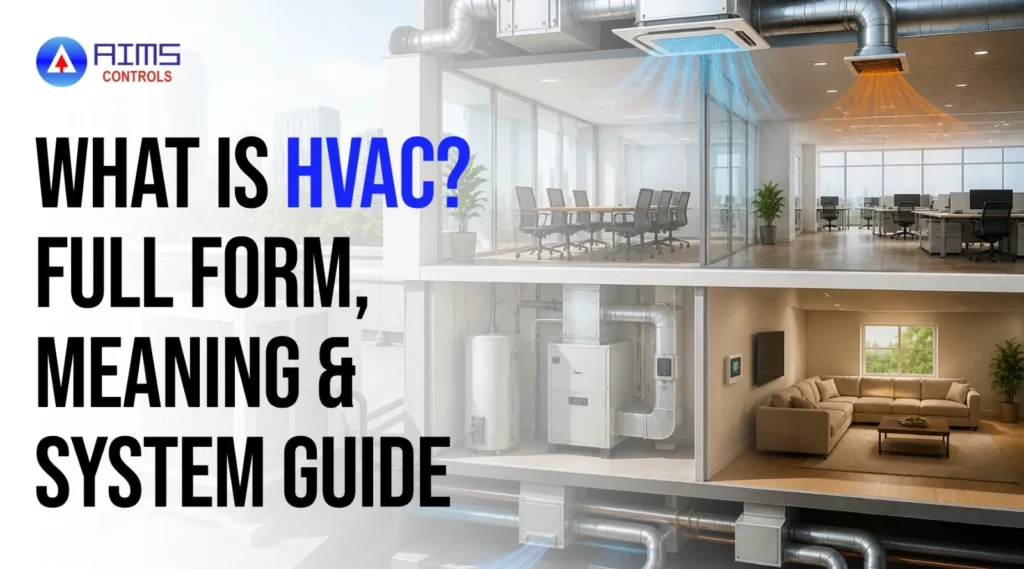
If you’ve ever walked into an air-conditioned office, a hospital corridor, or an industrial facility and felt comfortable – that’s an HVAC system doing its job.
HVAC stands for Heating, Ventilation, and Air Conditioning. It’s the integrated system that controls temperature, airflow, and air quality inside any built environment, from a single-room office to a multi-storey manufacturing plant.
Understanding how HVAC systems work isn’t just for building engineers. If you’re specifying instrumentation, managing a facility, or designing a process environment, HVAC directly affects your equipment selection, including sensors, switches, and control devices.
HVAC Full Form & Meaning
Let’s break it down:
| Letter | Stands For | What It Does |
| H | Heating | Raises indoor temperature during cold conditions |
| V | Ventilation | Circulates fresh air, removes stale or contaminated air |
| AC | Air Conditioning | Cools the air and controls humidity levels |
These three functions don’t operate independently; they work as one integrated system, automatically adjusting based on indoor conditions and external climate.
What Is an HVAC System?
An HVAC system is a mechanical and electrical infrastructure that regulates three core parameters inside a building or facility:
- Temperature keeping it within a set range, whether heating or cooling
- Humidity controls moisture levels in the air
- Air quality filtering, circulating, and refreshing indoor air
A well-designed HVAC system doesn’t just react to conditions. It monitors continuously and adjusts automatically, maintaining a stable indoor environment around the clock.
In industrial settings, HVAC goes beyond comfort. It protects sensitive equipment, maintains cleanroom standards, prevents condensation on electrical panels, and supports process stability in manufacturing and pharmaceutical environments.
How Does an HVAC System Work?
The operating cycle of an HVAC system follows a continuous loop:
Step 1: Sensing – Thermostats and sensors monitor indoor temperature, humidity, and air quality in real time.
Step 2: Processing – The control unit compares live readings against the set point (your desired conditions) and determines what action is needed.
Step 3: Heating or Cooling
- If the temperature is too low → the heating unit activates
- If the temperature is too high → the air conditioning unit activates
Step 4: Air Distribution – Conditioned air is pushed through ductwork or air handling units (AHUs) into the occupied space.
Step 5: Ventilation – Fresh outside air is drawn in, filtered, and mixed with recirculated indoor air. Stale or contaminated air is exhausted.
Step 6: Feedback Loop – Sensors continuously re-measure conditions and signal the control system to adjust, maintaining the set point without manual intervention.
This is a closed-loop control system, the same principle used across industrial process control, just applied to building environments.
Main Components of an HVAC System
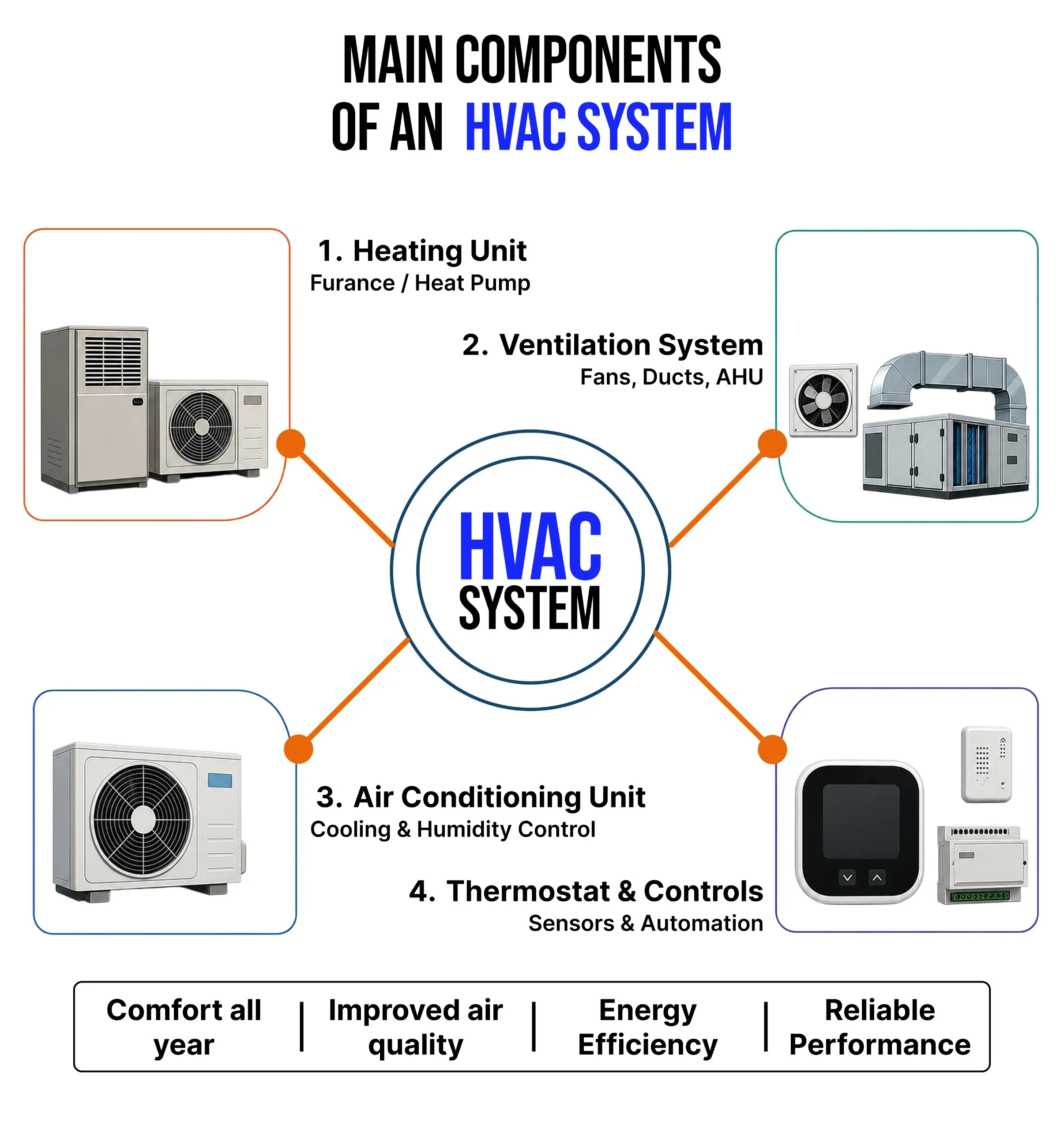
Heating Unit (Furnace or Heat Pump)
The heating unit raises indoor air temperature when conditions drop below the set point.
- Furnaces burn gas, oil, or use electrical resistance to generate heat
- Heat pumps extract heat energy from outside air or ground and transfer it indoors, making them more energy-efficient in moderate climates
- Heat is transferred to circulating air via a heat exchanger, then distributed through ducts
In industrial HVAC, hot water coils or steam heating units are also common, particularly in large facilities.
Ventilation System
Ventilation controls the movement and quality of air throughout a building.
- Natural ventilation: Passive airflow through windows, vents, and building design
- Mechanical ventilation: Fans, air handling units (AHUs), and ductwork force controlled air movement
Ventilation serves two purposes: delivering fresh oxygen-rich air to occupants, and removing pollutants, such as CO₂, humidity, dust, odours, and in industrial environments, chemical fumes or process gases.
Air Conditioning Unit
The AC unit removes heat from indoor air and expels it outside, cooling the space and typically reducing humidity.
The refrigeration cycle works as follows:
- A refrigerant fluid circulates between an indoor evaporator coil and an outdoor condenser unit
- At the evaporator, the refrigerant absorbs heat from indoor air (cooling the air)
- At the condenser, it releases that heat outside
- The cycle repeats continuously to maintain the set temperature
As a byproduct of cooling, moisture condenses out of the air, which is why air conditioning also controls humidity. This condensate must be managed and drained, something we’ll cover when discussing float switches.
Thermostat & Controls
The thermostat is the brain of the HVAC system. It reads the ambient conditions and sends signals to activate or deactivate heating, cooling, or ventilation components.
Modern HVAC control systems include:
- Programmable thermostats – set temperature schedules for different times of day
- Building Management Systems (BMS) – centralised control of HVAC alongside lighting, security, and power across large facilities
- Sensors – temperature sensors, humidity sensors, CO₂ sensors, pressure sensors, and level switches feeding live data to the control system
In industrial HVAC, these control inputs often connect to PLCs (Programmable Logic Controllers) or SCADA systems for automated and remote management.
Types of HVAC Systems
Different building types and applications require different HVAC configurations:
| System Type | How It Works | Best For |
| Split System | Separate indoor and outdoor units connected by refrigerant lines | Residential and small commercial buildings |
| Ductless Mini-Split | No ductwork in individual units in each room or zone | Buildings where ducting isn’t feasible; zone-specific control |
| Packaged Unit | All components (heating + cooling) are housed in one outdoor cabinet | Small commercial buildings with limited indoor space |
| Central Air System | A single large system distributes conditioned air through an extensive duct network | Large commercial buildings, industrial facilities |
| Hybrid System | Combines a heat pump with a gas furnace; switches automatically based on efficiency | Climates with both hot and cold seasonal extremes |
| VRF / VRV System | Variable refrigerant flow multiple indoor units, precise zone-by-zone control | Large commercial buildings, hotels, and IT facilities |
Where Float Switches Fit in HVAC Systems
This is where instrumentation becomes critical and where many HVAC systems develop problems when components are underspecified.
Float switches are used in HVAC systems to automatically monitor and control liquid levels. There are several key points:
Condensate Drain Pans
Every air conditioning unit generates condensate water that drips from the evaporator coil as humid air is cooled. This water collects in a drain pan and is pumped or drained away.
If the drain blocks or the pump fails, the pan overfills. A float switch mounted in the condensate pan detects the rising water level and:
- Shuts down the AC unit before water spills onto electrical components or ceilings
- Triggers an alarm for maintenance
Without a float switch in the condensate pan, a blocked drain can go undetected for hours, causing significant water damage.
Cooling Tower Basin Level Control
Cooling towers use evaporation to reject heat from HVAC chiller systems. Water constantly evaporates from the basin, so makeup water must be added automatically to maintain the correct level.
A float switch in the cooling tower basin controls the makeup water valve:
- When the water level drops below the set point → float switch opens the makeup valve
- When the level is restored → float switch closes the valve
This prevents the cooling tower from running dry, which would damage the pump and reduce heat rejection efficiency.
Chiller Water Tanks
Large HVAC systems use chilled water loops instead of direct refrigerant in the distribution system. The chilled water tank must maintain consistent levels for the chiller pump to operate correctly.
Float switches provide:
- Low-level protection stops the pump before it runs dry
- High-level alarm preventing tank overflow
Float Switch Types Used in HVAC
The correct float switch type depends on the installation point:
- Vertical float switch standard choice for condensate pans and chilled water tanks; compact and reliable in clean water applications
- Cable float switch used in cooling tower basins and larger water storage tanks, where a wide switching differential is beneficial
- Magnetic reed float switch preferred where long service life and minimal maintenance are priorities; common in clean chilled water systems
At AIMS Controls, we supply float switches specifically suited for HVAC condensate management, cooling tower control, and chiller system level monitoring. If you’re specifying an HVAC installation, our team can recommend the right type, material, and connection standard.
Why HVAC Systems Are Important
HVAC isn’t optional in most modern building types. Here’s why it matters:
Occupant comfort and productivity – Temperature and air quality directly affect how people feel and perform. Studies consistently show that poor thermal comfort reduces workplace productivity and increases sick days.
Equipment protection – Electronics, servers, and precision instruments have operating temperature limits. A data centre without HVAC will fail within hours. Manufacturing equipment can seize or degrade in uncontrolled humidity.
Air quality and health – Ventilation dilutes airborne contaminants, controls CO₂ levels, and removes pathogens. In hospitals and pharmaceutical facilities, HVAC is critical for infection control and regulatory compliance.
Energy efficiency – A well-maintained, correctly specified HVAC system uses energy efficiently. Oversized or poorly controlled systems waste significant power, and modern control systems with proper sensors dramatically reduce energy consumption.
Regulatory compliance – In many industries, pharmaceutical, food processing, healthcare, and indoor environment standards are legally mandated. HVAC is the primary mechanism for meeting those standards.
Applications of HVAC Systems
HVAC systems are deployed across virtually every built environment:
- Residential buildings – Home comfort, humidity control, fresh air supply
- Commercial offices – Occupant comfort, productivity, ventilation compliance
- Hospitals & healthcare – Infection control, cleanroom-grade air handling, operating theatre pressurisation
- Data centres & server rooms – Precision temperature and humidity control to protect IT infrastructure
- Pharmaceutical manufacturing – Regulated cleanroom environments, temperature-controlled storage
- Food & beverage processing – Temperature control during production, cold storage management
- Industrial manufacturing – Process temperature stability, fume extraction, equipment protection
- Hotels & hospitality – Zone-by-zone comfort control, energy management
- Warehouses & logistics – Climate-controlled storage for temperature-sensitive goods
Common Problems in HVAC Systems
Understanding failure modes helps with both specification and maintenance planning:
Blocked condensate drain: One of the most common HVAC faults. Algae, dust, and debris block the drain line → condensate pan overflows → water damage to ceilings, walls, and electrical components. A float switch with a pump shutoff is the standard protective measure.
Refrigerant leak: Loss of refrigerant reduces cooling capacity and can damage the compressor. Symptoms include poor cooling performance and ice forming on the evaporator coil.
Dirty or blocked air filters: Restricted airflow forces the system to work harder, increasing energy consumption and reducing component life. Filters should be checked regularly and replaced on schedule.
Thermostat sensor failure: If the temperature sensor drifts or fails, the system either over-heats/over-cools the space or fails to respond at all. Regular calibration checks are important in critical environments.
Float switch failure in condensate pan: If the condensate float switch fails in the open position, the AC unit shuts down unnecessarily. If it fails in the closed position, overflow protection is lost. Selecting a quality float switch and inspecting it during maintenance prevents both scenarios.
Cooling tower basin running dry: If the makeup water float switch fails or the supply is interrupted, the cooling tower basin runs low, the pump cavitates, and heat rejection drops. This cascades to the chiller, which shuts down on a high-temperature fault.
Poor airflow distribution: Blocked ducts, damaged dampers, or incorrectly balanced air distribution lead to hot/cold spots in the facility. Regular duct inspections and airflow balancing resolve most cases.
HVAC Maintenance Practical Checklist
A well-maintained HVAC system runs efficiently and reliably. Here’s a practical maintenance schedule:
Monthly checks:
- Inspect and clean or replace air filters
- Check the condensate drain pan for water accumulation and blockage
- Verify thermostat and control sensor readings against actual conditions
- Inspect the float switch operation in the condensate pan and the cooling tower basin
Quarterly checks:
- Clean evaporator and condenser coils
- Check refrigerant pressure and look for signs of leaks
- Inspect ductwork for damage, leaks, or blockages
- Test all safety switches, including float switches and pressure cutouts
- Check belt drives and fan bearings for wear
Annual checks:
- Full refrigerant system inspection by a certified engineer
- Calibrate thermostats and control sensors
- Clean and balanced air distribution system
- Inspect and service the heating unit heat exchanger, burner, or heat pump
- Full electrical inspection of connections, contactors, relays, and control wiring
HVAC vs Air Conditioning: What’s the Difference?
This is one of the most common points of confusion:
| Air Conditioning | HVAC | |
| Function | Cooling and dehumidification only | Heating + Ventilation + Cooling |
| Scope | Single function | Complete climate control system |
| Components | Compressor, condenser, evaporator | All AC components + heating unit + ventilation system + controls |
| Application | Residential cooling, spot cooling | Commercial, industrial, residential, complete climate management |
The simple answer: Air conditioning is one part of an HVAC system. HVAC is the complete solution.
When someone says “air conditioning” in a domestic context, they usually mean a split AC unit. When an engineer refers to “HVAC,” they mean the full integrated system, heating, ventilation, and cooling working together under centralised control.
Frequently Asked Questions
What is HVAC in simple terms?
HVAC stands for Heating, Ventilation, and Air Conditioning, a system that controls temperature, airflow, and air quality inside buildings to ensure comfort and safety.
What is the full form of HVAC?
Heating, Ventilation, and Air Conditioning. These three functions work together to regulate the indoor environment.
How does an HVAC system work?
The system continuously monitors temperature and air quality, then heats or cools incoming air and distributes it through the building while managing ventilation and humidity levels.
What are the main components of an HVAC system?
A heating unit, air conditioning system, ventilation system, and thermostat or control system. Large systems also include air handling units, chilled water circuits, and building management systems.
Where are float switches used in HVAC systems?
In condensate drain pans (to prevent overflow and shut down the AC unit), cooling tower basins (to control makeup water supply), and chilled water tanks (for pump protection and level alarms).
What float switch types are used in HVAC?
Vertical float switches for condensate pans and small tanks; cable float switches for cooling tower basins and larger reservoirs; magnetic reed switches where long service life and minimal maintenance are priorities.
Is HVAC the same as air conditioning?
No. Air conditioning is one component of an HVAC system. HVAC also includes heating and ventilation, making it a complete climate control solution.
Why is HVAC important?
It maintains indoor comfort, protects equipment, ensures air quality, supports regulatory compliance, and reduces energy consumption in both residential and industrial environments.
Conclusion
HVAC is one of the most critical systems in any modern building or industrial facility, yet it’s often treated as background infrastructure until something goes wrong.
Understanding how the system works, what its components do, and where instrumentation like float switches plays a protective role helps you specify correctly, maintain proactively, and avoid preventable failures.
At AIMS Controls, we supply the instruments that keep HVAC systems running reliably, including float switches for condensate management and cooling tower control, temperature sensors, pressure gauges, and control instruments for HVAC integration. Our team works with facility engineers, HVAC contractors, and OEMs across India to match the right instrument to the right application.
Have an HVAC instrumentation requirement? Share your system details with the AIMS Controls team. We’ll recommend the right product, specification, and configuration backed by technical support.