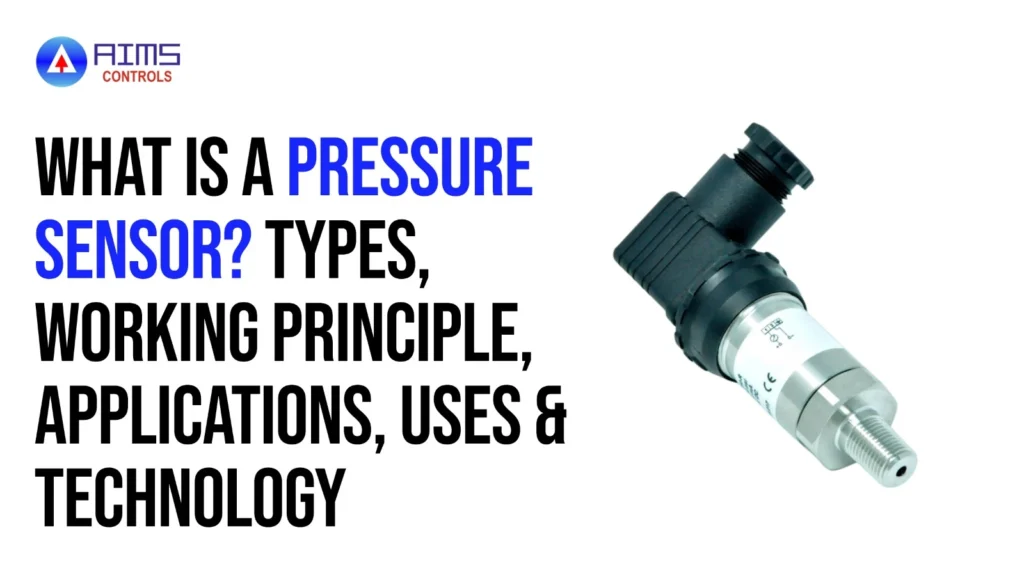
Ever wondered how your car knows your tire is low, or how a hospital ventilator delivers exactly the right amount of oxygen? The answer, more often than not, is a small device called a pressure sensor.
It doesn’t get much attention. It’s tucked inside machines, pipelines, and gadgets, quietly doing its job. But without it, a lot of the systems we depend on every day, from factories to weather stations, simply wouldn’t function safely.
If you’ve landed here searching for “what is a pressure sensor,” you’re probably trying to understand the basics before choosing one, specifying one for a project, or just satisfying genuine curiosity. Either way, this guide covers it all: what a pressure sensor does, how it works, the different types available, and where they’re used in the real world.
Let’s break it down in plain language.
What Is a Pressure Sensor?
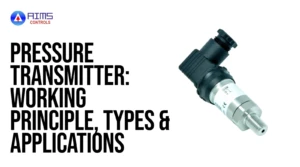
A pressure sensor is a device that detects and measures pressure, usually of gases or liquids, and converts that physical force into an electrical signal. That signal can then be read, displayed, recorded, or used to trigger an action elsewhere in a system.
Think of it as a translator. It takes something invisible (pressure) and turns it into something a machine or operator can actually understand and use.
What does a pressure sensor do, in simple terms? It sits at a point in a system a pipe, a tank, a chamber and constantly checks how much force is being exerted by the fluid or gas at that point. When pressure rises or falls, the sensor picks up on that change almost instantly and reports it.
You’ll also hear these devices called pressure transducers or pressure transmitters, depending on the industry and the exact function they perform. There are subtle technical differences between these terms, but for most people, they refer to the same basic idea.
How Does a Pressure Sensor Work?
This is probably the part you’re most curious about, so let’s get into it.
At its core, every pressure sensor working principle follows a similar pattern:
- Pressure hits a sensing element, usually a diaphragm, membrane, or similar flexible surface.
- The element physically deforms, even a tiny amount, based on how much pressure is applied.
- That deformation is measured using one of several methods (more on this below).
- The measurement is converted into an electrical signal, typically voltage or current.
- The signal is sent to a display, controller, or data system, where it’s interpreted as a pressure reading.
The clever part is step three: how the sensor actually “senses” that tiny physical movement. This is where different pressure sensor technologies come into play, and it’s also what separates one type of sensor from another.
Most pressure sensors rely on one of these detection methods:
- Piezoresistive sensing: resistance changes as the diaphragm bends, and these changes are measured electrically. This is one of the most common approaches used today.
- Capacitive sensing: pressure changes the distance between two conductive plates, altering capacitance.
- Piezoelectric sensing: certain materials generate a voltage when mechanically stressed, useful for rapidly changing pressures.
- Optical sensing: Light is used to detect tiny physical changes, often in harsh or hazardous environments.
Each method has strengths depending on the environment, required accuracy, and budget, which is exactly why so many types exist in the first place.
What Are the Types of Pressure Sensors?
This is one of the most-searched questions on the topic, and for good reason: picking the wrong type for an application can lead to inaccurate readings or premature failure.
Broadly speaking, pressure sensor types are categorized in two ways: by the sensing technology they use, and by what they measure pressure relative to.
By Sensing Technology
- Piezoresistive pressure sensors: Widely used across industries for their balance of cost, accuracy, and reliability.
- Capacitive pressure sensors: Known for high sensitivity and stability, often used in low-pressure applications like HVAC systems.
- Piezoelectric pressure sensors: Best suited for dynamic pressure changes, such as combustion engines or shock testing.
- Strain gauge sensors: A traditional and dependable option, commonly used in industrial pressure gauges and transmitters.
- Optical pressure sensors: Ideal for environments with high electromagnetic interference, such as power plants.
By Measurement Reference
- Absolute pressure sensors: Measure pressure relative to a perfect vacuum. Common in weather instruments and altimeters.
- Gauge pressure sensors: Measure pressure relative to atmospheric pressure. This is the most familiar type used in tire pressure gauges, for example.
- Differential pressure sensors: Measure the difference between two pressure points. Frequently used in filtration systems to detect clogging.
- Sealed pressure sensors: Measure relative to a fixed, sealed reference pressure rather than the atmosphere.
Choosing between these often comes down to the specific application, the environment the sensor will face, and the level of precision required, which is where working with an experienced instrumentation supplier makes a real difference. Manufacture a wide range of pressure instruments suited to different industrial needs, which can help take the guesswork out of selection.
Pressure Sensor Applications Across Industries
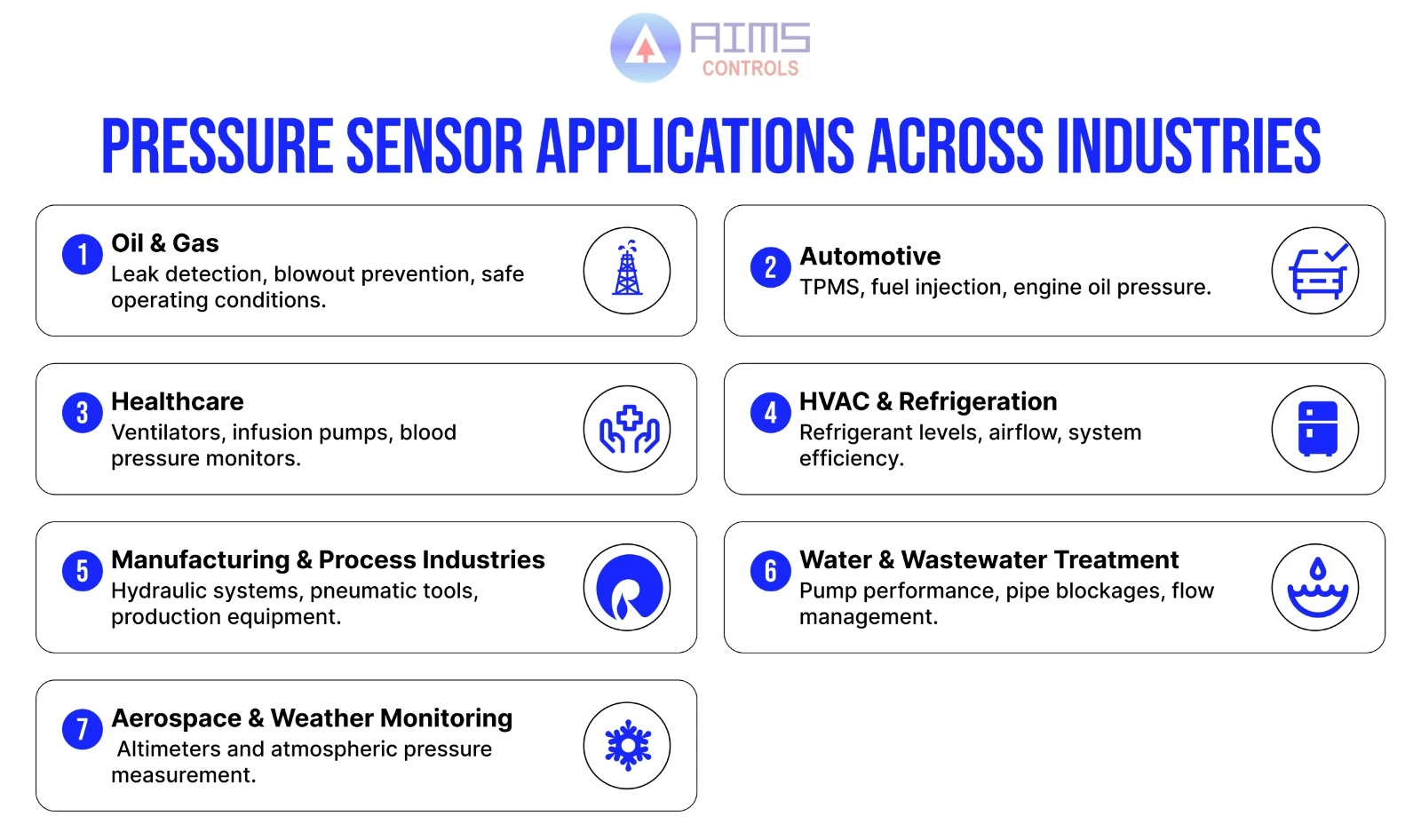
The reach of pressure sensor applications is honestly wider than most people expect. If a process involves gas, liquid, or air, there’s a good chance a pressure sensor is involved somewhere in it.
Here’s a look at where they show up most often:
Oil and Gas
Pipelines and drilling equipment rely heavily on pressure monitoring to detect leaks, prevent blowouts, and maintain safe operating conditions.
Automotive
From tire pressure monitoring systems (TPMS) to fuel injection and engine oil pressure, modern vehicles use multiple sensors just to keep things running smoothly and safely.
Healthcare
Ventilators, infusion pumps, and blood pressure monitors all depend on precise pressure readings where even small errors can have serious consequences.
HVAC and Refrigeration
Pressure sensors help regulate refrigerant levels and airflow, keeping systems efficient and preventing costly equipment damage.
Manufacturing and Process Industries
Factories use pressure sensors to monitor hydraulic systems, pneumatic tools, and production line equipment, helping avoid downtime and safety incidents.
Water and Wastewater Treatment
Pressure sensors are used to monitor pump performance, detect pipe blockages, and manage flow across treatment facilities.
Aerospace and Weather Monitoring
Altimeters and weather stations use absolute pressure sensors to measure atmospheric conditions with high precision.
It’s genuinely hard to find an industry today that doesn’t use pressure sensing in some form, which says a lot about how essential this technology has become.
Pressure Sensor Uses in Everyday Life
Beyond heavy industry, pressure sensor uses have quietly worked their way into daily life too:
- Smartphones use them for altitude tracking and step-counting accuracy.
- Coffee machines use them to regulate brewing pressure.
- Washing machines use them to detect water levels.
- Drones use them to maintain stable altitude.
- Home security systems sometimes use pressure-sensitive mats or switches.
It’s a good reminder that this isn’t some niche industrial component; it’s technology most of us interact with multiple times a day without realizing it.
Pressure Sensor Technology: What’s Changing
Pressure sensor technology has come a long way from bulky mechanical gauges. Today’s sensors are smaller, smarter, and increasingly connected.
Some notable shifts happening in the space:
- Miniaturization: MEMS (Micro-Electro-Mechanical Systems) sensors have made it possible to fit high-accuracy pressure sensing into tiny devices like smartphones and wearables.
- Wireless connectivity: Many industrial sensors now transmit data wirelessly, feeding directly into monitoring dashboards and predictive maintenance systems.
- IoT integration: Pressure sensors are increasingly part of larger IoT ecosystems, allowing real-time remote monitoring across entire facilities.
- Improved durability: Newer materials and coatings allow sensors to withstand extreme temperatures, corrosive chemicals, and high-vibration environments.
For industries dealing with demanding conditions oil and gas, petrochemical, or steel and power, for example durability and reliability aren’t optional extras. They’re the whole point. Reputable manufacturers such as AIMS Controls design pressure instruments specifically tested against national and international standards to handle exactly these kinds of harsh operating environments.
How to Choose the Right Pressure Sensor
If you’re evaluating options for a specific project, a few practical questions can narrow things down quickly:
- What’s being measured? Gas, liquid, or steam each may call for a different design.
- What pressure range is expected? Sensors are typically rated for specific ranges, and overshooting that range can damage the device.
- What’s the operating environment? Extreme heat, moisture, or corrosive substances all affect material choice.
- What accuracy level is required? Medical and aerospace applications, for instance, demand tighter tolerances than general industrial use.
- Is it a one-time reading or continuous monitoring? This affects whether you need a simple gauge or a transmitter with data output.
Getting this right upfront saves a lot of headaches and money down the line.
Frequently Asked Questions
What is a pressure sensor used for?
It’s used to measure and monitor pressure in gases or liquids, converting that measurement into an electrical signal for monitoring or control systems.
What does a pressure sensor do in a car?
It monitors tire pressure, oil pressure, and fuel system pressure to ensure safe and efficient vehicle operation.
What are the main types of pressure sensors?
Common types include piezoresistive, capacitive, piezoelectric, strain gauge, and optical sensors, plus absolute, gauge, and differential variants.
How does a pressure sensor work in simple terms?
Pressure deforms a sensing element slightly, and that tiny deformation is converted into a measurable electrical signal.
Is a pressure sensor the same as a pressure gauge?
Not exactly; a gauge typically gives a visual reading, while a sensor converts pressure into an electronic signal for systems.
What industries use pressure sensors the most?
Oil and gas, automotive, healthcare, HVAC, manufacturing, and water treatment are among the heaviest users.
Can pressure sensors measure vacuum?
Yes, absolute pressure sensors are specifically designed to measure pressure relative to a perfect vacuum.
How accurate are modern pressure sensors?
Accuracy varies by type and application, but many industrial sensors achieve accuracy within 0.1% to 1% of full scale.
Do pressure sensors need calibration?
Yes, periodic calibration is recommended to maintain accuracy, especially in critical industrial or medical applications.
What’s the difference between a sensor and a transmitter?
A sensor detects pressure; a transmitter processes and sends that data over longer distances, often with signal conditioning.
The Bottom Line
Pressure sensors might not be the flashiest piece of technology out there, but they’re doing important, often invisible work keeping engines running safely, medical devices accurate, and industrial processes stable.
Understanding the basics what they are, how they work, and which type fits which job puts you in a much better position, whether you’re troubleshooting a system, specifying equipment for a new project, or simply satisfying curiosity about the tech behind everyday devices.
If you’re at the stage of actually selecting a pressure sensor for a real-world application, it’s worth talking to people who deal with this daily. Instrumentation specialists can help match the right sensor type to your specific process conditions, saving you from costly trial and error.