Pressure measurement plays a critical role in industries such as oil and gas, power generation, pharmaceuticals, and manufacturing. Even a small error in a pressure reading can affect product quality, safety, or process efficiency. This is why routine calibration of pressure instruments is so important.
One of the most trusted tools for this job is the deadweight tester. It has been used for decades as a primary reference standard because it generates pressure directly from known physical weights rather than relying on another instrument’s reading. This article explains what a deadweight tester is, how it works, how it is used to calibrate pressure gauges, and where it is applied in industry.
What Is a Deadweight Tester?
A deadweight tester is a calibration device that generates a precise, known pressure by applying calibrated weights on a piston of a known area. Because the pressure it produces comes directly from mass, gravity, and area all quantities that can be measured very accurately it is considered a primary standard for pressure calibration.
Technicians use it to check whether a pressure gauge or transmitter is reading correctly. If the gauge under test shows a different value than the pressure generated by the tester, the difference tells you how much error the gauge has.
How Does a Deadweight Tester Work?
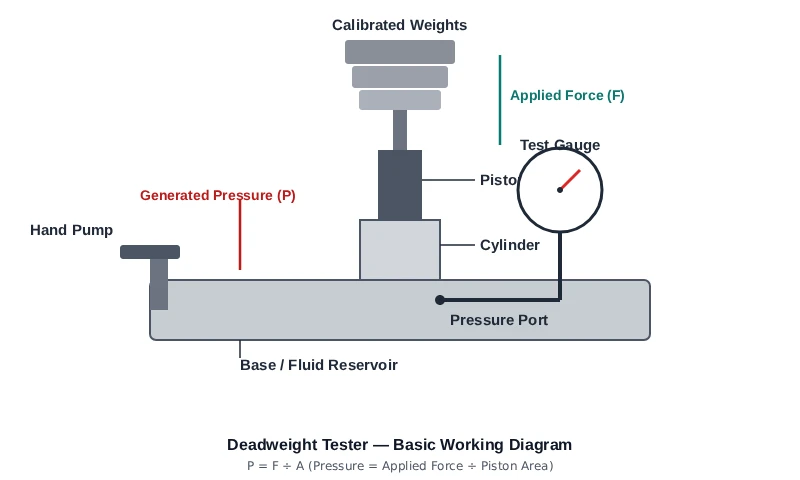
At its core, a deadweight tester works on a simple idea: a known force acting on a known area produces a known pressure. The instrument has a piston that fits closely inside a cylinder. Fluid, usually oil for high pressures or air for lower pressures, fills the cylinder and connects to the gauge being tested.
When calibrated weights are placed on top of the piston, they push down on the fluid. This creates pressure inside the system. A hand pump or screw press is used to raise the piston slightly until it “floats” freely, meaning it is fully supported by the fluid pressure rather than resting on the cylinder wall. At that point, the pressure in the system exactly matches the pressure calculated from the applied weight and piston area.
Deadweight Tester Working Principle
The relationship between force, area, and pressure is expressed with a simple formula:
Pressure = Force ÷ Area
The “force” comes from the mass of the weights multiplied by gravity, and the “area” is the effective cross-sectional area of the piston. Because both of these values are known with high accuracy, the pressure generated is equally accurate. This is what makes the deadweight tester’s working principle so reliable compared to instruments that depend on electronic sensors or springs, which can drift over time.
Deadweight Tester Diagram
The diagram below shows the main parts of a basic deadweight tester: the calibrated weights, piston, cylinder, hand pump, fluid reservoir, pressure port, and the test gauge connected to the system. As weights are added and the piston floats, the generated pressure travels through the pressure port to the gauge under test.
Calibration of Pressure Gauge Using Deadweight Tester
Calibration of a pressure gauge using a dead weight tester involves comparing the gauge’s reading against the known pressure produced by the tester at several points across its range. This process confirms whether the gauge is accurate or needs adjustment.
Steps for Pressure Gauge Calibration
- Inspect the deadweight tester and the gauge for damage, leaks, or contamination before starting.
- Connect the gauge securely to the pressure port using the correct fitting.
- Level the instrument and ensure the piston moves freely without friction.
- Add calibrated weights to generate a known pressure and let the piston float.
- Record the gauge reading once the pressure has stabilised.
- Repeat the process at multiple points across the gauge’s range, both increasing and decreasing.
- Compare each recorded reading with the known applied pressure and calculate the deviation, or error.
This step-by-step approach ensures the gauge is checked across its full working range, not just at a single pressure value.
Dead Weight Tester for Pressure Gauge Calibration
A dead weight tester for pressure gauge calibration is preferred in calibration laboratories because it doesn’t rely on another gauge or transducer as its reference. Since the pressure is derived directly from physical mass and area, there is very little chance of drift, making it an excellent traceable standard.
This is particularly useful for calibration labs that need to issue accredited certificates, since the tester’s accuracy can be traced back to national or international mass and dimensional standards. Field technicians also use portable deadweight testers to verify pressure gauges directly at the installation site.
What Is DWT on a Scale?
The abbreviation “DWT” can be confusing because it is used in more than one context. On a weighing scale or in shipping and cargo documentation, DWT usually stands for “deadweight tonnage,” which refers to the total weight a ship can safely carry, including cargo, fuel, and crew. This is unrelated to pressure calibration.
In the context of this article, “deadweight tester” refers specifically to the pressure calibration instrument, not a weighing or shipping term. It’s worth keeping this distinction in mind, since the same abbreviation appears across very different industries.
Types of Deadweight Testers
Deadweight testers are generally grouped by the fluid medium they use:
- Hydraulic deadweight testers use oil as the working fluid and are suited for medium to high pressure ranges.
- Pneumatic deadweight testers use air or nitrogen and are typically used for lower pressure ranges where oil contamination must be avoided.
Some models are built as bench-top laboratory units, while others are compact and portable for on-site calibration work. The right configuration depends on the pressure range and the environment where calibration will take place.
Dead Weight Tester Applications
Deadweight testers are used wherever accurate pressure verification is required. Common applications include:
- Calibrating analog and digital pressure gauges
- Verifying the accuracy of pressure transmitters
- Testing pressure switches for correct set points
- Supporting calibration labs that need traceable pressure standards
- Checking instrumentation in oil and gas, power, chemical, and manufacturing plants
Because of their accuracy and reliability, they remain a preferred choice wherever pressure measurement directly affects safety or product quality.
Advantages of Using a Deadweight Tester
- High accuracy compared to many other calibration methods
- Generates pressure directly, without depending on another sensor
- Acts as a reliable, traceable reference standard
- Produces highly repeatable results over time
- Well suited for calibration laboratories and demanding industrial environments
Factors to Consider When Selecting a Deadweight Tester
Before choosing a deadweight tester, it helps to review a few practical factors:
- Pressure range needed for the instruments you calibrate
- Required accuracy class for your application or certification needs
- Working medium: oil for hydraulic units, air for pneumatic units
- Piston-cylinder configuration and its compatibility with your pressure range
- Compliance with relevant calibration standards
- Portability, if the tester will be used for field calibration
- Maintenance and recalibration requirements over the unit’s service life
Deadweight Tester vs Other Pressure Calibrators
Digital pressure calibrators are popular for their speed and ease of use, and they are well suited for routine field checks. However, they rely on internal sensors that can drift and need periodic calibration themselves against a primary standard.
A deadweight tester, by contrast, generates pressure directly from mass and area, making it inherently more stable over long periods. This is why deadweight testers are commonly used as the reference standard against which digital calibrators are themselves checked, while digital units are often more practical for quick, everyday fieldwork.
Key Considerations for Accurate Calibration
A few practical details can significantly affect calibration accuracy:
- Keep the piston, cylinder, and weights clean and free of dust or corrosion
- Ensure the instrument is properly levelled before starting
- Account for temperature, since fluid density and piston dimensions can shift slightly with heat
- Always use the correct, verified weights for the required pressure
- Allow the pressure to stabilise fully before recording any reading
- Handle weights and the piston-cylinder assembly carefully to avoid damage or wear
Following the deadweight tester working principle correctly, along with these precautions, helps ensure accurate, repeatable calibration results.
FAQs
1. What is a deadweight tester?
A deadweight tester is a calibration instrument that generates precise pressure using calibrated weights on a piston of known area.
2. How does a deadweight tester work?
It applies known weights on a piston inside a cylinder, generating pressure that matches the calculated force divided by area.
3. What is the deadweight tester working principle?
Pressure equals force divided by area; known weights and piston area together produce an accurately calculable, traceable reference pressure value.
4. How is a pressure gauge calibrated using a deadweight tester?
The gauge is connected, known pressures are applied using weights, and readings are compared across several points to find errors.
5. Why is a deadweight tester used for pressure gauge calibration?
It generates pressure directly from mass and area, avoiding drift found in electronic sensors, making it a dependable reference standard.
6. What is a dead weight tester used for?
It is used to calibrate pressure gauges, transmitters, and switches, ensuring accurate readings across industrial, laboratory, and field measurement applications.
7. What is DWT on a scale?
On scales or in shipping, DWT usually means deadweight tonnage, a ship’s carrying capacity, unrelated to pressure calibration instruments entirely.
8. What are the applications of a deadweight tester?
Applications include calibrating pressure gauges and transmitters, testing pressure switches, and supporting traceable standards in calibration laboratories and industrial plants.
9. What is the difference between a deadweight tester and a pressure calibrator?
A deadweight tester generates pressure directly from mass, while digital calibrators use sensors that require their own periodic calibration checks.
10. Why are deadweight testers used as pressure standards?
Their pressure output depends only on traceable mass and area measurements, giving stable, repeatable results suited for primary reference standards.
Getting Reliable Pressure Calibration in Your Facility
A deadweight tester provides a reliable reference for pressure gauge calibration, helping maintain accurate and traceable pressure measurements. Choosing the right tester depends on pressure range, accuracy requirements, operating conditions, and the type of instrument being calibrated. If you need guidance on pressure calibration equipment, you can contact AIMS Controls to discuss your application requirements.