A PT100 is a platinum resistance temperature detector used across process industries wherever accurate, repeatable temperature measurement matters. Unlike thermocouples, PT100 sensors work on a different principle: the electrical resistance of platinum changes predictably as temperature changes.
This predictability is why PT100 sensors are common in industrial temperature monitoring, from reactor vessels to HVAC ducts. This article explains the PT100 working principle, the main PT100 types, what affects PT100 sensor accuracy, how to check a PT100 sensor, and where PT100 sensors are typically applied.
What Is a PT100 RTD Sensor?
A PT100 RTD sensor is a resistance temperature detector built from platinum, designed to have a resistance of exactly 100 ohms at 0°C. The “PT” refers to platinum, and the “100” refers to this nominal resistance value at the reference temperature.
Platinum is used because it offers a stable, predictable resistance-temperature relationship over a wide operating range, along with good resistance to oxidation and chemical degradation. This stability makes a PT100 far more drift-resistant over its working life compared to many other temperature-sensing technologies.
As temperature rises, the resistance of the platinum element increases in a well-defined, near-linear manner. This behavior is what allows a PT100 resistance temperature detector to be used for precise measurement, since the resistance-temperature relationship can be calculated and standardized rather than approximated.
Because of this reliability, RTD sensors built around the PT100 element are widely specified wherever consistent, drift-free temperature readings are critical.
PT100 Working Principle
The PT100 working principle is based on a simple physical fact: the electrical resistance of platinum changes in a predictable way as temperature changes. This relationship is how the PT100 converts a physical temperature into a usable electrical measurement.
When the PT100 element is exposed to a process temperature, the platinum wire or film absorbs that heat and its resistance shifts accordingly. A measuring instrument, whether a transmitter, indicator, or PLC input module, passes a small, controlled current through the PT100 and measures the resulting voltage drop to calculate resistance.
Once the resistance value is known, the electronics convert it into a temperature reading using a standardized resistance-temperature curve. This conversion is what allows a PT100 sensor to output a usable, calibrated temperature value rather than just a raw resistance number.
This sequence- heat affecting the platinum element, resistance changing in response, that resistance being measured, and electronics converting it into temperature- is the core of the PT100 working principle, and it is consistent across nearly all PT100 sensor designs.
Why Does PT100 Resistance Change With Temperature?
Platinum has a well-defined temperature coefficient of resistance, meaning its resistance rises in a consistent, repeatable manner as temperature increases. This behavior is a physical property of the metal itself rather than something built into the sensor electronics, which is why platinum was chosen as the standard material for precision RTDs in the first place.
PT100 Resistance-Temperature Relationship
The relationship between resistance and temperature in a PT100 sensor is described mathematically by the Callendar-Van Dusen equation, which defines how resistance changes across the sensor’s rated temperature range. Without going too deep into the mathematics, the practical takeaway is that this relationship is standardized, allowing PT100 sensors from different manufacturers to behave consistently when built to the same specification.
PT100 Types and Configurations
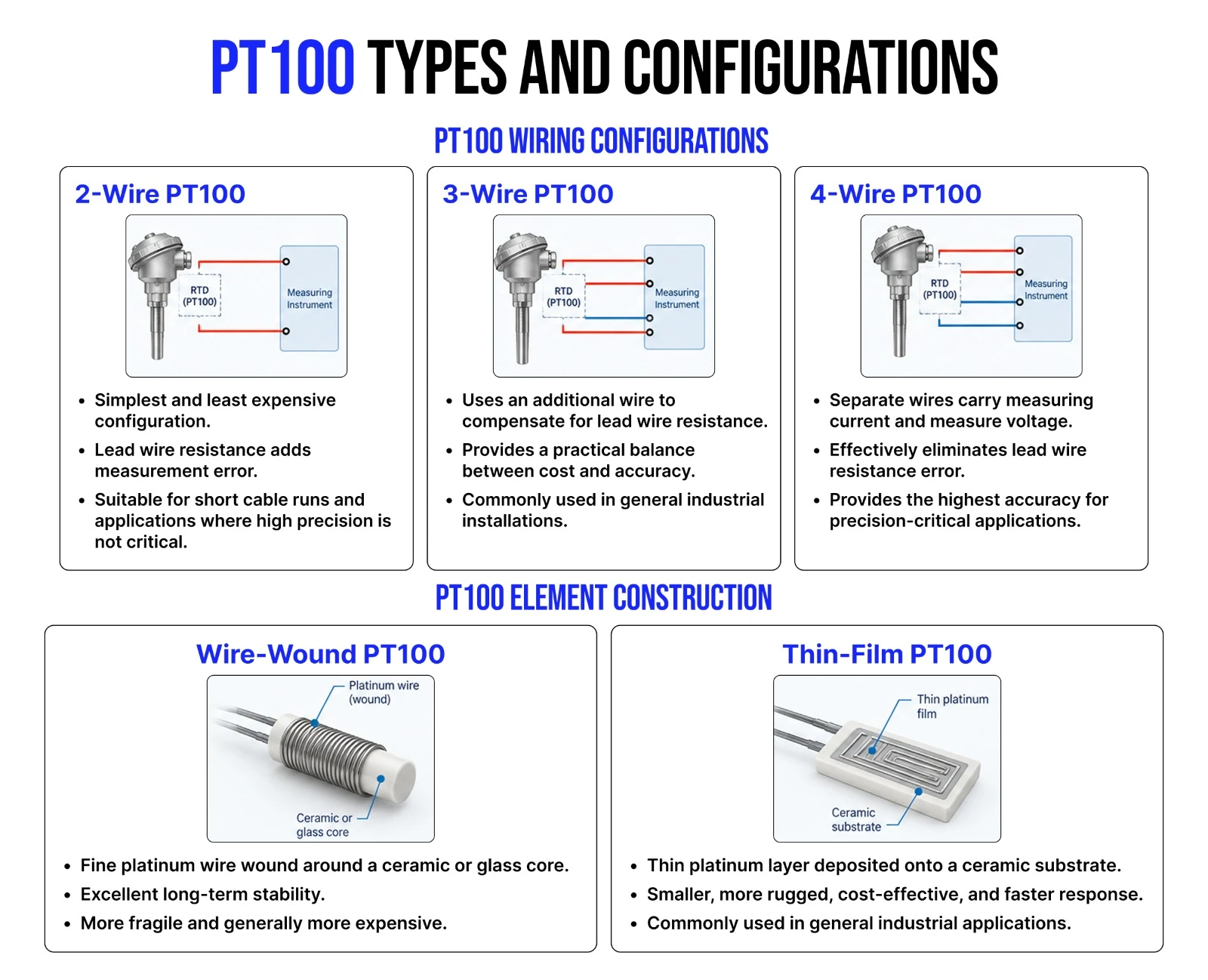
PT100 types differ mainly in two ways: how the PT100 element is wired back to the instrument, and how it is physically constructed. Understanding both is essential for choosing the right PT100 sensor for a given installation.
2-Wire PT100
A 2-wire PT100 uses only two lead wires connecting the sensing element to the instrument. This is the simplest, least expensive PT100 configuration, but lead wire resistance adds directly to the measured resistance, introducing error that grows with longer cable runs. 2-wire PT100 sensors suit mainly short cable lengths or applications where high precision is not critical.
3-Wire PT100
A 3-wire PT100 adds a third lead wire that lets the instrument compensate for lead wire resistance, significantly reducing the error introduced by cable length. This PT100 configuration strikes a practical balance between cost and accuracy, making it the most widely used PT100 configuration in general industrial installations.
4-Wire PT100
A 4-wire PT100 uses two wires to carry the measuring current and two separate wires to measure voltage across the element, effectively eliminating lead wire resistance from the measurement entirely. This PT100 configuration delivers the highest accuracy of the three and is typically reserved for laboratory work, calibration standards, or industrial applications where measurement precision is critical.
Wire-Wound vs Thin-Film PT100
Wire-wound PT100 elements are made by winding a fine platinum wire around a ceramic or glass core, offering excellent long-term stability, though they are generally more fragile and costlier to produce. Thin-film PT100 elements are made by depositing a thin layer of platinum onto a ceramic substrate, resulting in a smaller, more rugged, and more cost-effective sensor with a faster response time, sometimes with slightly less long-term stability. Thin-film construction is now the more common choice in general industrial use, while wire-wound elements remain preferred where the highest stability is required.
PT100 Sensor Accuracy: What Affects It?
Pt100 Sensor Accuracy is not determined by the sensing element alone. PT100 accuracy depends on a combination of factors including tolerance class, wiring configuration, installation quality, calibration status, and the measuring electronics processing the signal.
PT100 Accuracy Classes
PT100 sensors are typically manufactured to defined tolerance classes, commonly PT100 Class A and PT100 Class B, specifying the maximum allowable deviation from the standard resistance-temperature curve at a given temperature. Class A offers tighter tolerance for higher precision needs, while Class B is more economical and suited to general-purpose monitoring. Selecting the correct accuracy class is one of the most important decisions when specifying a PT100 sensor.
Effect of Lead Wire Resistance
As covered earlier, 2-wire PT100 configurations are most vulnerable to lead wire resistance errors, since resistance in the connecting cable is read as part of the PT100 measurement itself, and longer cable runs make this worse. 3-wire and 4-wire PT100 configurations were developed specifically to compensate for or eliminate this source of error.
Calibration and Installation Factors
Even a high-quality PT100 sensor will produce inaccurate readings if poorly installed or improperly calibrated. Insufficient thermal contact, incorrect insertion depth, and exposure to conditions outside the PT100’s rated environment can all introduce error. Periodic calibration against a known reference standard confirms that a PT100 sensor continues performing within its specified accuracy class over time.
How to Check PT100 Sensor
Knowing how to check a PT100 sensor is a useful skill for maintenance teams troubleshooting a suspected temperature measurement fault. A basic resistance test can confirm whether a sensor is functioning, but it should not be treated as a substitute for proper calibration against a certified reference.
How to Check PT100 Resistance With a Multimeter
Start by safely disconnecting the PT100 sensor from its transmitter or control loop to avoid interference from live circuitry. Identify the correct terminals based on the wiring configuration two, three, or four wires and set a multimeter to resistance mode across the sensing element terminals.
Compare the measured resistance against the expected value for the known ambient or process temperature, using a standard PT100 resistance-temperature table as reference. A reading close to 100 ohms at 0°C, or the corresponding value at room temperature, generally indicates a functioning sensor. Significant deviation, instability, or no continuity typically points to a sensor problem.
When a PT100 Sensor May Need Replacement
Signs that a PT100 sensor may need replacement include an open circuit reading, indicating a broken element or lead wire; a short circuit reading near zero ohms; unstable or fluctuating resistance values; resistance that does not correspond to any reasonable temperature; or a sensor that consistently drifts out of its expected calibration tolerance despite proper installation.
PT100 Applications in Industrial Temperature Measurement
PT100 application areas span nearly every industry where accurate, stable temperature measurement directly affects process quality, safety, or efficiency.
Process Manufacturing & Chemical Industries
In process manufacturing and chemical plants, PT100 sensors monitor reactor, vessel, and pipeline temperatures, providing the accuracy needed to keep temperature-sensitive reactions within safe limits.
Oil & Gas & Petrochemical
Oil, gas, and petrochemical facilities rely on PT100 sensors to monitor process equipment temperature, supporting both operational efficiency and safety compliance.
Pharmaceutical & Food Processing
Pharmaceutical and food processing operations depend on stable, accurate temperature measurement to maintain product quality, making PT100 sensors a natural fit for these controlled environments.
Power, HVAC & Utilities
Power generation, HVAC systems, and utility processes use PT100 sensors for boiler monitoring, equipment tracking, and general thermal management across a facility.
Industrial Automation & Control
In automated environments, PT100 sensor readings are commonly paired with temperature transmitters that convert the resistance signal into a standardized output for PLC or DCS systems.
Robust field installation also matters for sensor longevity. An RTD with a protective tube design shields the sensing element from mechanical stress, corrosive media, or high-velocity flow, helping the PT100 sensor maintain accuracy over its operating life.
PT100 vs PT1000: What Is the Difference?
The main difference between PT100 and PT1000 is nominal resistance at 0°C: 100 ohms for the PT100 versus 1000 ohms for the PT1000. The higher base resistance of PT1000 makes it inherently less sensitive to lead wire resistance errors, which can suit 2-wire installations over longer cable runs.
Despite this, PT100 remains the more widely used standard in industrial process instrumentation, thanks to its established track record and broad compatibility with existing transmitters and control systems. PT1000 is more common in building automation and HVAC, where longer wiring runs are typical and slightly lower precision is acceptable.
How to Choose the Right PT100 Sensor
Selecting the right PT100 sensor starts with defining the required accuracy class, Class A for tighter tolerance or Class B for general-purpose monitoring. Next, confirm the PT100’s rated temperature range comfortably covers actual process conditions, including expected excursions.
Choose the wiring configuration based on cable length and required precision: 2-wire for short, low-precision runs, 3-wire for standard industrial use, or 4-wire where maximum accuracy is essential. Construction type matters too, with wire-wound elements favored for stability and thin-film elements favored for durability, size, and response time.
Sheath material and process connection must be compatible with the process medium, particularly in corrosive or high-pressure environments. Consider an RTD assembly with adjustable connector where insertion depth needs to be field-adjustable.
Frequently Asked Questions About PT100 Sensors
1. What is a PT100 RTD sensor?
A PT100 RTD sensor is a platinum resistance temperature detector with 100 ohms nominal resistance at 0°C, used for accurate temperature measurement.
2. How does a PT100 sensor work?
It works by measuring the change in platinum resistance as temperature changes, then converting that resistance into a temperature value.
3. What is the PT100 working principle?
Temperature affects the resistance of the platinum element, which is measured electrically and converted into a calibrated temperature reading.
4. What is the resistance of a PT100 at 0°C?
A PT100 sensor has a nominal resistance of exactly 100 ohms at 0°C, which is the reference point for its naming.
5. What are the different PT100 types?
PT100 sensors come in 2-wire, 3-wire, and 4-wire configurations, and in wire-wound or thin-film construction styles.
6. How accurate is a PT100 sensor?
Accuracy depends on the sensor’s tolerance class, wiring configuration, installation quality, and calibration status over time.
7. How do you check a PT100 sensor?
Disconnect the PT100 sensor, measure resistance with a multimeter, and compare it against expected values at a known temperature.
8. What are the common PT100 applications?
PT100 sensors are used in process manufacturing, oil and gas, pharmaceuticals, food processing, power, and HVAC systems.
9. What is the difference between PT100 and PT1000?
PT1000 has ten times the nominal resistance of PT100, making it less sensitive to lead wire resistance errors.
10. Is a 3-wire or 4-wire PT100 more accurate?
A 4-wire PT100 is more accurate because it eliminates lead wire resistance, unlike the partial compensation in 3-wire designs.
Choosing PT100 for Reliable Temperature Measurement
Getting reliable results from a PT100 sensor comes down to a handful of deliberate choices: the right accuracy class, an appropriate wiring configuration for the cable length involved, suitable construction for the operating environment, and correct installation practices. Skipping any one of these steps tends to show up later as drift, instability, or readings that no longer match reality.
If you are selecting a PT100 sensor for an industrial application, make sure the sensor configuration matches the actual process conditions, not just the required temperature range.
AIMS Controls offers PT100 RTD solutions in different configurations for industrial temperature measurement. The right selection can depend on factors such as accuracy class, wiring configuration, temperature range, installation conditions, and the surrounding environment.
- Explore available PT100 RTD solutions
- Compare PT100 configurations for different applications
- Get expert guidance for the right sensor selection
Taking a little time to review these factors before installation can help reduce measurement errors, unnecessary recalibration, and temperature-related process issues.