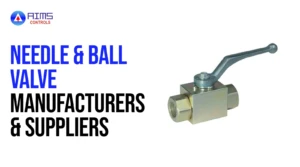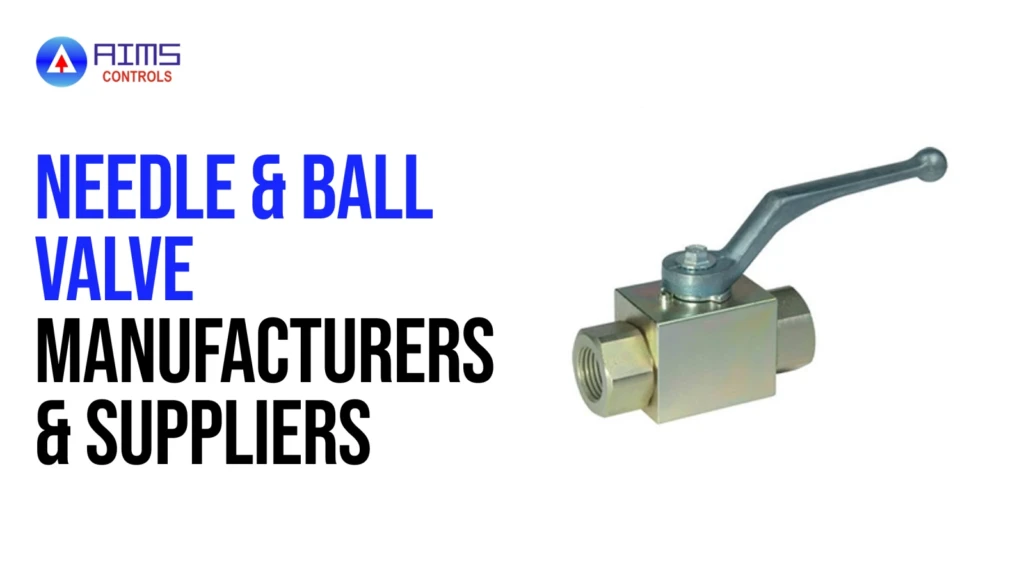
Selecting industrial needle and ball valves requires attention to application needs, specifications, and supplier capabilities. Buyers need to look closely at construction quality, material grades, pressure and temperature ratings, connection types, inspection practices, and whether the source can supply orders consistently after order. A manufacturer that gets these details right reduces the risk of rework, delays, or field failures. This article looks at needle valve manufacturers and ball valve manufacturers separately, since the two product types raise different manufacturing and procurement questions, and outlines what engineers and purchasing teams should evaluate before placing an order.
Needle Valve Manufacturers: What Manufacturing Quality Means
A needle valve’s performance depends almost entirely on how precisely it is built. The tapered needle and matching seat must be machined to close tolerances, because even small deviations affect shut-off accuracy and fine flow control. Stem threading also matters: a poorly finished stem can introduce play that makes fine adjustment unreliable over repeated cycles.
Body material and how it is machined and finished affect resistance to the process fluid and pressure conditions the valve will see. Sealing components need to match the media and temperature range, and packing or gland assembly has to be done under controlled conditions to avoid leak paths. Connection ends must be machined to the correct thread or fitting standard so the valve installs without adaptation. A needle valve manufacturer that controls each of these steps rather than assembling from inconsistent parts is what actually determines whether the valve performs as specified once it’s in service.
Key Specifications to Share With a Needle Valve Manufacturer
Getting an accurate quotation and the right product depends on how much technical detail a buyer provides upfront. The table below covers what a needle valve manufacturer typically needs.
| Specification | Why It Matters |
| Valve size | Determines body dimensions and orifice sizing |
| Operating pressure | Sets the pressure class the valve must be rated for |
| Operating temperature | Affects material and seal/packing selection |
| Fluid/media type | Determines material and sealing compatibility |
| Material compatibility | Ensures the wetted parts resist the process fluid |
| Connection type | Confirms thread standard or fitting type required |
| Flow requirement | Helps size the orifice and stem taper correctly |
| Quantity | Affects production planning and lead time |
Sharing these details at the enquiry stage, instead of after a sample order, generally shortens the quotation cycle and reduces the chance of receiving a valve that needs to be re-specified.
Ball Valve Manufacturers: From Material Selection to Final Assembly
Ball valve manufacturing involves a different set of process steps than needle valves. The body, ball, and stem are typically produced from bar stock or forgings and machined to the required pressure class. Ball surface finish directly affects sealing performance; a poorly finished or improperly hardened ball wears the seat faster and increases the chance of leakage over time.
Seat and seal material selection depends on the media and temperature the valve will handle; PTFE, reinforced PTFE, and metal seats each behave differently under pressure and thermal cycling, and the manufacturer needs to match this to the application rather than defaulting to a single seat type. End connections threaded, flanged, or welded are machined or fitted at this stage, and the valve is then assembled and torqued to the correct specification before inspection. Because ball valves are frequently ordered in larger batches for projects, consistency between individual units across the same order is as important as the quality of any single valve.
How Ball Valve Requirements Change by Project
The right ball valve specification shifts depending on the project. A few common scenarios:
- A chemical processing line handling corrosive media may need a body material upgrade and a seat material rated for chemical resistance, even if the pressure and size requirements are otherwise standard.
- A high-pressure gas application may require a higher pressure class and a metal-seated design instead of a soft-seated one, since soft seats can extrude or degrade at elevated pressure and temperature.
- A retrofit project matching existing piping may need a specific face-to-face dimension or connection type to avoid re-piping, which limits which manufacturers can supply a compatible product.
- A project requiring remote operation may need the valve body prepared for actuator mounting, which affects stem design and mounting pad dimensions.
Because these variables change from project to project, a ball valve manufacturer needs to be able to work from actual project conditions rather than a single generic specification sheet.
Manufacturer vs Trader: What Should Industrial Buyers Verify?
Buyers sourcing valves often have a choice between ordering directly from a manufacturer and buying through a trader or supplier that resells another company’s product. Neither route is automatically better; the right choice depends on what the buyer needs to verify.
Buying directly from a manufacturer generally gives clearer visibility into how the product is made, more direct answers to technical questions, and a better chance of getting customization assessed accurately, since the same organization that builds the valve is the one responding to the enquiry. A trader or supplier can still be a reasonable source, particularly for standard products or when logistics and stock availability matter more than direct technical access, but the depth of technical information and traceability may depend on what the trader can obtain from the manufacturer they represent.
What buyers should verify either way includes: whether technical questions are answered with specific, verifiable detail; whether documentation and material traceability can be provided; whether the source can support repeat orders with consistent specifications; and whether communication happens directly with people who understand the manufacturing process, not just the sales catalogue.
How to Compare Needle Valve Manufacturers Before Placing an Order
| Comparison Point | What to Check |
| Product specifications | Do published specs match the pressure, size, and connection needed? |
| Material options | Are the required body and seal materials actually available? |
| Manufacturing capability | Is production done in-house or outsourced for key components? |
| Testing practices | What testing is performed before dispatch? |
| Documentation | Can datasheets and test records be provided on request? |
| Customization | Can non-standard dimensions or connections be assessed? |
| Production capacity | Can the manufacturer handle the required quantity and timeline? |
| Technical response | How specific and fast are answers to technical queries? |
Working through these points before placing an order avoids surprises after the valve has already been produced and shipped.
How to Compare Ball Valve Manufacturers for Bulk or Project Orders
For bulk or project orders, the comparison shifts toward consistency rather than a single product’s specification sheet. Buyers should check whether the manufacturer can hold dimensional and material consistency across an entire batch, not just a sample unit. Material availability matters too: a manufacturer that has to source an unusual seat or body material for a large order may face longer lead times than one that stocks it as standard.
Testing and documentation should be confirmed at the batch level: are test records issued per batch or per unit, and can they be tied back to material certificates? Delivery planning is also a differentiator on larger orders: whether the manufacturer can commit to phased deliveries if the project schedule requires it. Finally, for buyers with recurring project needs, it’s worth confirming whether the manufacturer can maintain the same specification on repeat orders placed months or years apart, since drawing revisions or material substitutions between orders can create compatibility issues on-site.
What Quality Checks Matter Before Valve Dispatch?
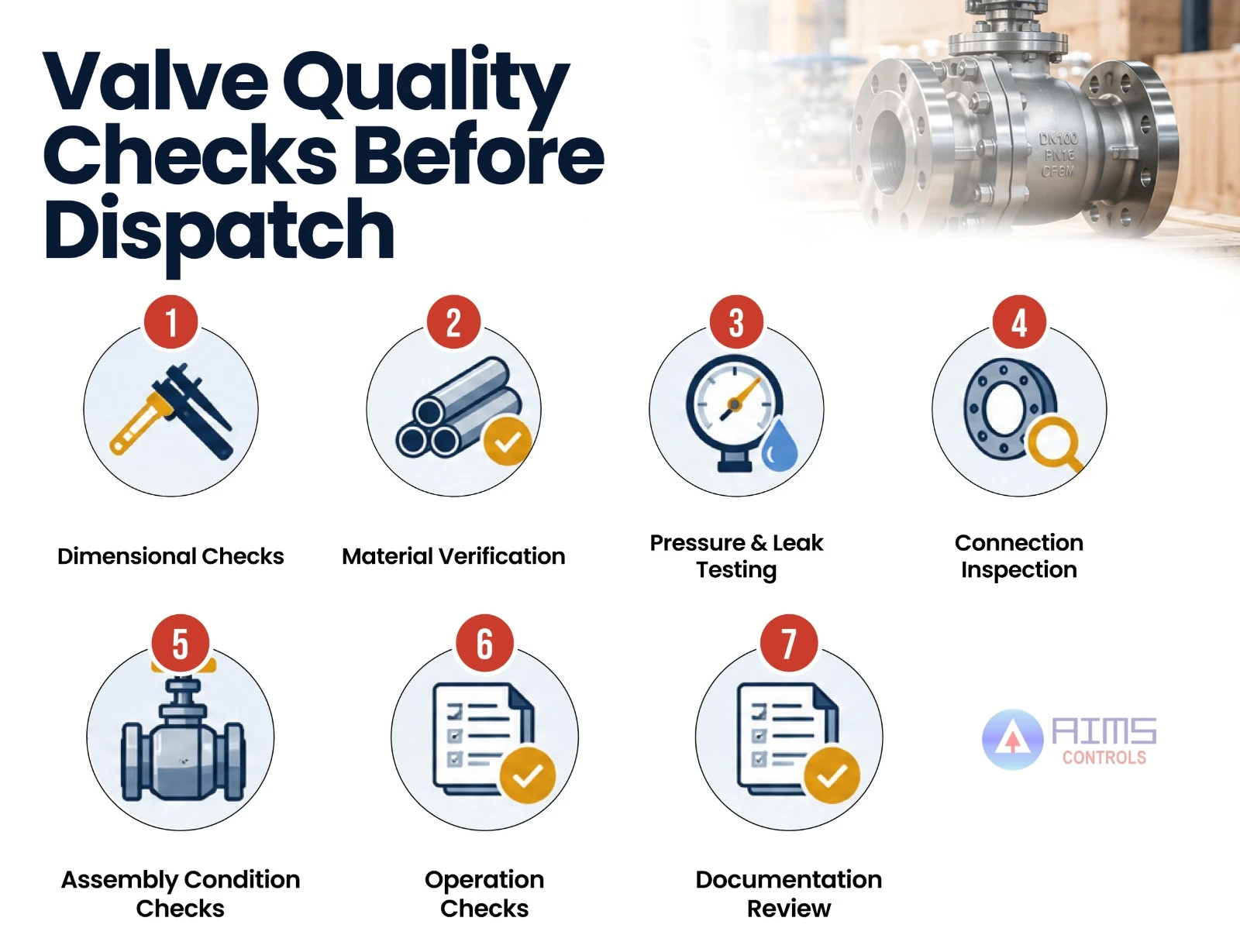
Not every check applies to every valve configuration, but the following are generally relevant before a valve manufacturer dispatches an order:
- Dimensional checks confirm the valve matches the ordered size and connection dimensions.
- Material verification, where applicable, confirms the body and wetted parts match the specified grade.
- Pressure and leak testing confirms the valve holds its rated pressure without leakage through the seat or body.
- Connection inspection checks thread or flange faces for damage or out-of-tolerance machining.
- Assembly condition checks confirm the valve is correctly torqued and free of assembly defects.
- Operation checks confirm the valve opens, closes, or throttles smoothly without excessive resistance.
- Documentation review confirms the paperwork accompanying the shipment matches the order.
Buyers working on regulated or critical service projects should confirm which of these checks are actually performed and documented, rather than assuming all apply by default.
Customization Requests Valve Manufacturers Should Be Able to Assess
Standard catalogue valves don’t always fit every application. Buyers may need to request a different body or seal material for compatibility with unusual media, non-standard dimensions to match existing piping, a different connection type, a higher pressure class than the standard range, or provisions for actuation. A capable manufacturer should be able to assess these requests against their existing manufacturing process and give a clear answer on feasibility, lead time, and cost impact rather than treating every request as either automatically possible or automatically rejected. Buyers should be cautious of manufacturers who claim unlimited customization without asking for the underlying application details first.
Documentation to Request From a Valve Manufacturer or Supplier
The exact documentation needed depends on the project and the industry it serves, but buyers commonly request:
- Product datasheets and technical specifications
- Material composition or grade information
- Test reports or certificates, where applicable to the order
- Dimensional drawings
- Inspection records
- Detailed quotation breakdowns covering specification, quantity, and delivery terms
Requesting this documentation at the enquiry stage, rather than after the order is placed, makes it easier to confirm the manufacturer can actually meet project requirements.
Why Choose AIMS Controls for Needle & Ball Valves
- Instrumentation background: AIMS Controls is the official trademark of PI Controls Instruments Pvt. Ltd., established in 2018, and draws on its founders’ 20+ years of experience in instrumentation manufacturing.
- Manufacturing facility: The company is based in Vapi, Gujarat, and operates a 3,500 sq. ft. manufacturing facility for process control and measuring instruments.
- Related instrument range: Valves and manifolds sit within a wider product range that covers pressure and temperature gauges and switches, temperature elements, level gauges, flow switches, and instrumentation fittings.
- Needle valve materials and checks: AIMS Controls lists stainless steel, brass, and alloy bodies for its needle valves and states that each needle valve goes through quality checks and testing.
- Ball valve configurations: Its published ball valve information covers 2-way valves as well as 3-way and multi-way assemblies, with manual lever or gear operation and pneumatic or electric actuator options.
- Industry exposure: Oil and gas, petrochemical, steel, cement, food and beverages, HVAC, and pharmaceuticals.
- Support beyond supply: Calibration and repair services for process instruments, engineering support from P&IDs to control schematics, and a free consultation for instrumentation requirements.
Getting a Valve Requirement Ready for Quotation
Before reaching out to a manufacturer, it helps to have this information ready:
- Valve type (needle or ball) and quantity
- Nominal size and end connection type
- Operating pressure and temperature range
- Fluid or media being handled
- Required body and sealing material
- Any customization needs (dimensions, actuation, special connections)
- Documentation required for the project
- Delivery location and timeline
High-Value Buyer Reference Table
| Information to Share | Why the Manufacturer Needs It |
| Valve type | Determines the appropriate product configuration |
| Nominal size | Helps determine dimensions and connection requirements |
| Operating pressure | Helps establish the required pressure specification |
| Operating temperature | Affects material and sealing considerations |
| Fluid/media | Helps assess material and sealing compatibility |
| End connection | Determines the required connection configuration |
| Body/component material | Ensures compatibility with the intended service |
| Quantity | Helps with quotation and production planning |
| Required documentation | Ensures project or procurement requirements are addressed |
| Delivery requirement | Helps establish supply and project timelines |
FAQs
What information should I give a needle valve manufacturer for a quotation?
Valve size, operating pressure and temperature, media type, material and connection requirements, flow needs, and quantity.
How do I compare different ball valve manufacturers?
Check batch consistency, material availability, testing and documentation practices, delivery planning, and their ability to support repeat orders with the same specification.
What should I verify before ordering industrial valves?
Technical response quality, documentation availability, manufacturing visibility, and whether the source can support the required quantity and timeline.
What documents can I request from a valve manufacturer?
Datasheets, material information, test reports where applicable, dimensional drawings, inspection records, and a detailed quotation.
Can needle and ball valve manufacturers provide customized configurations?
Many can assess requests for different materials, dimensions, connections, or actuation, though feasibility depends on the specific request and the manufacturer’s process capability.
What is the difference between a valve manufacturer and a valve supplier?
A manufacturer produces the valve directly, offering more technical visibility and traceability; a supplier or trader resells manufactured valves, which can still work well for standard products but may offer less direct technical access.
How can I select a valve supplier for repeat industrial requirements?
Confirm they can maintain consistent specifications, documentation, and lead times across multiple orders placed over time.
Needle & Ball Valve Manufacturer and Supplier for Industrial Requirements
Choosing between needle valve manufacturers and ball valve manufacturers comes down to a few practical questions: can the manufacturer understand your service conditions, make the valve to a consistent standard, test it before dispatch, and document what it supplies? Buyers who share complete requirements and verify these points early avoid most of the delays and site rejections that follow a rushed order. If your needle valve or ball valve requirement is ready, contact AIMS Controls with your specifications, quantity, and documentation needs to discuss a suitable configuration and quotation.