If you’ve ever stared at a pressure gauge and felt mildly confused, you’re not alone. Whether it’s on a compressor, a boiler, a hydraulic system, or a water line, pressure gauges can look intimidating if nobody ever walked you through them. The numbers, the colored zones, the units… It’s a lot to take in at once.
The good news? Reading a pressure gauge correctly is actually a straightforward skill once you understand a few basics. In this guide, we’ll walk you through everything from understanding pressure units and scale markings to identifying different gauge types, checking accuracy, and avoiding common reading mistakes. By the end, you’ll feel genuinely confident the next time you look at a dial.
What Is a Pressure Gauge and Why Does It Matter?
A pressure gauge is an instrument that measures the force exerted by a gas or liquid within a system. It tells you whether the pressure inside a pipe, tank, or vessel is where it should be and alerts you when something’s off.
Getting a correct pressure gauge reading isn’t just a technical formality. Pressure that’s too high can cause equipment damage, leaks, or even dangerous failures. Pressure that’s too low can mean poor system performance or signal a hidden fault somewhere upstream. Either way, knowing how to read a pressure gauge is a practical skill with real safety implications.
In industrial settings, especially in oil refineries, chemical plants, water treatment facilities, or manufacturing lines, operators check gauges dozens of times a day. The accuracy of those readings matters a great deal.
Understanding Pressure Units: PSI, Bar, kPa, and More
Before you can read a pressure gauge, you need to understand what unit it’s measuring in. Different industries and different parts of the world use different standards, and it’s not uncommon to see a gauge face with two sets of numbers printed on it.
PSI (Pounds Per Square Inch)
PSI is the most common unit in the United States and is widely used in industries like automotive, HVAC, and compressed air systems. When someone says, “Check the tire pressure, it should be 35,” they mean 35 PSI. If you’re learning how to read a PSI gauge for the first time, you’re essentially just reading the number the needle points to on a scale labeled in PSI.
Bar
Bar is the standard across much of Europe and in many industrial applications globally. One bar is approximately equal to atmospheric pressure at sea level, roughly 14.5 PSI. You’ll often see gauges with dual scales showing both bar and PSI.
kPa and MPa (Kilopascal / Megapascal)
These are SI units used frequently in engineering, scientific, and industrial contexts. 1 bar equals 100 kPa, and 1 MPa equals 10 bar. High-pressure systems like hydraulic presses or gas pipelines often express pressure in MPa.
Which Unit Does Your Gauge Use?
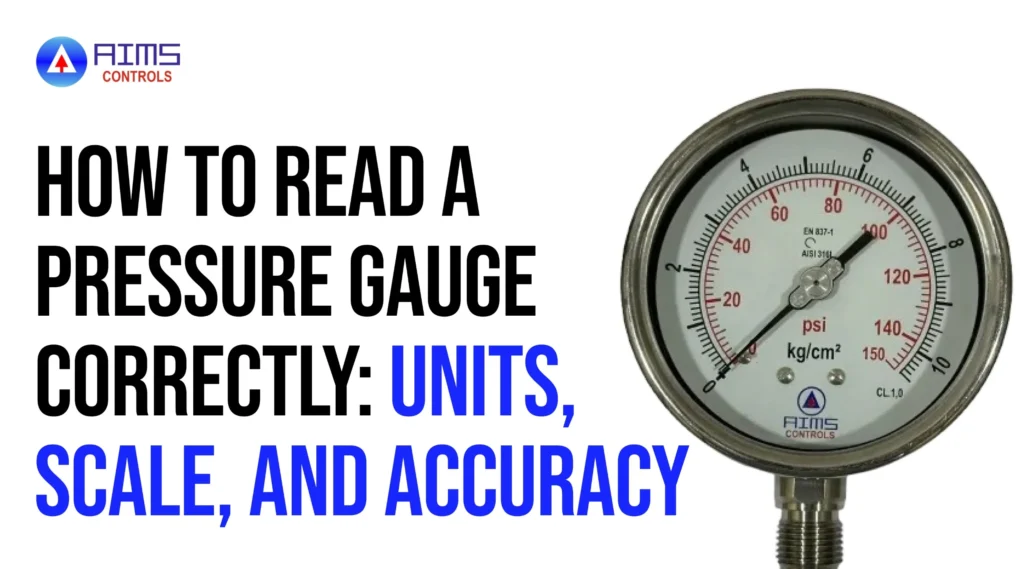
Look at the label printed around the outer rim of the dial face. It will typically show the unit abbreviation (psi, bar, kPa) and the full-scale value. If your gauge shows two rings of numbers, the outer ring is usually the primary unit, and the inner ring is the secondary.
How to Read Pressure Gauge Markings
Once you know your unit, the next step is understanding the physical dial itself. Most standard pressure gauges share a similar layout.
The Dial Face
The circular face of the gauge is divided into a scale usually from zero to some maximum value (called the full-scale range). The range is chosen based on the intended application. A gauge meant for a water supply line might go from 0 to 160 PSI, while a high-pressure hydraulic gauge might run from 0 to 5,000 PSI.
Tip: For most applications, the ideal working pressure should sit in the middle third of the gauge scale, roughly between 30% and 70% of the maximum. This is where the gauge reads most accurately and experiences the least wear.
Major and Minor Divisions
The scale is broken into major divisions (the larger, numbered tick marks) and minor divisions (the smaller ticks between them). To determine the value of each minor division:
- Identify the value between two consecutive major divisions
- Count the number of small intervals between them
- Divide: minor division value = major division range ÷ number of intervals
For example, if major divisions go from 0 to 20 to 40, and there are 4 small intervals between them, each minor tick represents 5 units.
Colored Zones
Many pressure gauges use colored arcs on the dial face, typically green, yellow, and red, to indicate safe operating zones at a glance:
- Green zone: Normal operating range
- Yellow zone: Caution approaching limits
- Red zone: Danger action needed immediately
These colored zones are especially common in gauges used in boiler systems, medical equipment, and fire suppression setups.
The Pointer/Needle
The needle rotates from zero (typically at the bottom-left or top-left of the scale) clockwise as pressure increases. Always read the pressure at the tip of the needle, not the base. View the gauge straight-on; looking at it from an angle introduces parallax error, where the reading appears different from what it actually is.
Types of Pressure Gauges and How to Read Each One
Not all pressure gauges work the same way, and different types have slightly different reading methods.
Bourdon Tube Gauge
This is the classic analog dial gauge you’ll see on air compressors, boilers, and water systems. The Bourdon tube, a curved metal tube inside the gauge, flexes as pressure increases, moving the needle. Reading it is as simple as noting where the needle points on the scale.
Digital Pressure Gauge
Digital gauges display the pressure as a numerical value on an LCD or LED screen. They’re easier to read at a glance and eliminate parallax error. Some models allow you to switch between units (PSI, bar, kPa) with the press of a button. Just make sure the unit displayed matches what you need.
Differential Pressure Gauge
These gauges measure the difference between two pressure points in a system, say, across a filter or heat exchanger. They have two inlet ports and display the pressure difference on a single dial. A reading near zero means the pressures are equal; a high reading means there’s a significant drop, often indicating a blockage or restriction.
Compound Gauge
A compound gauge reads both positive pressure (above atmospheric) and vacuum (below atmospheric) on the same dial. The scale runs from a negative value (vacuum) through zero to a positive maximum. These are common in refrigeration and HVAC systems.
Step-by-Step: How to Read a Pressure Gauge Reading
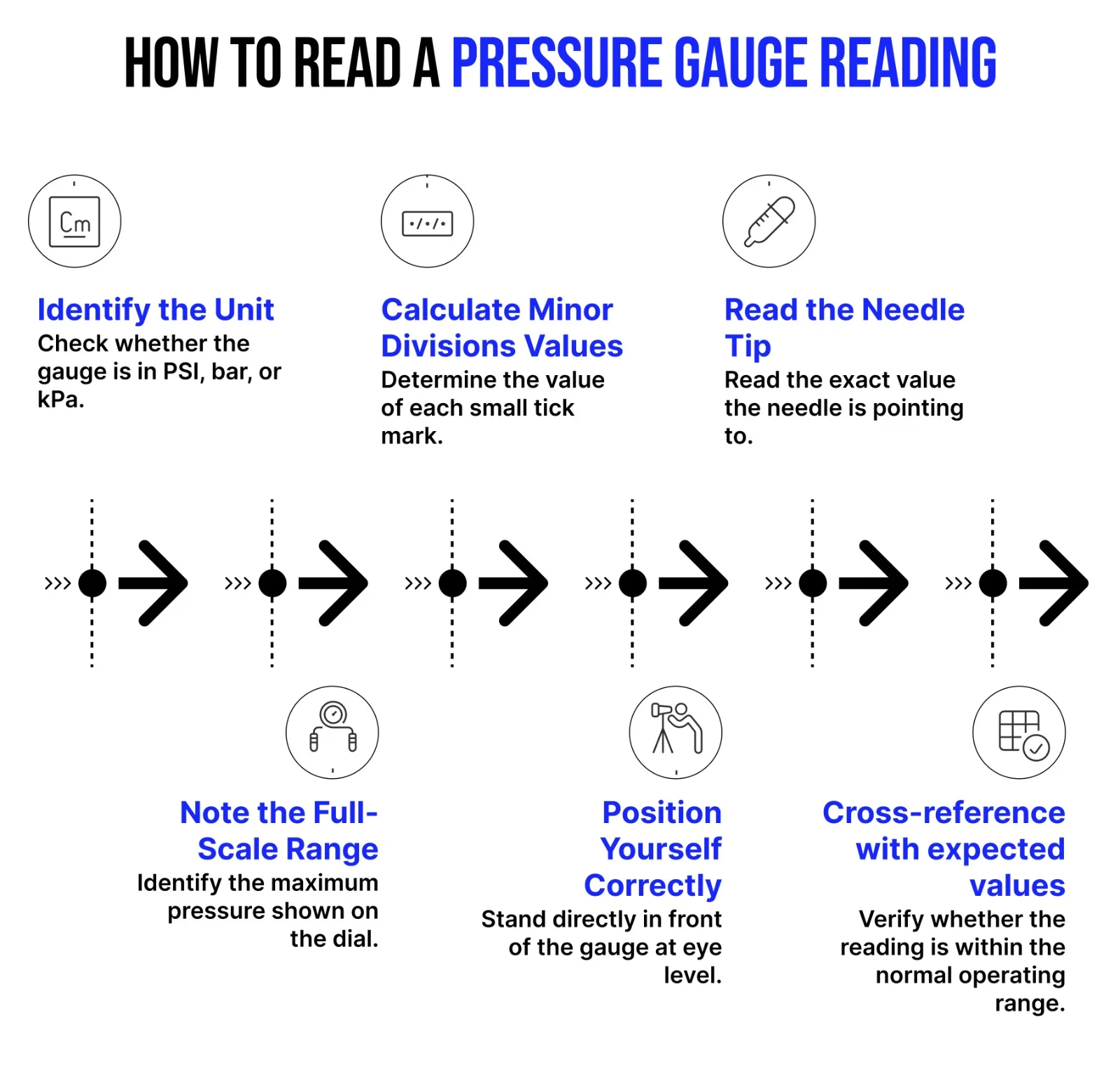
Here’s a simple, practical process to follow each time you read a pressure gauge:
Step 1: Identify the unit
Check the dial face label for PSI, bar, kPa, or another unit before doing anything else.
Step 2: Note the full-scale range
This tells you the maximum the gauge can measure and helps you understand the scale divisions.
Step 3: Calculate minor division values
Use the method described above so you know exactly what each small tick represents.
Step 4: Position yourself correctly
Stand directly in front of the gauge, at eye level, so you’re looking straight at the needle, not from above or below.
Step 5: Read the needle tip
Note the value that the very tip of the needle is pointing to. If it falls between two minor ticks, estimate the midpoint.
Step 6: Cross-reference with expected values
Compare your reading to the system’s normal operating range. If you’re outside that range, investigate before proceeding.
It sounds simple, and it is, once you’ve done it a few times. The important habit is always starting with Step 1. Assuming you know the units on an unfamiliar gauge is one of the most common mistakes in the field.
How to Check Pressure Gauge Accuracy
Even the best gauge drifts over time. Mechanical wear, vibration, temperature changes, and overpressure events can all affect calibration. Knowing how to check pressure gauge accuracy is just as important as knowing how to read it.
Zero Check
The most basic check: when the gauge is disconnected from any pressure source, the needle should rest at zero. If it reads slightly above or below zero, the gauge has a zero error. Some gauges have an external adjustment screw to re-zero the needle.
Comparison Method
Connect the gauge you want to check alongside a reference gauge of known, certified accuracy to the same pressure source. Apply a range of pressures and compare the two readings. Significant differences, typically more than 1-2% of the full-scale value, indicate the gauge needs recalibration or replacement.
Deadweight Tester
A deadweight tester uses calibrated weights applied to a piston to generate a precise, known pressure. It’s the gold standard for calibration in laboratories and critical applications. The gauge under test is connected to the tester, and its reading is compared against the calculated pressure at each weight.
When to Recalibrate
Industry best practice is to calibrate pressure gauges at least once a year, more frequently in harsh environments or safety-critical applications. If a gauge has been subjected to a significant overpressure event (a pressure spike beyond its rated range), it should be checked immediately.
For industrial facilities where instrumentation quality and traceability matter, working with a trusted supplier that offers calibration and repair services ensures your gauges remain reliable and compliant with applicable standards.
Common Mistakes When Reading Pressure Gauges
Even experienced technicians can fall into habits that lead to inaccurate readings. Here are the most common ones to watch out for:
- Parallax error: Reading the gauge from an angle rather than straight-on causes the needle to appear to point to a different position than it actually does. Always position yourself directly in front of the dial.
- Ignoring vibration: In systems with pulsating flow or mechanical vibration, the needle may oscillate continuously. A liquid-filled gauge (filled with glycerin or silicone oil) dampens this movement and gives a stable reading. If your gauge needle is shaking wildly, the reading you’re getting may not be reliable.
- Misidentifying units: On a dual-scale gauge, reading the inner scale when you need the outer one (or vice versa) gives completely wrong results. Always confirm which ring of numbers corresponds to your required unit.
- Not accounting for gauge position: Gauges installed vertically versus horizontally can sometimes read slightly differently due to the weight of the internal mechanism. For precision applications, this is worth noting during calibration.
- Reading an out-of-range gauge: If the needle is pinned at maximum or sitting below zero, the gauge may have been subjected to overpressure or may be damaged. Don’t trust the reading of the gauge and the system.
FAQ: Reading Pressure Gauges
Q: What does a pressure gauge read at zero?
Zero indicates no pressure above atmospheric; the gauge is unpressurized or at ambient conditions.
Q: How do I read a PSI gauge with two scales?
The outer scale is typically PSI; the inner scale is usually bar or kPa. Always confirm labels first.
Q: What is the red zone on a pressure gauge?
The red zone indicates the danger range where operating here risks equipment damage, leaks, or failure.
Q: How accurate are standard pressure gauges?
Most industrial gauges have accuracy ratings of ±1% to ±2% of full scale under normal conditions.
Q: Can a pressure gauge read negative values?
Yes, compound gauges measure vacuum (below atmospheric) and display negative values below zero.
Q: How often should pressure gauges be calibrated?
At a minimum, annually; more frequently in critical or harsh environments where accuracy is essential.
Q: What fluid is inside a liquid-filled pressure gauge?
Typically, glycerin or silicone oil is used, which dampens needle vibration and protects internal components.
Q: Why is my pressure gauge needle not moving?
Possible causes include a blocked inlet port, a seized Bourdon tube, or the system genuinely having no pressure.
Q: What is gauge pressure vs absolute pressure?
Gauge pressure is measured relative to atmospheric pressure. Absolute pressure includes atmospheric pressure added to gauge pressure.
Q: How do I convert PSI to bar?
Divide the PSI value by 14.504. For example, 100 PSI ÷ 14.504 ≈ 6.89 bar.
The Right Gauge Makes a Difference
Reading a pressure gauge correctly comes down to three things: knowing your units, understanding the scale, and verifying accuracy over time. Once those three habits are in place, the process is fast, reliable, and second nature.
That said, none of it matters if the gauge itself isn’t built to a decent standard. A poorly manufactured gauge, one with inconsistent scale markings, a weak Bourdon tube, or a dial that fogs up will give you unreliable readings regardless of how well you’re trained to use it. This is especially true in industrial environments where pressure measurement directly affects process quality, equipment life, and operator safety.
If you’re sourcing pressure gauges for industrial or commercial applications, take a look at the range offered by AIMS Controls, a Gujarat-based manufacturer with over 20 years of combined expertise, supplying precision pressure gauges, transmitters, and process control instruments to industries across India and beyond. Their products are tested to national and international standards (IS/EN/ASME/JIS), and their team is available for free consultation to help you choose the right instrument for your specific application.
Whether you need a simple dial gauge for a water line or a high-accuracy instrument for a critical process loop, getting the right tool and knowing how to read it is always the smarter starting point.