Understanding the difference between gauge pressure and absolute pressure is fundamental to accurate industrial measurement. Whether you’re managing an HVAC system, operating hydraulic machinery, monitoring boiler systems, or working with vacuum processes, selecting the wrong pressure reference can lead to costly errors and safety risks.
Pressure is measured in different ways depending on what the reading is referenced against. The two most common methods are gauge pressure and absolute pressure. Knowing when to use each and how they relate directly affects system accuracy, equipment selection, and process safety.
This guide clearly breaks down both pressure types, covers their formulas, highlights the key differences in a side-by-side table, and explains real-world industrial use cases. Whether you’re an engineer selecting pressure gauges or a technician calibrating transmitters, this article has you covered.
Introduction to Pressure Measurement
Before comparing pressure types, it helps to understand what pressure actually measures. In simple terms, pressure is the force exerted per unit area on a surface. In industrial systems, this refers to the force exerted by fluids, liquids, or gases on pipe walls, vessels, or sensing elements.
Three reference points matter in pressure measurement:
- Atmospheric pressure – the ambient air pressure at any given location (approximately 101.325 kPa or 14.696 psi at sea level)
- Perfect vacuum – the theoretical state of zero pressure, used as the reference for absolute pressure measurements
- Local atmospheric reference – the ambient pressure at the measurement point, used as the zero reference for gauge pressure
For reliable industrial pressure monitoring, engineers must choose the correct pressure reference from the start. Using the wrong type can produce readings that appear accurate but carry significant real-world error, especially at high altitudes or in vacuum environments.
What is Absolute Pressure?
Absolute pressure is the total pressure measured relative to a perfect vacuum, that is, a space with zero pressure whatsoever. Unlike other pressure measurements, absolute pressure always produces a positive value because nothing can be below zero in this reference frame.
In practical terms, absolute pressure equals the sum of gauge pressure and atmospheric pressure. A reading of zero absolute pressure would represent a complete vacuum, something that doesn’t exist in normal operating environments.
Common applications of absolute pressure measurement include:
- Vacuum system monitoring in semiconductor manufacturing
- Aerospace and high-altitude applications where atmospheric pressure changes significantly
- Sealed vessel and storage tank monitoring
- Steam and condensate systems
- Scientific research requiring precise thermodynamic calculations
A practical example: a vacuum chamber operating at 20 kPa absolute means only 20 kPa of pressure remains inside, compared to the normal atmospheric pressure of ~101 kPa. This clearly conveys the actual pressure state, unaffected by where on Earth (or in the atmosphere) the measurement is taken.
For critical applications like these, pressure transmitters designed for absolute measurement provide the stability and accuracy required.
Absolute Pressure Formula
The relationship between absolute and gauge pressure is straightforward:
P(absolute) = P(gauge) + P(atmospheric)
Breaking down each variable:
- P(absolute) is the total pressure measured from a perfect vacuum reference
- P(gauge) the pressure reading above (or below) atmospheric pressure
- P(atmospheric) the ambient atmospheric pressure at the measurement location (~101.325 kPa / 14.696 psi at sea level)
Example calculation:
A pressure gauge on a boiler reads 200 kPa (g). The local atmospheric pressure is 101.325 kPa.
P(absolute) = 200 + 101.325 = 301.325 kPa (abs)
Common units:
- Pounds per square inch absolute: psia
- Bar absolute: bara
- Pascal’s absolute: Pa (abs) or Pa (a)
A smart pressure transmitter designed for absolute measurement internally references a sealed vacuum cavity, eliminating the need for a separate atmospheric correction.
What is Gauge Pressure?
Gauge pressure is the pressure measured relative to the local atmospheric pressure. It represents how much higher or lower a system’s pressure is compared to the surrounding atmosphere. When a gauge reads zero, the system is at atmospheric pressure, not in a vacuum.
This is the most commonly used pressure type in industrial settings because most processes operate above atmospheric pressure. Gauge pressure readings are simpler for operators to interpret: a positive reading indicates the system is pressurized, a zero reading indicates atmospheric balance, and a negative reading indicates vacuum conditions.
Industries that rely heavily on gauge pressure include:
- Compressor and pump systems monitoring
- Hydraulic press and actuator control
- Pipeline and process plant operations
- Water distribution and treatment systems
- HVAC ductwork pressure balancing
A familiar example: a car tire inflated to 32 psig means the tire contains 32 psi above atmospheric pressure, not 32 psi in absolute terms. The actual absolute pressure inside the tire would be approximately 32 + 14.7 = 46.7 psia.
For most field applications, industrial pressure gauges use gauge pressure because they naturally reference atmospheric conditions through a small vent hole in the instrument casing.
Gauge Pressure Formula
Gauge pressure is derived from absolute pressure by subtracting the atmospheric component:
P(gauge) = P(absolute) – P(atmospheric)
Understanding negative gauge pressure:
When a system operates below atmospheric pressure, the gauge reading becomes negative. This is referred to as vacuum pressure or negative gauge pressure. For example, a reading of -50 kPa (g) means the system is 50 kPa below the surrounding atmosphere.
Industrial vacuum examples:
- Vacuum packaging lines operating at -80 kPa (g)
- Distillation columns under partial vacuum
- Suction lines on centrifugal pumps
Industrial pressure transmitters with gauge measurement capability can detect both positive and negative pressure, making them versatile for a wide range of process applications.
Difference Between Absolute Pressure and Gauge Pressure
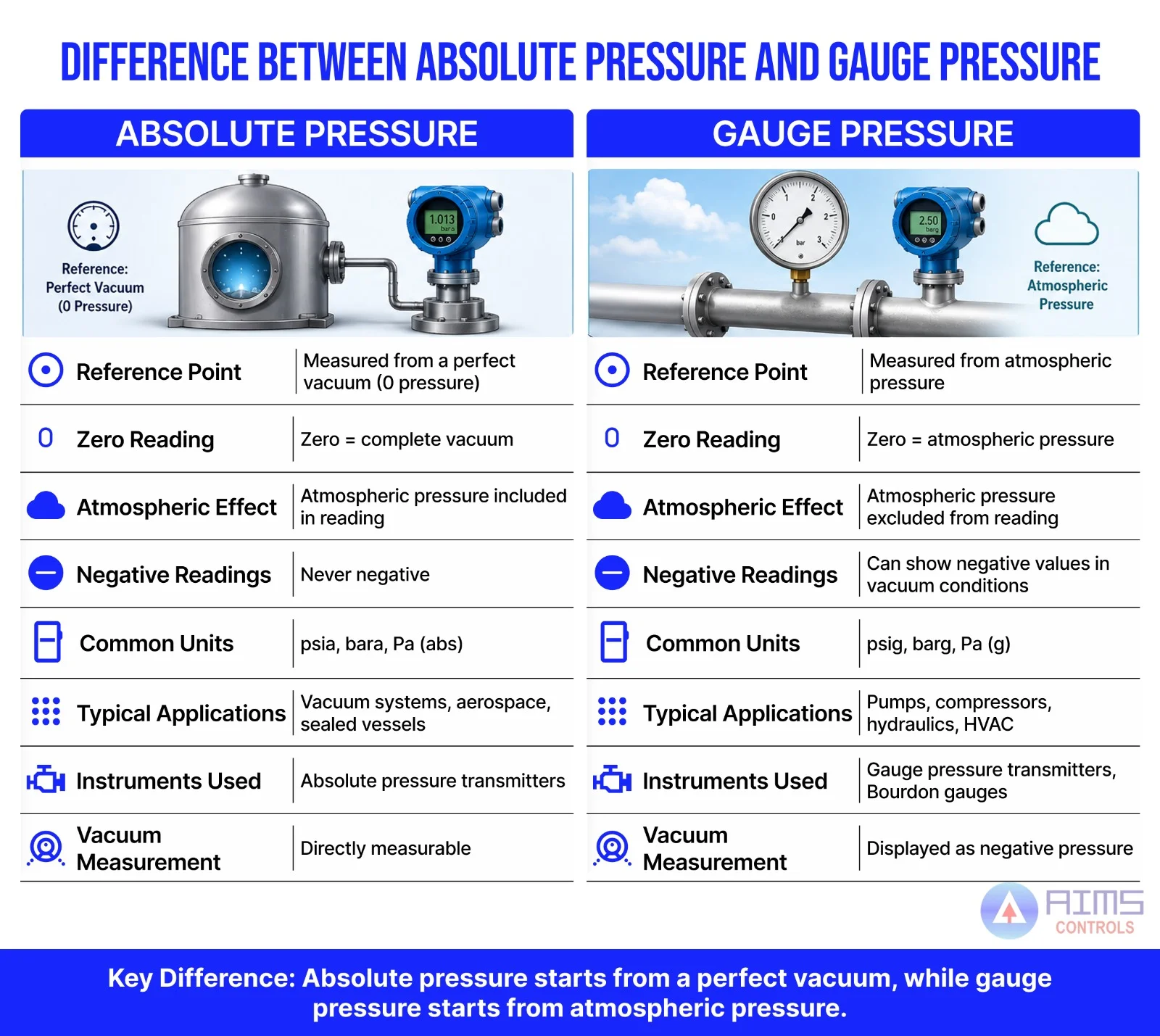
The table below summarizes the key differences between absolute and gauge pressure at a glance. This comparison is useful when selecting the right measurement instrument for any industrial application.
| Parameter | Absolute Pressure | Gauge Pressure |
| Reference Point | Perfect vacuum (0 pressure) | Atmospheric pressure |
| Zero Reading | Absolute zero pressure | Local atmospheric pressure |
| Atmospheric Effect | Always included in reading | Excluded measured above/below the atm |
| Negative Readings | Never negative | Yes, in vacuum conditions |
| Common Units | psia, bara, Pa (abs) | psig, barg, Pa (gauge) |
| Primary Applications | Aerospace, vacuum, sealed systems | Pumps, compressors, hydraulics, tires |
| Best Used For | Atmospheric-sensitive processes | Most industrial field measurements |
| Instruments Used | Absolute pressure transmitters | Gauge pressure transmitters, Bourdon gauges |
| Vacuum Measurement | Yes directly measurable | Shown as negative values |
The most important distinction is the reference point: absolute pressure always starts from zero (perfect vacuum), while gauge pressure starts from local atmospheric pressure. This makes absolute pressure ideal for thermodynamically sensitive processes and gauge pressure ideal for most everyday industrial monitoring tasks.
Real-World Examples of Absolute and Gauge Pressure
Understanding gauge pressure and absolute pressure becomes easier with concrete examples drawn from real industrial and everyday settings.
1. Tire Pressure (Gauge Pressure)
A vehicle tire inflated to 35 psig is a gauge pressure reading. The atmosphere already surrounds the tire at ~14.7 psi, so the actual absolute internal pressure is roughly 49.7 psia. Tire gauges are calibrated to read gauge pressure zero, which means the tire is completely flat (at atmospheric pressure), not in a vacuum.
2. Vacuum Chamber (Absolute Pressure)
In semiconductor fabrication, vacuum chambers must maintain precise low-pressure conditions, often 1-10 Pa absolute. Using gauge pressure here would produce a negative reading that’s harder to manage precisely. Absolute pressure transmitters provide a direct, unambiguous measurement of the chamber’s distance from true vacuum.
3. Boiler System (Both Types)
A steam boiler operating at 500 kPa (g) gauge pressure has an absolute pressure of approximately 601 kPa (abs). Engineers use gauge pressure for daily operational monitoring, but thermodynamic calculations such as determining steam properties or efficiency always require absolute pressure values.
4. Hydraulic Press (Gauge Pressure)
Hydraulic systems generate working pressure well above atmospheric, often 100-400 bar. Gauge pressure is the standard for hydraulic system design and monitoring because all calculations are performed relative to the ambient environment. High-accuracy pressure gauges are used here for real-time feedback.
5. HVAC Ductwork (Gauge Pressure)
HVAC systems measure static duct pressure relative to ambient using gauge pressure, typically very low values in inches of water column (in. WC). Balancing air distribution across a building requires precise differential pressure monitoring, where gauge readings naturally express the deviation from atmospheric equilibrium.
Applications of Absolute and Gauge Pressure Measurement
Different industries choose absolute or gauge pressure based on process sensitivity, required accuracy, and environmental conditions.
Oil & Gas
Wellhead and pipeline monitoring typically uses gauge pressure since operations occur far above atmospheric levels. However, gas processing plants and distillation columns may require absolute pressure measurement for accurate thermodynamic modeling. Explore how the AIMS Solutions Blog covers pressure instrumentation in these demanding environments.
Water Treatment
Pump discharge pressures, filter differential pressures, and tank levels are all monitored using gauge pressure. The relative simplicity of gauge measurement suits water treatment’s rugged field conditions.
Pharmaceuticals
Cleanroom environments, lyophilizers (freeze dryers), and sterile filling systems often require absolute pressure measurement. Any atmospheric variation must be eliminated to maintain process integrity and regulatory compliance.
Chemical Processing
Reactors, evaporators, and distillation units operating under vacuum or at elevated temperatures depend on absolute pressure for accurate process control. Gauge pressure is used elsewhere in chemical plants for standard pump and pipeline monitoring.
HVAC & Building Automation
Low-pressure duct sensing, room pressurization control, and air handling unit monitoring all use gauge pressure. The values are small but critical for energy efficiency and air quality control.
Industrial Automation
Pneumatic actuators, compressed air manifolds, and injection molding machines use gauge pressure measurement as their operating standard. High-performance pressure transmitters enable precise control loops in automated production environments.
Which is better, absolute or Gauge Pressure?
Neither absolute nor gauge pressure is universally better. The right choice depends entirely on the application, environment, and accuracy requirements.
Choose absolute pressure when:
- Atmospheric pressure varies significantly (high altitudes, aerospace)
- Thermodynamic accuracy is required (steam tables, gas laws)
- Vacuum processes must be precisely controlled
- Processes in sealed or isolated systems need self-referencing measurement
Choose gauge pressure when:
- The process operates consistently above atmospheric pressure
- Operators need intuitive, easy-to-interpret readings
- Instrument cost and simplicity are priorities
- Field calibration and maintenance are frequent
In many facilities, both types co-exist: gauge pressure for routine field monitoring and absolute pressure for process control systems where atmospheric variability cannot be ignored. Consulting an instrumentation expert helps ensure the right selection for long-term accuracy and safety.
FAQs
1. What is the main difference between gauge and absolute pressure?
Gauge pressure is measured relative to local atmospheric pressure, while absolute pressure is measured relative to a perfect vacuum. Gauge pressure can be zero (at atmospheric) or negative (in a vacuum), while absolute pressure is always a positive value. The formula linking them: P(absolute) = P(gauge) + P(atmospheric).
2. Can gauge pressure be negative?
Yes. When a system operates below atmospheric pressure, such as in a vacuum line, suction manifold, or distillation column, gauge pressure readings become negative. This is called vacuum pressure or negative gauge pressure. For example, -60 kPa (g) means the system is 60 kPa below atmospheric.
3. Why is atmospheric pressure added to absolute pressure?
Absolute pressure is referenced to a perfect vacuum (zero pressure). Since most practical gauges measure above or below atmospheric not above zero pressure, the atmospheric component must be added to convert gauge readings into true absolute values. This ensures thermodynamic accuracy regardless of altitude or ambient conditions.
4. Which industries use absolute pressure?
Industries that commonly use absolute pressure measurement include aerospace, semiconductor manufacturing, pharmaceutical processing, chemical distillation, scientific research, and vacuum packaging. Any application where atmospheric pressure varies or where thermodynamic precision is critical benefits from absolute measurement.
5. Which instrument measures gauge pressure?
Bourdon tube gauges are the most common field instruments for gauge pressure measurement. Electronic gauge pressure transmitters are used where remote monitoring, digital output, or higher accuracy is required. These instruments are vented to the atmosphere, so they naturally reference local ambient pressure as their zero point.
Conclusion
The difference between gauge pressure and absolute pressure comes down to their reference points. Gauge pressure measures above or below atmospheric practical and intuitive for most industrial work. Absolute pressure measures from a perfect vacuum are essential when atmospheric variation, thermodynamic precision, or vacuum control matters.
Choosing the right pressure type from the start prevents measurement errors, reduces calibration issues, and ensures system safety. Whether you need simple field monitoring or high-accuracy process control, the correct instrument makes all the difference.
AIMS Controls offers a comprehensive range of pressure measurement instruments from standard Bourdon gauges to advanced smart transmitters to meet every industrial application requirement. Explore our full product range and find the right solution for your process today.