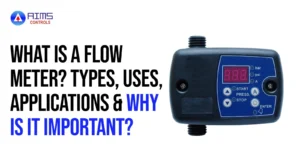
Whether a plant is treating millions of litres of drinking water each day, blending pharmaceutical ingredients to the gram, or managing fuel distribution across a refinery, every operation depends on knowing exactly how much fluid is moving through the system at any given moment. That is precisely what a flow meter does.
A flow meter is an instrument that measures the rate or volume of a fluid, liquid, gas, or steam as it moves through a pipe or channel. From industrial systems to municipal utilities, flow meters are the backbone of process control, resource management, and operational safety.
This guide covers everything you need to know: what a flow meter is, how it works, the major types available, key industrial applications, and how to choose the right instrument for your process requirements. You can also explore more industrial automation insights and technical resources on the AIMS Controls blog.
What is a Flow Meter?
A flow meter is a precision instrument used to measure the volumetric or mass flow rate of a fluid moving through a defined path, typically a pipe, duct, or open channel. It converts the physical movement of fluid into a readable signal that can be displayed locally, transmitted to a control system, or logged for data analysis.
Flow meters are used across virtually every industry that handles fluids: water utilities, oil and gas, food processing, pharmaceutical manufacturing, chemical plants, HVAC systems, and power generation. Their outputs enable operators to monitor consumption, control processes, detect leaks, ensure regulatory compliance, and optimize energy use.
Flow meters measure three fundamental quantities:
- Volumetric flow rate: the volume of fluid passing a point per unit time (e.g., litres per minute, cubic metres per hour)
- Mass flow rate: the mass of fluid passing per unit time (e.g., kg/s), critical for custody transfer and chemical dosing
- Totalized flow: the cumulative volume or mass of fluid that has passed over a defined period, used for billing, batching, and inventory management
Different fluids, such as water, oil, gas, steam, and slurry, require different measurement technologies. Selecting the right instrument means matching the meter’s operating principle to the fluid’s physical properties, pressure, temperature, and the accuracy the application demands. Explore the full range of industrial flow products to find instruments suited to your process.
How Does a Flow Meter Work?
Understanding how a flow meter works starts with recognizing that different technologies detect fluid movement in fundamentally different ways. However, all flow meters share the same basic chain: detect → convert → output.
A sensor or sensing element inside or around the meter responds to the fluid’s movement, whether that’s a rotating turbine, an induced electrical voltage, a pressure differential, sound wave travel time, or vortex shedding frequency. This physical response is then converted by a transmitter into a standardized electrical signal, typically 420 mA analogue, pulse, or digital protocol that represents the real-time flow rate.
That signal is then sent to a flow instrumentation display unit, SCADA system, PLC, or DCS, where operators can monitor, record, and act on the flow data. Many industries also integrate these systems with advanced industrial automation services for centralized monitoring and process optimization.
Basic Flow Measurement Principle
Regardless of the technology, every flow meter translates one physical phenomenon into a flow rate:
- Velocity-based meters (electromagnetic, ultrasonic, turbine, vortex) measure how fast the fluid moves and multiply by the known pipe cross-sectional area to calculate volumetric flow rate
- Differential pressure meters (orifice plates, Venturi tubes) measure the pressure drop across a restriction and infer velocity using the Bernoulli principle
- Mass flow meters (Coriolis) measure the fluid’s inertial effect on a vibrating tube to directly calculate mass flow, independent of fluid density
The transmitter applies the meter’s calibration constants, pipe geometry, and any temperature or pressure compensation to produce an accurate, linearized output. This signal is then used for industrial automation, process control, and data logging.
Types of Flow Meters
The right type of flow meter depends on the fluid being measured, the required accuracy, installation constraints, and operating conditions. Here are the five most widely used technologies in industrial applications.
Electromagnetic Flow Meter
Also known as a magmeter or mag flow meter, the electromagnetic flow meter operates on Faraday’s Law of Electromagnetic Induction. Electromagnetic coils generate a magnetic field across the flow tube. As conductive liquid passes through, it induces a voltage proportional to its velocity, detected by electrodes mounted on the pipe wall.
Best for: Water and wastewater treatment, chemical dosing, food and beverage, mining slurries, and pharmaceutical process water, any application involving electrically conductive liquids.
Key advantages:
- No moving parts, extremely low maintenance, and long service life
- Full-bore, unobstructed design, zero pressure drop
- High accuracy: ±0.20.5% of reading
- Bi-directional flow measurement capability
Electromagnetic meters require a minimum fluid conductivity (typically 5 µS/cm) and are unsuitable for gases, steam, or hydrocarbons.
Ultrasonic Flow Meter
Ultrasonic flow meters use high-frequency sound waves to measure fluid velocity without contacting the fluid at all. Transit-time models compare the travel time of sound pulses sent upstream versus downstream through the liquid. Faster downstream travel indicates higher flow velocity. Doppler models use sound reflected from suspended particles or bubbles.
Best for: Clean, non-conductive liquids; energy metering for HVAC chilled water and hot water circuits; custody transfer of natural gas; retrofitting existing pipelines without cutting pipes (clamp-on models).
Key advantages:
- Non-invasive clamp-on installation for existing pipelines with no process shutdown
- Suitable for non-conductive fluids where electromagnetic meters cannot be used
- Bidirectional measurement and no pressure drop
Clamp-on ultrasonic meters are especially popular in industrial process monitoring retrofits where pipe access is limited. They are less accurate than magmeters in dirty or aerated liquids.
Turbine Flow Meter
A turbine flow meter contains a precisely engineered rotor mounted in the flow stream. As fluid passes through, it spins the rotor at a speed proportional to the fluid velocity. A magnetic or optical pickup counts the rotor revolutions and converts them into a flow rate signal.
Best for: Clean, low-viscosity liquids and gases, fuel, light oils, chemicals, compressed air, and natural gas in applications requiring high accuracy and a wide flow range.
Key advantages:
- High accuracy (±0.5%) with fast response time
- Wide rangeability can accurately measure from very low to very high flow rates
- Compact, economical design for gas and liquid measurement
Turbine meters have moving parts that wear over time, making them unsuitable for abrasive slurries, high-viscosity fluids, or applications requiring minimal maintenance. They are widely used in industrial automation solutions for fuel management, oil distribution, and batch processes.
Differential Pressure Flow Meter
Differential pressure (DP) flow meters work by restricting the flow path through an orifice plate, Venturi tube, or flow nozzle, which creates a measurable pressure drop. The Bernoulli principle relates this pressure difference to the fluid velocity: greater flow velocity produces a larger pressure drop.
Best for: Steam, gas, and liquid measurement in high-temperature, high-pressure process environments. Orifice plates are the most economical option for large pipe sizes.
Key advantages:
- No moving parts in most DP designs (orifice, Venturi)
- Suitable for high-temperature steam and process gas measurement
- Low cost for large pipe diameter applications
DP meters introduce a permanent pressure drop and require accurate differential pressure transmitters to maintain measurement quality. Rangeability is more limited than velocity-based meters.
Vortex Flow Meter
A vortex flow meter exploits the phenomenon of vortex shedding: when a fluid stream flows past a bluff body (a shedder bar inside the pipe), it creates alternating vortices downstream. The frequency of these vortices is directly proportional to the fluid velocity; the faster the flow, the higher the vortex shedding frequency.
Best for: Steam, compressed gases, natural gas, and clean liquids in industrial plant utilities. Especially common in energy management and HVAC applications.
Key advantages:
- No moving parts and minimal maintenance requirements
- Suitable for steam, gas, and liquid measurement in a single instrument design
- Wide temperature range with no risk of pressure leakage (unlike DP taps)
Vortex meters can be affected by mechanical vibration and perform poorly at very low flow rates where vortex shedding becomes irregular.
Flow Meter Uses
The practical uses of a flow meter extend far beyond simply displaying a number on a screen. In industrial operations, flow measurement is the foundation of six critical functions:
- Process monitoring and control: Real-time flow data feeds directly into automated control loops that regulate valve positions, pump speeds, and dosing rates to maintain target process conditions without operator intervention.
- Utility billing and custody transfer: Water utilities, gas distributors, and energy suppliers use certified flow meters to measure consumption for accurate, auditable billing. Custody transfer applications require meters with the highest accuracy and regulatory approval.
- Leak detection and loss control: By comparing inlet and outlet flow readings in a distribution network, operators can identify losses that indicate pipe leakage, valve bypasses, or unauthorized consumption, critical for water conservation and loss reduction programmes.
- Batch processing and recipe control: Food and beverage, pharmaceutical, and chemical manufacturers use flow totalizers to measure exact volumes dispensed in each production batch, ensuring product consistency and minimizing waste.
- Energy management: Heat energy meters combine flow measurement with temperature sensors to calculate thermal energy transferred in heating and cooling circuits, enabling industrial process monitoring for energy efficiency and cost allocation.
- Environmental compliance: Regulatory bodies require accurate measurement of effluent discharge, chemical usage, and emissions. Flow meters provide the certified data needed for environmental permits and compliance reporting.
Flow Meter Applications
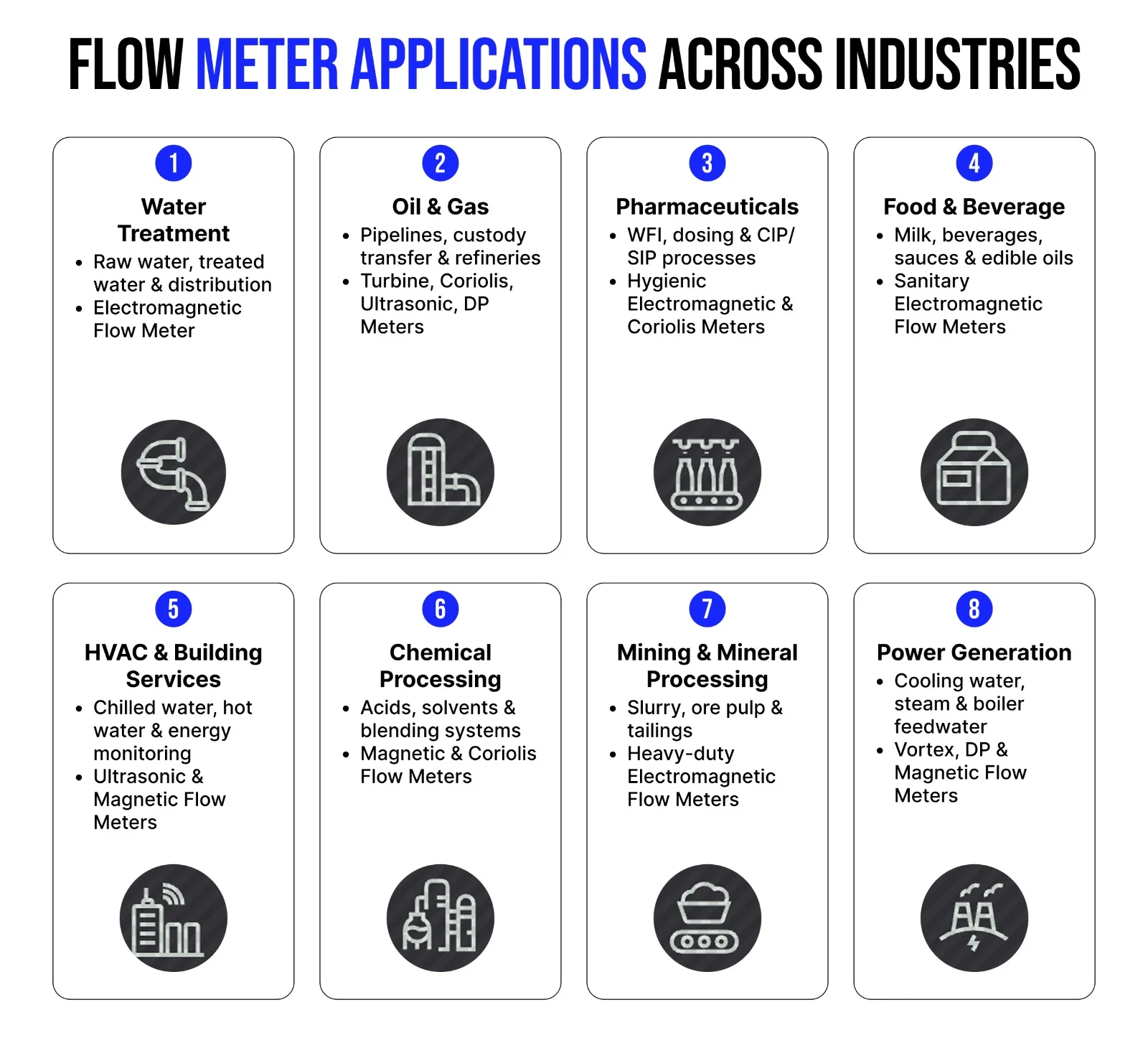
Every industry that handles fluids depends on accurate flow meter applications. Here is how different sectors put this technology to work:
Water Treatment and Distribution
Municipal water treatment plants measure raw water intake, coagulant dosing, filter backwash rates, and treated water output. Distribution networks rely on flow meters to balance pressure zones, detect losses, and generate customer billing data. Electromagnetic flow meters dominate this sector for their reliability and zero-maintenance operation in water.
Oil and Gas
From wellhead production metering to pipeline custody transfer and refinery process control, oil and gas is one of the most demanding flow measurement environments. Turbine, Coriolis, and ultrasonic meters are widely used for hydrocarbon liquids and natural gas, while DP meters handle high-temperature, high-pressure steam injection and gas lift applications.
Pharmaceuticals
Pharmaceutical manufacturing requires validated, traceable flow measurement for process water, WFI (water for injection), active ingredient dosing, and CIP/SIP solution flows. Hygienic electromagnetic and Coriolis meters with FDA-compliant materials and 21 CFR Part 11 data logging are standard in this industry.
Food and Beverage
From milk and juice to sauces, beverages, and edible oils, food processing demands sanitary flow measurement that withstands frequent cleaning and does not contaminate the product. Electromagnetic flow meters with PTFE liners, polished electrodes, and tri-clamp fittings are the standard choice for these applications.
HVAC and Building Services
Chilled water, hot water, and condenser water flows are metered in commercial and industrial HVAC systems for energy sub-metering, tenant billing, and system balancing. Ultrasonic clamp-on meters are favoured in retrofit applications where pipe access is limited, while magmeters serve new construction. Industrial automation integrates flow data with building management systems for real-time energy optimization.
Chemical Processing
Chemical reactors, blending systems, and transfer lines require precise measurement of acids, alkalis, solvents, and specialty chemicals, often at elevated temperatures and pressures. Material compatibility is paramount: magmeters with PTFE liners and Hastelloy electrodes, or Coriolis meters for direct mass flow measurement, are widely specified in this sector.
Mining and Mineral Processing
Mining operations handle abrasive slurries, ore pulp, tailings, and concentrates that destroy most mechanical instruments within weeks. Electromagnetic flow meters with polyurethane liners and tungsten carbide electrodes are purpose-built for these extreme conditions, providing reliable measurement in slurry pipelines and processing circuits.
Power Generation
Power plants measure cooling water, boiler feedwater, steam, fuel gas, and condensate flows throughout the generation cycle. Vortex meters are the standard for steam measurement; DP meters handle high-pressure gas; electromagnetic meters manage cooling water circuits. Accurate flow data is critical for plant efficiency, safety, and regulatory compliance.
Why are Flow Meters Important?
Across every industry that manages fluids, flow meters provide the data foundation for safe, efficient, and profitable operations. Their importance goes well beyond reading a number:
- Operational efficiency: Accurate real-time flow data enables tighter process control, reducing energy consumption, minimising raw material waste, and maximizing throughput without operator guesswork.
- Cost management: Precise measurement of utilities and raw materials allows accurate cost allocation by process unit, product line, or customer, essential for profitability analysis and waste reduction programmes.
- Safety and hazard prevention: Abnormal flow, unexpected surges, drops, or reversals often signal equipment failure, blockage, or process upset. Flow meters feed alarm systems that trigger automatic shutdowns before conditions become dangerous.
- Regulatory compliance: Environmental regulations require verified measurement of water discharges, chemical releases, and gas emissions. Certified flow meters provide the traceable, auditable data that regulators require.
- Predictive maintenance: Flow trends over time reveal developing problems, such as pump wear, valve leakage, or fouling, before they cause unplanned downtime. Integrating flow data with industrial automation enables condition-based maintenance strategies.
- Resource conservation: In water-scarce regions and energy-intensive industries, flow meters are the essential tool for identifying inefficiencies, reducing waste, and meeting sustainability targets.
How to Choose the Right Flow Meter
Choosing the wrong flow meter is an expensive mistake that can result in inaccurate measurement, premature instrument failure, or process safety risks. Use this framework to select the right instrument for your application:
- Fluid type: Is the fluid a liquid, gas, or steam? Conductive or non-conductive? Clean or carrying solids? Each answer eliminates certain technologies. Electromagnetic meters need conductivity; turbines need clean, low-viscosity fluid; vortex meters excel in steam and gas.
- Conductivity: For electromagnetic meters, the fluid must exceed the minimum conductivity specification (typically 5 µS/cm). Hydrocarbons, gases, and ultrapure water do not qualify; alternative technologies must be selected.
- Pipe size and flow range: Select a meter sized to keep normal flow within the optimum measurement range (typically 2080% of full scale). Oversized meters are inaccurate at normal flow; undersized meters create excess pressure drop.
- Temperature and pressure rating: Confirm that the selected meter’s body, liner, and seal materials are rated for the maximum operating temperature and pressure, including transient spikes throughout the application.
- Liner and electrode materials: For electromagnetic meters, match liner (rubber, PTFE, polyurethane) and electrode materials (316L SS, Hastelloy, titanium) to the fluid’s chemical composition, pH, and abrasive content.
- Accuracy requirements: Custody transfer and batching require ±0.20.5% accuracy; general process monitoring may accept ±12%. Higher accuracy instruments cost more, and match the specification to the actual need.
- Output and communication: Confirm that the meter’s output protocol (420 mA, HART, Modbus, Profibus, pulse) is compatible with your DCS, PLC, or BMS infrastructure.
- Maintenance and access: Meters with no moving parts (electromagnetic, ultrasonic, vortex) minimize maintenance burden. Where pipes cannot be taken offline, clamp-on ultrasonic meters allow installation and removal without process shutdown.
- Installation environment: Hazardous area? Ensure ATEX/IECEx certification. Hygiene-critical? Specify 3-A or EHEDG sanitary design. Outdoor or corrosive? Select IP67/68 rated enclosures.
The right choice the first time saves high cost over the instrument’s operating life. For expert guidance on selecting the ideal meter for your application, you can contact the AIMS Controls team.
Flow Meter Comparison Table
The table below provides a quick-reference comparison of the five major types of flow meters to support instrument selection decisions.
| Parameter | Electromagnetic | Ultrasonic | Turbine | Vortex | Diff. Pressure |
| Accuracy | ±0.2–0.5% | ±1–2% | ±0.5–1% | ±0.5–1% | ±1–2% |
| Moving Parts | None | None | Yes | None | None |
| Pressure Drop | None | None | Moderate | Moderate | High |
| Conductive Fluid Req. | Yes | No | No | No | No |
| Fluid Types | Conductive liquids | Liquids & gases | Clean liquids | Steam, gas, liquid | Gas, steam, liquid |
| Handles Slurries | Yes | Limited | No | No | No |
| Maintenance | Very low | Low | High | Low | Moderate |
| Installation Cost | Moderate | Moderate-high | Low-moderate | Low-moderate | Low |
| Best Application | Water, chemicals, food | Non-conductive fluids | Fuel, clean oil | Steam, gas, HVAC | Gas, compressed air |
This comparison highlights why no single flow meter technology is universally best. Application-specific requirements, such as fluid type, accuracy, maintenance budget, and installation constraints, determine the optimum selection.
FAQs
1. What is a flow meter used for?
A flow meter measures the rate or volume of fluid moving through a pipe or system. It is used for process monitoring, utility billing, leak detection, batch control, energy metering, and regulatory compliance reporting across water treatment, oil and gas, food processing, pharmaceuticals, and industrial automation.
2. How does a flow meter work?
A flow meter detects a physical change caused by the moving fluid, such as induced voltage, pressure drop, sound wave travel time, or rotor speed, and converts it into an electrical signal representing the flow rate. A transmitter processes this signal and outputs a standard 420 mA pulse or digital reading.
3. What are the different types of flow meters?
The main types of flow meters are: electromagnetic (for conductive liquids), ultrasonic (for non-conductive fluids and gas), turbine (for clean liquids and gas), vortex (for steam, gas, and clean liquids), and differential pressure (for steam, gas, and high-pressure processes). Coriolis meters directly measure mass flow.
4. Which industries use flow meters?
Flow meters are used across water and wastewater treatment, oil and gas, pharmaceutical manufacturing, food and beverage processing, chemical plants, HVAC, mining, and power generation. Any industry that monitors, controls, or bills for fluid consumption relies on flow measurement instruments.
5. Why are flow meters important?
Flow meters ensure process efficiency, reduce waste, support regulatory compliance, enhance safety through anomaly detection, and enable accurate billing and resource management. Without reliable flow data, industrial processes cannot be optimized, controlled, or audited to the standards modern operations require.
Conclusion
Understanding what a flow meter is and knowing which type to use is fundamental to safe, efficient industrial operations. From electromagnetic meters measuring conductive process liquids with ±0.2% accuracy to vortex meters handling high-temperature steam, the right flow measurement instrument transforms raw fluid movement into actionable process intelligence.
The flow meter application landscape spans every fluid-handling industry on the planet. Whatever the process, water, oil, gas, food, chemical, or pharmaceutical, there is a measurement technology engineered to deliver reliable, accurate data throughout the instrument’s operating life.
AIMS Controls supplies a comprehensive range of flow measurement solutions for every industrial application. From instrument selection support to full industrial automation solutions, the AIMS Controls team is ready to help you find the right flow meter for your process.