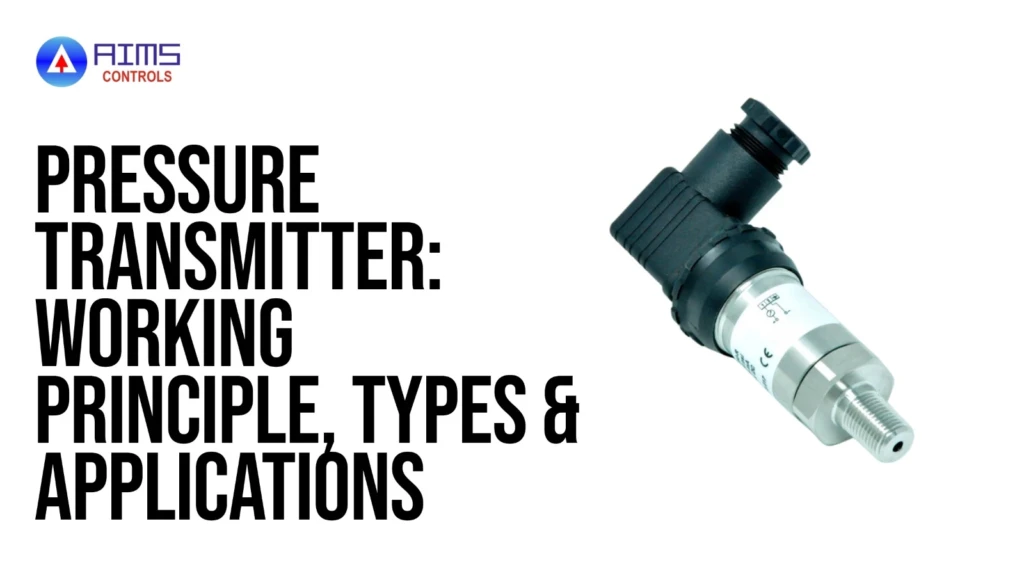
A pressure transmitter is one of the most widely used field instruments in process industries. Wherever a plant needs to monitor line pressure, tank pressure, or pump discharge pressure, a pressure transmitter is usually doing the job, turning physical pressure into a signal that a control system can actually use.
For anyone working with pressure instruments on a plant floor, understanding how a pressure transmitter works, what types are available, and where each one fits is essential for accurate process monitoring. This article covers the pressure transmitter working principle, the smart pressure transmitter working principle, the main types of pressure transmitters, and where these instruments are applied every day.
What Is a Pressure Transmitter?
So, what is a pressure transmitter? In simple terms, it is a field device that measures the pressure of a liquid, gas, or steam in a process and converts that measurement into a standardized electrical signal. This signal is sent to a PLC, DCS, or SCADA system, where it is used for monitoring, alarming, or automatic control.
A pressure transmitter is often confused with a pressure gauge or a pressure switch, but the three serve different purposes. A pressure gauge gives a local visual reading only, with no output signal for a control system. A pressure switch simply opens or closes a contact when pressure crosses a set point, without providing a continuous reading. A pressure transmitter, on the other hand, provides a continuous, proportional signal across a defined range, making it suitable for real-time process monitoring and closed-loop control.
Because of this continuous output capability, pressure transmitters are the preferred instrument wherever pressure data needs to be logged, trended, or fed into automated control logic rather than just observed locally.
Pressure Transmitter Working Principle
Understanding the pressure transmitter working principle starts with recognizing that these devices convert a physical force into an electronic signal through a defined sequence of steps.
The process begins when process fluid contacts the transmitter’s sensing element, usually through a diaphragm or isolating membrane. Applied pressure causes a small, measurable deflection in the sensing element, and this mechanical response is what the internal electronics are designed to detect.
This physical change is then converted into an electrical property, commonly a change in capacitance, resistance, or piezoresistive output, depending on the sensor technology used. The transducer inside the pressure transmitter handles this conversion, and its quality largely determines the accuracy and stability of the final measurement.
The raw electrical signal is then amplified, linearized, and conditioned. Raw sensor output is rarely linear across the full pressure range, so signal conditioning circuitry compensates for temperature effects, non-linearity, and other errors before the reading is usable.
This conditioned signal is converted into a standardized output format that control systems can interpret, most commonly a 4-20 mA analog signal or a digital protocol signal. This output travels through field wiring back to the control room, where the DCS, PLC, or SCADA system reads it as a live pressure value, used for monitoring, alarming, or triggering automatic control actions such as adjusting a valve position. This sequence, from applied pressure to actionable data, is the essence of the pressure transmitter working principle across nearly all transmitter designs.
How Pressure Is Converted Into an Electrical Signal
The sensing element is the heart of any pressure transmitter. Whether it is a metal diaphragm, a silicon sensor, or a capacitive cell, its job is to physically respond to pressure in a repeatable, predictable way. That mechanical response is transferred to a transduction circuit, which turns the deflection into a measurable electrical quantity. Signal conditioning circuitry then cleans up and scales this raw signal so it accurately represents the applied pressure across the transmitter’s full calibrated range.
Common Pressure Transmitter Output Signals
Most industrial pressure transmitter units still rely on the 4–20 mA analog signal because it is simple, robust over long cable runs, and compatible with almost every legacy control system. Increasingly, however, transmitters also support digital communication protocols layered on top of or alongside this analog signal. HART remains the most common, allowing digital diagnostic data to ride on the same two wires as the 4–20 mA signal. Fieldbus-based protocols such as Modbus, PROFIBUS PA, and Foundation Fieldbus are also widely used in larger plants where multiple instruments share a digital communication network.
Smart Pressure Transmitter Working Principle
The smart pressure transmitter working principle builds on the basic transmitter operation but adds a layer of onboard intelligence. A smart pressure transmitter still uses the same fundamental sensing element and transduction process, but it incorporates a microprocessor that actively manages signal processing, compensation, and communication.
This microprocessor continuously corrects for temperature drift, non-linearity, and other environmental influences in real time, something a purely analog transmitter cannot do as effectively, typically resulting in tighter accuracy and better long-term stability.
Smart transmitters also support remote configuration. Engineers can adjust range, damping, and output settings from a handheld communicator or asset management software without physically opening the device, which is particularly useful for instruments installed in hard-to-reach locations.
Diagnostics are another major advantage. These transmitters can self-monitor for sensor drift, wiring faults, or abnormal operating conditions, and report status digitally to maintenance teams before a failure disrupts the process, functioning as active nodes within a plant’s control network rather than simple measurement devices.
Types of Pressure Transmitter
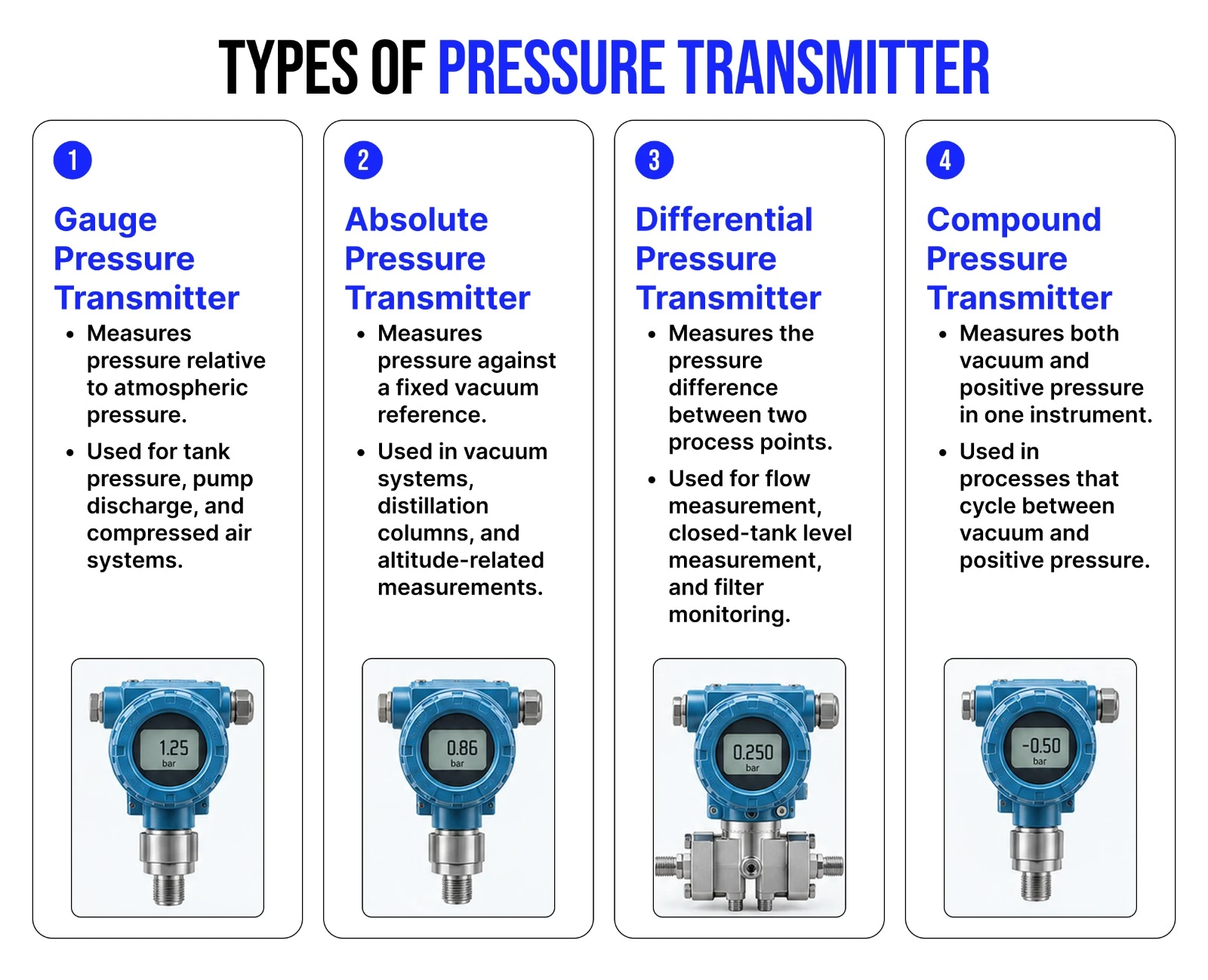
There are several types of pressure transmitter, and selecting the correct one depends primarily on what reference point the instrument measures pressure against and what kind of process condition it needs to capture. Understanding the different types of pressure transmitter available helps engineers match the right instrument to the right application instead of defaulting to a generic choice.
Gauge Pressure Transmitter
A gauge pressure transmitter measures pressure relative to local atmospheric pressure. This is the most common configuration used across general industrial applications such as tank pressure monitoring, pump discharge pressure, and compressed air systems, where atmospheric pressure as a reference point is perfectly acceptable.
Absolute Pressure Transmitter
An absolute pressure transmitter measures pressure against a fixed vacuum reference rather than atmospheric pressure. This makes it suitable for applications like vacuum systems, distillation columns, and certain barometric or altitude-related measurements, where atmospheric variation would otherwise introduce measurement error.
Differential Pressure Transmitter
A differential pressure transmitter measures the difference in pressure between two separate points in a process. This type of pressure transmitter is extremely versatile and is commonly used for flow measurement across orifice plates, level measurement in closed tanks, and filter or strainer monitoring, where a rising pressure differential signals a clogging element.
Compound Pressure Transmitter
A compound pressure transmitter is designed to measure both pressure above and below atmospheric pressure within a single instrument. This makes it useful in applications where a process cycles between vacuum and positive pressure conditions, such as certain reactor vessels or specialized vacuum-assisted processes.
Pressure Transmitter Applications
Pressure transmitter applications span nearly every industry that involves fluid, gas, or steam handling. Rather than simply listing industries, it helps to understand what role the instrument actually plays within each system.
Process & Manufacturing
In general process and manufacturing plants, pressure transmitters monitor pipeline pressure, vessel pressure, pump performance, and production line conditions, feeding this data directly into control loops that keep operations running within safe and efficient limits.
Oil & Gas & Petrochemical
Oil, gas, and petrochemical facilities depend heavily on pressure transmitters to track pipeline pressure, monitor process equipment such as separators and compressors, and provide continuous data on critical systems where pressure deviations can indicate leaks, blockages, or safety risks.
Water & Wastewater
Water and wastewater facilities use pressure transmitters extensively on pumps, distribution pipelines, and treatment systems to maintain consistent flow, detect pump cavitation or failure, and ensure treatment processes operate within their designed pressure ranges.
HVAC & Utility Systems
In HVAC and utility applications, pressure transmitters monitor duct pressure, chilled water systems, and compressed air networks, helping building and facility systems maintain efficient operation while flagging abnormal pressure conditions that could indicate a fault.
Power & Other Industrial Applications
Power generation facilities rely on pressure transmitters to monitor boiler pressure, steam lines, and other high-temperature, high-pressure processes where accurate, continuous measurement is directly tied to both efficiency and safety.
Pressure Transmitter vs Pressure Gauge vs Pressure Switch
While all three instruments deal with pressure, they are not interchangeable. A pressure gauge provides a local, visual-only reading with no electrical output, useful for quick manual checks but not for automation. A pressure switch monitors pressure only to the extent of triggering a single action, such as opening or closing a contact when a pressure threshold is crossed, without giving a continuous value.
A pressure transmitter, by comparison, delivers a continuous, proportional output signal across its full measurement range, enabling real-time trending, remote monitoring, and integration into automated control loops. This is why transmitters are chosen for critical process points, while gauges and switches remain useful for simpler, localized needs. When comparing measurement reliability across these instruments, it also helps to understand pressure gauge accuracy classes, since gauge accuracy expectations differ significantly from transmitter-grade accuracy.
How to Choose the Right Pressure Transmitter
Selecting the right pressure transmitter involves matching the instrument specifications to actual process conditions rather than choosing based on price alone. Start with the pressure range required, keeping the normal operating pressure comfortably within the transmitter’s calibrated span rather than at its upper limit.
Next, determine the correct pressure reference, gauge, absolute, or differential, based on what the application needs to measure. Accuracy requirements should be defined by the process itself; tighter tolerance applications justify a higher-accuracy pressure transmitter, while general utility monitoring may not.
The process medium matters too. Corrosive, viscous, or high-temperature fluids require compatible wetted materials and, in some cases, diaphragm seals to protect the sensing element, and ambient temperature ranges should be checked against the transmitter’s rated limits.
Output signal type, whether 4-20 mA, HART, or a fieldbus protocol, should match the existing control system, and process connection size must physically fit the installation point.
Finally, consider communication and diagnostic requirements. If remote configuration or predictive maintenance data is valuable in your operation, a smart pressure transmitter with digital communication capability is usually worth the additional investment. For a broader look at selecting the right instrumentation across a facility, this guide on measuring and control instruments is a useful reference, and understanding common measurement errors can help avoid selection mistakes that lead to inaccurate readings down the line.
Frequently Asked Questions About Pressure Transmitters
1. What is a pressure transmitter?
A pressure transmitter is a field device that measures process pressure and converts it into a standardized electrical signal for control systems.
2. How does a pressure transmitter work?
It senses applied pressure through a diaphragm, converts the deflection into an electrical signal, and transmits it to a control system.
3. What is the pressure transmitter working principle?
Pressure acts on a sensing element, producing a measurable electrical change that is conditioned and output as a standardized signal.
4. What is the smart pressure transmitter working principle?
A built-in microprocessor manages signal conditioning, compensation, diagnostics, and digital communication, improving accuracy and enabling remote configuration.
5. What are the different types of pressure transmitter?
Common types include gauge, absolute, differential, and compound pressure transmitters, each referenced against a different pressure baseline.
6. What is the difference between gauge and differential pressure transmitters?
Gauge transmitters measure against atmospheric pressure, while differential transmitters measure the difference between two separate pressure points.
7. What are pressure transmitters used for?
They are used for continuous pressure monitoring, flow and level measurement, and feeding real-time data into automated control systems.
8. What are the main pressure transmitter applications?
Applications include process manufacturing, oil and gas, water and wastewater, HVAC systems, and power generation facilities.
9. What output signal does a pressure transmitter provide?
Most transmitters output a 4-20 mA analog signal, often combined with digital protocols such as HART, Modbus, or PROFIBUS PA.
10. How do you choose the right pressure transmitter?
Match pressure range, reference type, accuracy, process medium, temperature, output signal, and connection type to the specific application.
Improving Industrial Pressure Measurement
Reliable pressure measurement comes down to choosing the correct transmitter type, matching its range and sensing technology to the actual process, and selecting an output signal that fits the existing control architecture. A pressure transmitter that is mismatched to its application, whether by range, reference type, or wetted material, will eventually produce inaccurate readings or premature failure, regardless of how well it was built.
If you are selecting a pressure transmitter for an industrial application, make sure the transmitter type matches the process conditions, not just the required pressure range.
AIMS Controls offers pressure measurement solutions for different industrial applications. The right pressure transmitter can vary depending on factors such as pressure range, process medium, temperature, accuracy, output signal, and installation requirements.
- Explore available pressure transmitter solutions
- Compare different pressure transmitter types
- Get expert guidance for the right selection
Taking a few minutes to review the process requirements with an instrumentation expert can help avoid incorrect selection, unnecessary recalibration, and avoidable downtime.