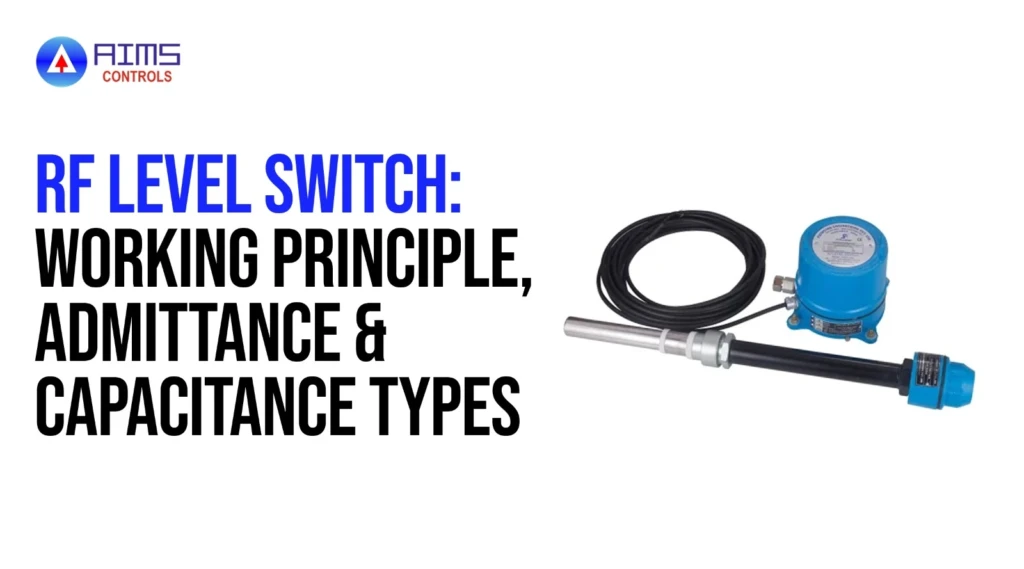
Tanks, vessels, silos, and process systems all depend on knowing when a material has reached a specific point. If that detection fails, the result can be an overflow, a dry-run pump, or an unplanned shutdown. This is why reliable point-level detection is such a basic requirement in process design. An RF level switch is one of the sensing options engineers turn to for this job, particularly when the material being measured is difficult for simpler technologies to handle. This article looks at how an RF level switch works, the difference between RF admittance and RF capacitance designs, and how to pick the right one for a given application.
What Is an RF Level Switch?
An RF level switch is a point-level detection device. It doesn’t measure how much material is in a vessel from top to bottom; instead, it tells you whether material has reached one fixed point, such as a high-level alarm or a low-level cutoff. The “RF” stands for radio frequency, which refers to the type of electrical signal the sensor uses to detect the presence of material.
This is different from continuous level measurement, where an instrument reports the level constantly as a percentage or a distance value. A point-level switch simply gives a signal that material is either present at the sensing point or it isn’t. Many plants use level switches alongside continuous instruments so that operators get both an ongoing reading and a reliable alarm at a critical point.
How Does an RF Level Switch Work?
At the core of an RF level switch is a probe that extends into the vessel. This probe carries a low-power radio frequency signal. When the surrounding area around the probe is just air, the signal behaves in a predictable, stable way. Once the process material, liquid, powder, or granular solid, reaches the probe, the material changes the electrical characteristics around it.
The switch’s electronics are built to notice this change. Because different materials interact with the RF signal differently, based on properties like conductivity and dielectric constant, the sensor can distinguish between “material present” and “material absent” at the probe. When the change crosses a set threshold, the switch changes its output state, which then triggers an alarm, a relay, or a control signal elsewhere in the process.
Understanding RF Level Detection
When the process material reaches the sensing point, it alters the RF signal traveling along the probe. The switch’s circuit reads that shift, compares it against a preset trigger point, and changes its output the moment the material makes contact. This single action is what all RF level switches are built around, regardless of the specific technology inside.
RF Admittance Level Switch Working Principle
Admittance-based sensing is one of the more advanced approaches used in RF level switches, and it deserves closer attention because it addresses a common weak point in simpler designs.
Admittance is an electrical property that reflects how easily a circuit allows current to flow when an RF signal is applied. In an RF admittance level switch, the probe and the surrounding electronics are designed to interpret this property in detail, not just detect a rough change in signal. This allows the instrument to separate the actual presence of material from things like probe coating, condensation, or minor material build-up, which can otherwise trick basic sensors into a false reading.
The dielectric properties of the material essentially, how it responds to an electric field play a major role here. Materials with different dielectric constants affect the RF signal differently, and admittance-sensing electronics are tuned to recognize these differences accurately. This is what allows the sensing probe to give a dependable output even in process conditions that are not perfectly clean or stable.
What Is an RF Admittance Level Switch?
An RF admittance level switch is a point-level instrument that uses admittance measurement, rather than a simple capacitance reading, to detect material at the probe. It is particularly useful in applications where probe coating or changing process conditions might otherwise cause a conventional sensor to misread the presence of material. Because the electronics can account for a coated probe, admittance technology tends to hold up well in situations involving sticky solids, condensing vapors, or materials that leave residue behind.
RF Admittance Type Level Switch
In its basic configuration, an RF admittance type level switch consists of a probe inserted through the top or side of a vessel, connected to an electronics housing that generates and interprets the RF signal. This type of switch is commonly considered for applications involving powders, granular solids, and liquids where build-up on the probe is a known challenge. The probe length and mounting orientation are chosen based on where in the vessel the switch point needs to be.
What Is an RF Capacitance Level Switch?
An RF capacitance level switch also uses a radio frequency signal, but it operates around the principle of capacitance rather than full admittance. Capacitance describes the ability of two conductive surfaces, in this case the probe and the vessel wall or a reference electrode, to store an electrical charge when separated by a material (the dielectric).
As material comes into contact with the probe, it changes the capacitance value at that point, and the switch detects this shift as its trigger. It’s worth being clear that RF capacitance and RF admittance are related but not identical technologies. Both fall under the wider umbrella of RF-based level sensing, but admittance-based designs typically extend the concept further to account for factors like probe coating.
RF Capacitance Level Sensor
An RF capacitance level sensor is generally well suited to a wide range of liquids, solids, and bulk materials, particularly where the process is relatively clean and the material has a fairly consistent dielectric constant. Its role is straightforward: sense the change in capacitance at a fixed point and switch its output accordingly. Where materials are more likely to cause coating or where dielectric properties vary during the process, an admittance-based design is often the better fit.
RF Admittance vs RF Capacitance Level Switch
Both technologies fall under the RF level switch category, and the right choice depends on the specific process rather than a fixed rule. The table below outlines the main points of comparison.
| Factor | RF Admittance | RF Capacitance |
| Basic sensing | Admittance-based detection | Capacitance-based detection |
| Typical purpose | Point-level detection | Point-level detection |
| Media | Depends on instrument/application | Depends on dielectric properties |
| Build-up considerations | Technology may compensate for coating | Build-up can affect sensing |
| Selection | Based on process and material conditions | Based on material dielectric properties and process conditions |
Neither technology is universally better than the other. The right selection depends on the material being handled, how likely it is to coat the probe, and the overall stability of the process conditions.
Applications of RF Level Switches
RF level switches are used across a range of industrial settings where a dependable point-level signal is needed:
- Storage tanks for liquids and bulk materials
- Silos and hoppers holding powders or granules
- Powder handling systems where dust and build-up are common
- Granular material storage, such as pellets or grains
- Chemical vessels handling varying dielectric materials
- Slurries and other semi-liquid mixtures
- High-level and low-level alarm points in process control
In some of these applications, particularly where the material or mounting geometry doesn’t favor an RF probe, a float switch may be considered as an alternative point-level technology. The right choice always comes back to the specific material and vessel conditions.
Benefits and Limitations of RF Level Switches
Benefits:
- Reliable point detection for liquids, powders, and granular solids
- No moving parts, which reduces mechanical wear over time
- Can be configured to handle probe coating and build-up (particularly with admittance designs)
- Works across a range of dielectric materials
Limitations:
- Performance depends on correct probe length and installation
- Extremely low-dielectric materials can be harder to detect reliably
- Heavy build-up can still affect basic capacitance-only designs
- Selection needs to match the specific process, since no single design suits every application
How to Choose the Right RF Level Switch
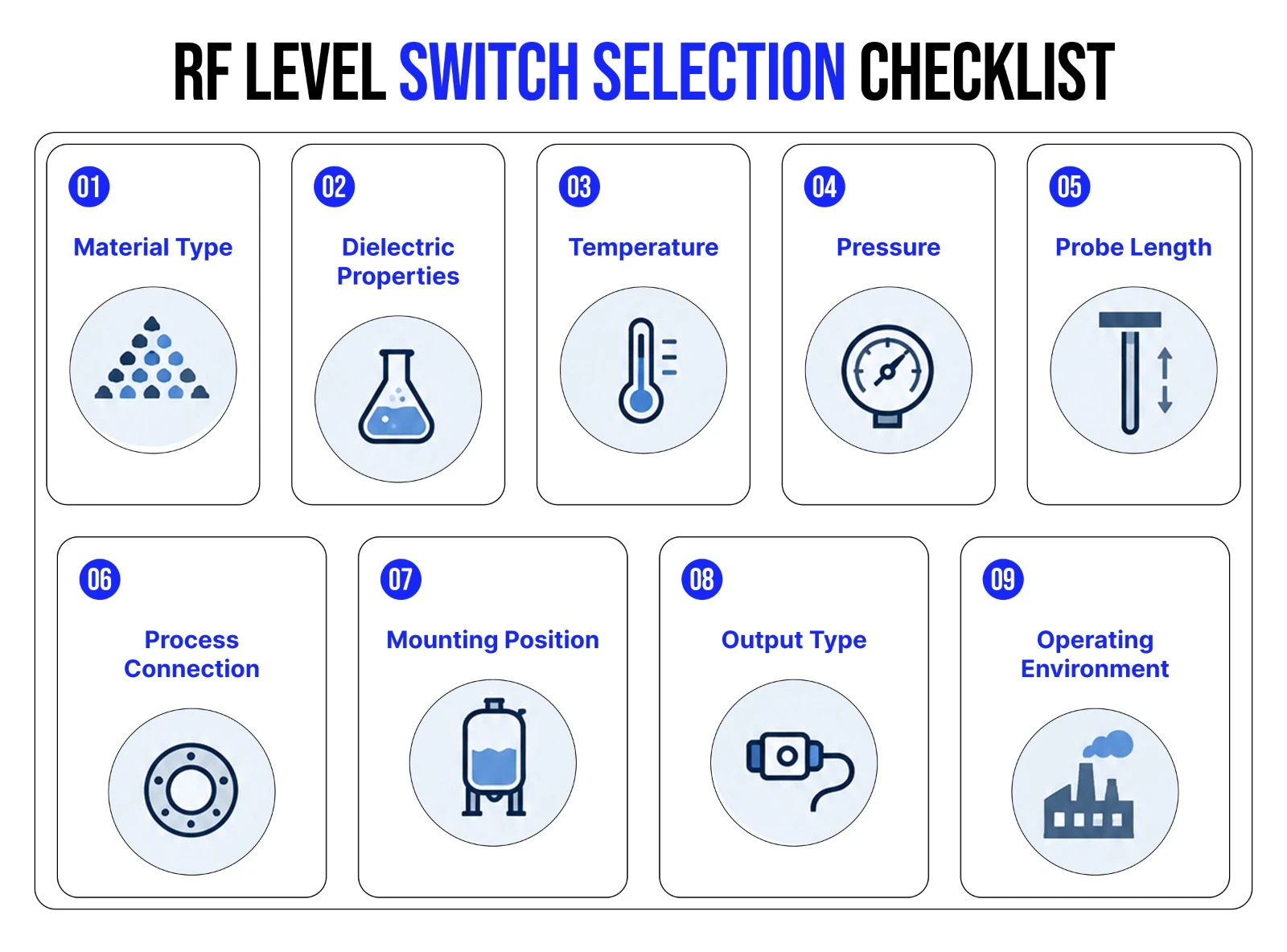
Selecting the correct RF level switch comes down to matching the instrument to the process. A practical checklist includes:
- Material type: liquid, powder, granular solid, or slurry
- Dielectric properties: how the material interacts with an electric field
- Temperature: the operating range the probe and electronics must withstand
- Pressure: vessel pressure ratings the switch needs to handle
- Probe length: matched to the vessel size and desired switch point
- Process connection: thread, flange, or other mounting type
- Mounting orientation: top-mounted, side-mounted, or angled
- Output type: relay, alarm signal, or control system interface
- Environment: hazardous area classification, washdown needs, or outdoor exposure
Working through each of these points before ordering helps avoid a mismatch between the instrument and the actual process conditions.
RF Level Switch vs Level Transmitter
An RF level switch and a level transmitter solve two different problems. The switch gives a single point-level signal: material present or not present at a fixed location. A transmitter, by contrast, provides continuous measurement, reporting the level across a range rather than at one point.
Many process systems use both together: a transmitter for ongoing level tracking and one or more switches for high or low alarm points. For applications needing a continuous reading rather than a fixed alarm, it’s worth reviewing level transmitters as a separate but related instrumentation category.
Key Considerations Before Installation
Before installing an RF level switch, a few practical points are worth reviewing:
- Probe placement: position it at the exact height where switching needs to occur
- Process conditions: account for temperature, pressure, and material flow near the probe
- Material build-up: consider whether the process material is likely to coat the probe over time
- Electrical connection: confirm wiring, output type, and area classification match plant requirements
- Application requirements: match probe length and sensitivity settings to the specific vessel and material
Reviewing these factors ahead of installation reduces the chances of a false trigger or a missed detection point once the switch is in service. For teams comparing options across their instrumentation, AIMS Controls’ broader range of level instruments can be a useful reference point when weighing switches against transmitters and other sensing technologies.
Frequently Asked Questions
What is an RF level switch?
It’s a point-level instrument using radio frequency signals to detect when material reaches a fixed sensing point in a vessel.
How does an RF level switch work?
Material contacting the probe changes the RF signal’s electrical properties, and the switch changes output once a threshold is crossed.
What is an RF admittance level switch?
It’s an RF switch that measures admittance in detail, helping it stay accurate even with probe coating or build-up present.
What is the RF admittance level switch working principle?
It reads admittance changes caused by material at the probe, using dielectric properties to distinguish real material from coating effects.
What is an RF capacitance level switch?
It’s an RF switch that detects material by sensing capacitance changes between the probe and a reference surface nearby.
What is an RF level sensor?
It’s another term for the sensing element within an RF level switch, referring to the probe and its detection function.
What is the difference between RF admittance and RF capacitance?
Admittance designs typically compensate better for probe coating, while capacitance designs rely more directly on the material’s dielectric constant.
Where are RF level switches used?
They’re used in storage tanks, silos, hoppers, chemical vessels, powder handling systems, and slurry applications needing point-level alarms.
How do you choose an RF level switch?
Match probe length, dielectric properties, temperature, pressure, process connection, and output type to your specific material and vessel.
What is the difference between an RF level switch and a level transmitter?
A switch detects one fixed point; a transmitter continuously measures level across a range, often used together in the same system.
Final Thoughts on Selecting the Right Point-Level Technology
RF level switches remain a practical, dependable choice for point-level detection across a wide range of industrial materials. Understanding the difference between admittance and capacitance sensing and matching that choice to the actual process conditions is what determines whether the instrument performs reliably over the long term. Rather than treating RF level switches as a one-size-fits-all solution, the better approach is to work through material properties, mounting requirements, and environmental conditions before making a final selection.