Level Gauge Manufacturer & Supplier India
A trusted level gauge manufacturer supplies one of the most fundamental instruments in any process plant, a device that gives operators direct, real-time visibility of liquid levels inside tanks, vessels, boilers, and process equipment. From simple glass gauges to advanced magnetic and electronic level gauges, the right product ensures safe operation, accurate inventory, and confident process control.
What is a Level Gauge?
A level gauge is an instrument mounted on the side of a tank or vessel that provides a direct or remote indication of the liquid level inside. Unlike level transmitters that send electrical signals to a control room, level gauges offer immediate local visual indication, making them the first line of reference for operators on the plant floor.
Level gauges are used for:
- Local visual monitoring of tank and vessel levels
- Operator reference during manual operations and filling
- Independent verification of transmitter and switch readings
- Safety-critical level indication on boilers and pressure vessels
- Inventory management in storage tanks and process vessels
Types of Level Gauges
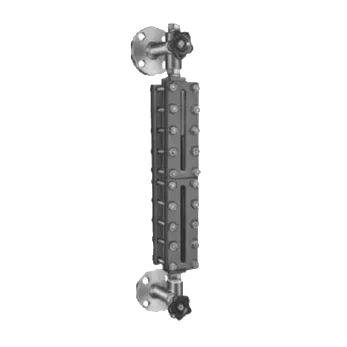
Glass Level Gauge
The most traditional and widely used type. A transparent glass tube or flat glass panel is connected to the vessel via top and bottom process connections. The liquid inside the gauge rises to the same level as the vessel contents, providing a direct visual indication.
Available in two main designs, tubular glass gauges for low-pressure applications and flat glass gauges (transparent and reflex) for higher pressure and temperature service.
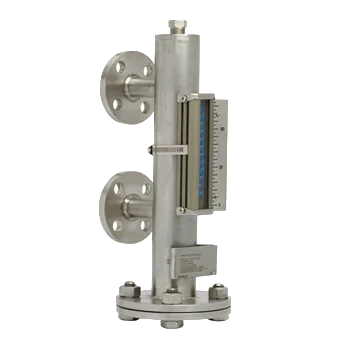
Magnetic Level Gauge (MLG)
A float with an internal permanent magnet moves inside a non-magnetic bypass chamber connected to the vessel. The magnet actuates a series of bi-colored magnetic flippers on the external indicator board, flipping from one color to another as the float passes, giving a clear, visible level indication without any glass in contact with the process fluid.
Magnetic level gauges are the preferred choice for hazardous, toxic, high-pressure, and high-temperature applications where glass gauges present a safety risk.
Reflex Level Gauge
A variation of the flat glass gauge where the glass surface has prismatic grooves. The refractive index difference between liquid and vapor causes the liquid zone to appear dark and the vapor zone to appear bright, giving a sharp, easy-to-read level indication without illuminators.
Transparent Level Gauge
Uses two flat glass plates with the process fluid visible between them. Suitable for colored liquids, interface measurement, and applications where the actual fluid appearance needs to be observed. Often fitted with illuminators for better visibility.
Magnetic Float Level Gauge (Tank Side Indicator)
A float inside the vessel is connected via a magnetic coupling to an external indicator scale mounted on the tank wall. Provides continuous local-level reading across the full tank height without any direct fluid connection to the indicator.
Electronic / Digital Level Gauge
Combines a magnetic level gauge chamber with an integrated magnetostrictive or reed switch transmitter, providing both local visual indication and a 4-20 mA / HART output signal for remote monitoring simultaneously.
Key Features of Quality Level Gauges
- Full chamber length options from 300mm to 3000mm+ per section with multi-section extensions
- Body materials, carbon steel, SS304, SS316, duplex SS, Hastelloy, and exotic alloys
- Glass types: borosilicate glass for standard service, tempered glass for high-temperature applications
- Process connections, flanged, threaded BSP/NPT, or socket weld to suit vessel nozzle configuration
- Isolation valves, integral gauge cocks, or ball valves for safe isolation and maintenance
- Drain valve, bottom drain connection for easy purging and maintenance
- Illuminators for transparent gauges in low-light environments or colored fluid applications
- Scale & graduation, mm, cm, or percentage scale printed or engraved on the indicator board
- Multiple switch points, reed switches, or proximity switches are mountable along the chamber length
- Transmitter integration, magnetostrictive transmitter for simultaneous 4-20 mA output
Applications of Level Gauges
Oil & Gas, crude oil storage tanks, separator vessels, fuel storage, LPG bullets, offshore platform vessels, and pig receivers.
Chemical & Petrochemical, storage and process vessels handling acids, solvents, alkalis, and hydrocarbons, where glass gauges may be unsuitable.
Power Generation, boiler drum level indication, feedwater tanks, deaerators, condensate vessels, and fuel oil day tanks.
Pharmaceuticals, hygienic vessel level indication in GMP-compliant manufacturing, WFI storage, and buffer preparation tanks.
Food & Beverage, ingredient storage tanks, mixing vessels, fermentation tanks, and CIP solution vessels.
Water & Wastewater, chemical dosing tanks, sludge vessels, filter vessels, and treated water storage.
Refineries & Petrochemicals, distillation column level, reflux drums, reactor vessels, and high-pressure separators.
Marine & Offshore, ballast tanks, fuel tanks, hydraulic oil tanks, and cargo vessel level monitoring.
Frequently Asked Questions
Q: What is the difference between a reflex and a transparent level gauge?
A: A reflex gauge uses prismatic glass that makes the liquid zone appear dark and the vapor zone bright, ideal for clear, single-phase liquids. A transparent gauge uses flat glass on both sides, allowing the actual fluid to be seen, preferred for colored liquids, interface measurement, and applications where fluid appearance matters.
Q: When should I choose a magnetic level gauge over a glass gauge?
A: Choose a magnetic level gauge for hazardous, toxic, flammable, or corrosive fluids where glass breakage would be dangerous, for high-pressure and high-temperature applications beyond glass limits, and when remote output signals or long-distance visibility are required.
Q: Can a magnetic level gauge also provide a 4-20 mA output signal?
A: Yes. A magnetostrictive or reed switch transmitter can be mounted directly onto the magnetic level gauge chamber, providing simultaneous local visual indication and a continuous 4-20 mA / HART output for remote monitoring and control.
Q: What materials are available for the gauge chamber and float?
A: Standard construction uses SS316 for the chamber and float. For aggressive media, Hastelloy C-276, Duplex SS, Monel, and PTFE-coated floats are available. The chamber material must be non-magnetic to allow the float magnet to actuate the external indicators.
Q: How long can a magnetic level gauge be?
A: Individual gauge sections are typically manufactured up to 3000mm in length. For taller vessels, multiple sections are connected in series to cover the full tank height, with no practical upper limit on total gauge length.
Q: Do level gauges require calibration?
A: Glass level gauges require no calibration; the liquid level is read directly. Magnetic level gauges with integrated transmitters require periodic calibration of the transmitter output. Reed switch positions can be adjusted along the chamber for alarm set point changes.
Why Choose a Specialist Level Gauge Manufacturer
- Complete range of glass, reflex, transparent, and magnetic level gauges from a single source
- Custom chamber lengths, materials, flange ratings, and process connections to specification
- Integrated reed switches and magnetostrictive transmitters for combined local and remote indication
- Full material traceability with MTRs and pressure test certificates
- ATEX and IECEx certified transmitter options for hazardous area installations
- PED-compliant design and manufacturing for pressure vessel applications
- Fast delivery from stock on standard configurations
- On-site installation support, commissioning, and after-sales technical service