Industrial Temperature Transmitters Supplier in India
A trusted temperature transmitter supplier in India, we engineer precision signal conversion devices that transform temperature sensor inputs (RTD, thermocouple) into standardized industrial signals (4-20mA, HART, Modbus) for seamless integration with modern PLCs, DCS, and process automation systems. Temperature transmitters are essential middleware in industrial automation, bridging the gap between analog temperature sensors and digital control networks, enabling real-time monitoring, remote diagnostics, and closed-loop process control across petrochemical plants, power generation facilities, pharmaceutical reactors, and HVAC systems. Our transmitter solutions serve process automation engineers, system integrators, and facility managers who demand reliable signal conversion and intelligent measurement capabilities across demanding industrial environments.
What is a Temperature Transmitter?
A temperature transmitter is an electronic instrument that receives temperature input from sensors (RTD or thermocouple), converts the raw signal through amplification and linearization, and outputs a standardized industrial signal suitable for direct connection to process control systems. Temperature transmitters function as intelligent signal converters, translating the weak sensor output (millivolts from thermocouples, resistance from RTDs) into robust industrial signals (4-20mA current loops, 0-10V, HART digital) that transmit reliably over long distances without signal degradation.
Unlike passive sensors alone, transmitters add signal conditioning, isolation, temperature compensation, and diagnostic capabilities, transforming raw temperature data into actionable automation intelligence.
Common Temperature Transmitter Applications:
- Converting RTD/thermocouple signals to 4-20mA for direct PLC analog input
- Remote temperature monitoring across distributed process locations
- HART communication enabling two-way diagnostic data and remote calibration
How Temperature Transmitters Work
Temperature transmitters operate through a multi-stage signal processing sequence. The RTD or thermocouple sensor generates a raw signal, either a resistance change (RTD) or a voltage (thermocouple), proportional to temperature. This weak signal enters the transmitter’s input stage, where it undergoes amplification to measurable levels.
The amplified signal flows through linearization circuits that convert the non-linear thermocouple voltage curve or RTD resistance function into a linear temperature representation. Temperature compensation circuits account for cold-junction effects (thermocouple) or sensor lead resistance (RTD), improving measurement accuracy.
The conditioned signal drives output circuitry that generates standardized industrial signals: 4-20mA current loop (most common), 0-10V analog voltage, or digital HART/Modbus protocols. The current loop output transmits over twisted-pair copper cabling up to 1000 meters without signal loss. HART transmitters overlay digital commands on the 4-20mA signal, enabling bidirectional communication with compatible devices for set-point adjustment, diagnostics, and predictive maintenance features.
Why Temperature Transmitters are Important in Industry
- Signal Standardization & Long-Distance Transmission: Transmitters convert weak sensor signals (millivolts, ohms) into robust industrial signals transmitting reliably over hundreds of meters, enabling remote monitoring across distributed facilities.
- Seamless PLC/DCS Integration: Standardized 4-20mA or digital signals connect directly to any modern industrial controller without custom signal conditioning. Transmitters eliminate proprietary analog conditioning, reducing system complexity and cost.
- Accurate Temperature Measurement & Process Control: Signal amplification, linearization, and temperature compensation deliver ±0.5°C to ±1°C accuracy, enabling precise process control and consistent product quality in temperature-sensitive manufacturing.
- Diagnostic Capability & Predictive Maintenance: Smart transmitters (HART-capable) provide sensor health diagnostics, trend data, and failure alerts, enabling condition-based maintenance and preventing unexpected measurement failures.
- Multi-Point Remote Monitoring: Transmitters enable centralized monitoring of hundreds of temperature points across a facility through distributed analog/digital networks, replacing costly manual gauge reading with real-time automation.
- Cold-Junction & Lead Compensation: Transmitters automatically compensate for thermocouple cold-junction errors and RTD lead resistance, improving accuracy across temperature ranges without user intervention.
Without the Right Temperature Transmitter
- Measurement Signal Degradation Over Distance: Raw sensor signals weaken over long cable runs, introducing errors that make reliable remote temperature monitoring impossible and force expensive sensor relocation.
- PLC Input Overload & Scaling Complexity: Without transmitters, raw sensor signals require custom analog input cards and software scaling, increasing system cost, complexity, and commissioning time while introducing scaling errors.
- Inability to Monitor Distributed Temperature Points: Lack of standardized signal outputs prevents economical remote temperature monitoring, forcing either expensive multi-point sensor installation or manual gauge reading at each location.
- Loss of Sensor Diagnostics & Predictive Capability: Without HART-capable transmitters, operators cannot detect sensor degradation, fouling, or failure risk before measurement accuracy is lost, leading to unexpected control failures.
- Accuracy Loss from Thermal Drift & Compensation Errors: Uncompensated thermocouple cold-junction errors and RTD lead resistance variations introduce 2–5°C accuracy loss, preventing precise process control and product quality assurance.
- Maintenance Challenges & Extended Commissioning Time: Complex custom signal conditioning requires specialized troubleshooting skills and extended commissioning, delaying startup and increasing project costs.
Types of Temperature Transmitters
Head Mounted Temperature Transmitter
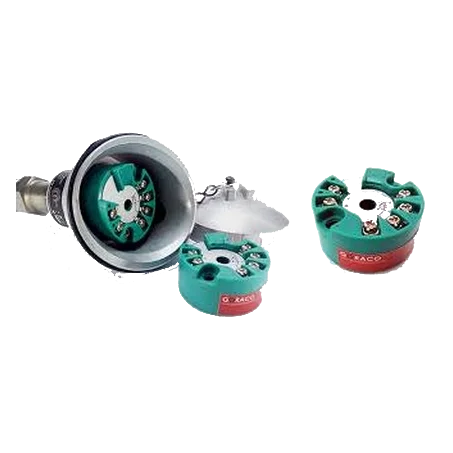
Compact transmitters mounted directly on sensor connection heads (thermowells, process connections). Head-mounted design minimizes signal cable length, reducing noise and signal loss. Ideal for high-noise industrial environments, remote locations, or installations where control room proximity is impractical. Signal transmits via standard twisted-pair cabling to distant control systems.
Field-Mounted Temperature Transmitter
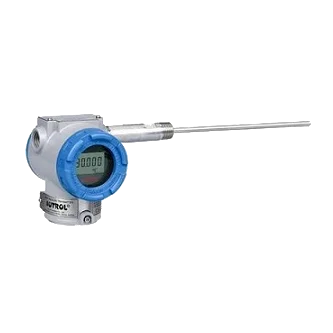
Standalone transmitters are installed in instrumentation junction boxes or panel enclosures near process equipment. Field-mounted transmitters enable sensor replacement without transmitter repositioning. Common in retrofit applications and facilities where signal reliability over long distances is critical. Supports multiple sensor inputs through selector switches or manifold integration.
DIN Rail Mounted Temperature Transmitter
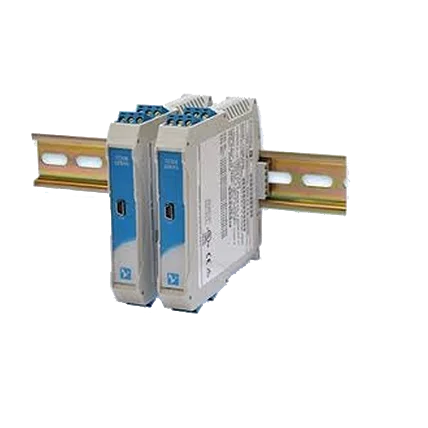
Standardized transmitters are installed on DIN-rail infrastructure within control panels alongside PLCs and power supplies. DIN-rail mounting enables centralized signal conditioning for multiple temperature points, simplifies panel integration, and facilitates technician access for adjustment and replacement. Preferred in modern control systems architecture.
Smart Temperature Transmitter
Microprocessor-based transmitters with HART, Modbus, or Profibus communication protocols, enabling two-way data exchange, remote diagnostics, and asset management capabilities. Smart transmitters provide sensor health monitoring, sensor drift detection, out-of-range alerts, and historical trend logging, enabling condition-based maintenance and predictive failure analysis.
Key Features of Industrial Temperature Transmitters
- Dual RTD/thermocouple input auto-detection with automatic range selection
- 4-20mA output isolated from sensor input (eliminates ground loops)
- HART communication enabling remote calibration and diagnostics
- ±0.5% accuracy over −20°C to +80°C operating range
- Passive loop power (draws <4mA external supply current)
- Modular design supporting up to four sensor inputs per unit
- IP67 stainless steel enclosure for harsh industrial environments
- Selectable temperature range (−200°C to +600°C) via software
- Output fail-safe to 3.6mA or 21mA configurable on sensor failure
Applications of Temperature Transmitters
- Oil & Gas Industry: Wellhead temperature signal transmission, pipeline outlet monitoring, compressor discharge signal conversion, heat exchanger remote monitoring in distributed offshore/onshore locations.
- Power Generation: Steam system temperature signal digitization, cooling water circuit remote monitoring, turbine inlet temperature transmission, and boiler outlet signal conversion to central control.
- Petrochemical & Chemical Plants: Reactor temperature signal conversion, distillation column remote monitoring, heat exchanger outlet signal transmission, hazardous area temperature instrumentation.
- Pharmaceutical Manufacturing: Reactor vessel temperature remote signal transmission, autoclave sterilization cycle monitoring, freeze-drying chamber temperature signal conversion, GMP-compliant temperature documentation.
- Food & Beverage Processing: Pasteurization system temperature signal transmission, sterilization cycle remote monitoring, cold-chain temperature data transmission, storage facility temperature network.
- HVAC Systems: Boiler outlet temperature signal conversion, chilled water distribution monitoring, compressor discharge signal transmission, multi-zone heating/cooling feedback networks.
- Water & Wastewater Treatment: Anaerobic digester temperature remote monitoring, multi-stage treatment facility temperature networks, thermal disinfection system signal transmission.
How to Select the Right Temperature Transmitter
- Identify Sensor Type: Determine if your existing sensors are RTD (Pt100/Pt1000) or thermocouples (K, J, R types). Select transmitters supporting your specific sensor type or dual-input models for flexibility.
- Define Required Temperature Range: Identify minimum and maximum process temperatures. Select transmitter range matching your requirements (e.g., −50°C to +200°C, 0–600°C). Confirm the transmitter is rated for your maximum with a 1.3× safety margin.
- Choose Output Signal Type: Select 4-20mA for standard industrial automation, 0-10V for legacy systems, HART for smart diagnostics and remote adjustment capability, or Modbus/Profibus for modern DCS integration.
- Determine Transmitter Location: Head-mounted transmitters mount directly on sensors in harsh environments; field-mounted units are located in junction boxes or panels; DIN-rail mounted transmitters integrate within control panels. Installation location affects noise immunity and commissioning complexity.
- Verify Accuracy Requirements: Standard ±1% accuracy is sufficient for process monitoring; ±0.5% required for precision control applications like pharmaceutical or food processing. High-accuracy transmitters cost slightly more but deliver superior process stability.
- Confirm Environmental Compatibility: Specify stainless steel or specialty enclosure material if exposed to corrosive atmospheres. Verify IP rating (IP67 minimum for wet environments). Confirm the temperature operating range encompasses your facility conditions.
Frequently Asked Questions
Q: What is a temperature transmitter, and what does it do?
A: A temperature transmitter converts temperature sensor inputs (RTD or thermocouple) into standardized industrial signals (4-20mA, HART, Modbus) compatible with PLCs, DCS, and process control systems. It bridges the gap between analog temperature sensors and digital automation networks, enabling remote monitoring and control.
Q: Why is 4-20mA the standard industrial signal for temperature transmitters?
A: 4-20mA current loops are preferred in industrial automation because current signals transmit reliably over long distances (up to 1000m) without signal degradation from cable resistance, unlike voltage signals. The 4mA baseline enables detection of cable breaks or sensor failures (signals below 4mA indicate a fault). Current loops are immune to electrical noise from motors and welders, making them reliable in electrically harsh environments.
Q: What is the difference between a temperature sensor and a temperature transmitter?
A: A temperature sensor (RTD or thermocouple) generates a weak raw signal (millivolts or resistance change) proportional to temperature. A temperature transmitter receives the sensor signal, amplifies it, compensates for errors, and outputs a standardized industrial signal (4-20mA, HART) suitable for remote transmission and PLC input. Transmitters add signal conditioning intelligence that sensors alone cannot provide.
Q: Where are temperature transmitters typically used in industrial facilities?
A: Temperature transmitters enable remote monitoring across distributed industrial locations: petrochemical refineries (wellhead and pipeline monitoring), power plants (steam system and cooling circuit temperature transmission), pharmaceutical reactors (sterilization cycle monitoring), HVAC systems (multi-zone temperature networks), and water treatment plants (multi-stage temperature monitoring). Any facility requiring remote temperature monitoring over distances beyond practical sensor placement relies on transmitters.
Q: What is HART communication, and why should I use a HART-capable temperature transmitter?
A: HART (Highway Addressable Remote Transducer) is a digital communication protocol that overlays digital commands on the standard 4-20mA analog signal. HART transmitters enable two-way communication, allowing remote calibration, sensor diagnostics, historical data access, and out-of-range alerts without requiring separate cabling. HART enables condition-based maintenance, sensor health monitoring, and predictive failure analysis impossible with standard analog transmitters.
Advantages of Using Temperature Transmitters
- Eliminates custom signal conditioning and reduces control system complexity
- Transmits temperature signals reliably over 1000+ meters without signal loss
- Provides ±0.5% to ±1% accuracy through signal amplification and linearization
- Enables centralized monitoring of hundreds of distributed temperature points
- HART-capable models provide sensor diagnostics and predictive maintenance alerts
- Automatic cold-junction and lead resistance compensation improves measurement accuracy
- Isolated 4-20mA output eliminates ground loops and electrical noise interference
- Selectable output ranges via software eliminate hardware reconfiguration requirements
- Passive loop power draws minimal external supply current for distributed applications
- Seamless integration with modern PLC, DCS, and SCADA systems without custom drivers
Why Choose a Specialist Temperature Transmitter Supplier in India
- ISO 9001:2015 certified manufacturing with traceable calibration protocols
- 20+ years of temperature signal conversion and process automation experience
- Complete product range supporting RTD, thermocouple, and analog voltage inputs
- HART, Modbus, Profibus communication options enabling diverse automation architectures
- Custom transmitter configurations for non-standard temperature ranges and specialized applications
- Competitive pricing 30–40% lower than imported alternatives without quality compromise
- Fast lead times with stock availability ensuring 24–48 hour delivery of standard models
- Technical support and application engineering for proper transmitter selection and integration
- On-site commissioning and field training for customer automation teams
- Compliance with IS, ISO, PED, and international standards for regulated industries
- Proven track record serving automotive, petrochemical, pharmaceutical, and power generation sectors